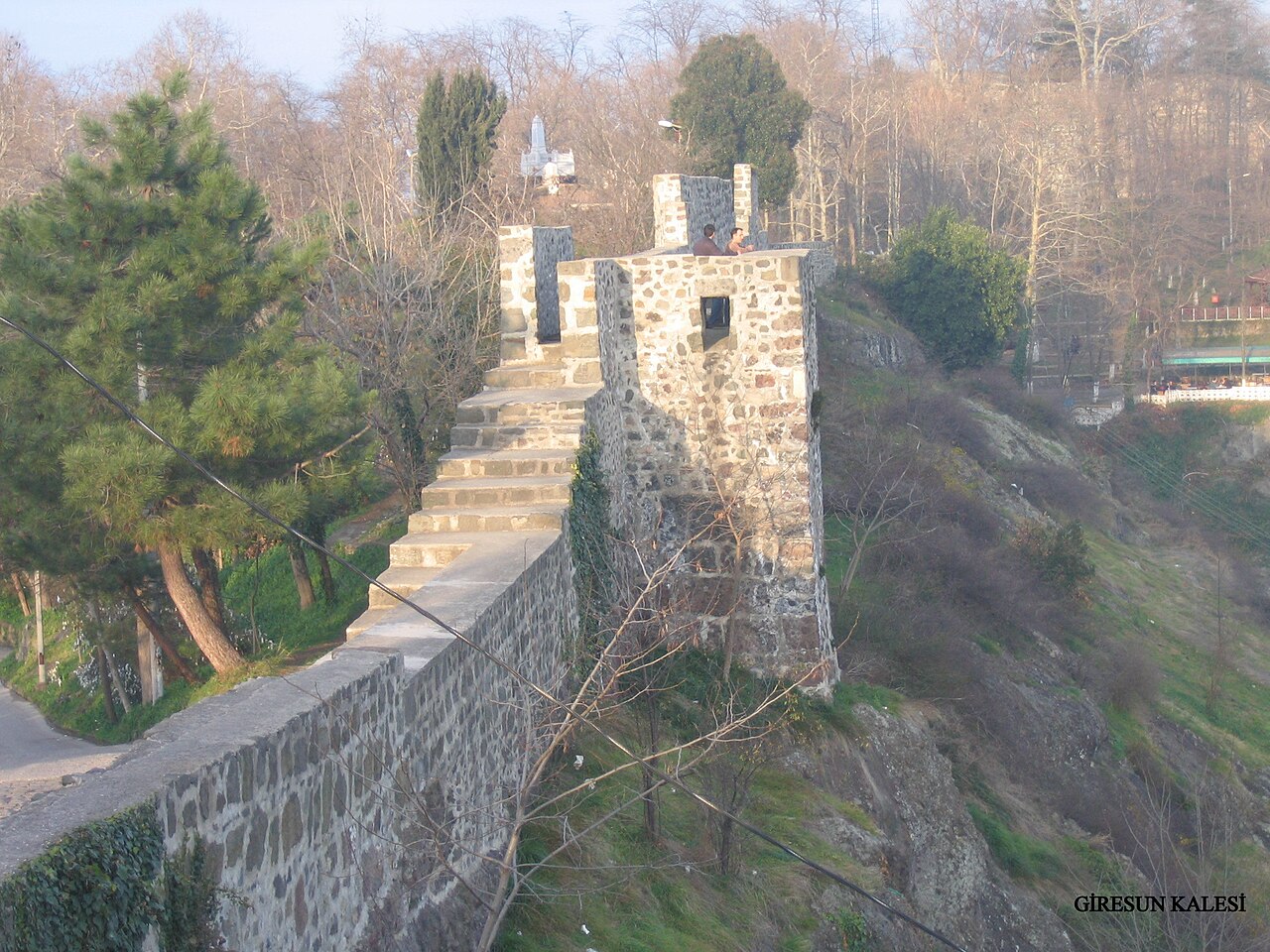
Andoz Castle
Andoz Castle, locally known as Andoz Kalesi, is a medieval fortress situated west of Espiye in the province of Giresun, Turkey. Perched on a narrow, steep rock formation, the castle commands a strategic position overlooking the Yağlıdere valley and the river mouth to the north, providing control over a significant stretch of the surrounding landscape.
Historical background and significance
The precise origins of Andoz Castle remain somewhat obscure, but scholarly research and local sources generally date its construction to the 13th century, placing it firmly within the high medieval period. The castle likely functioned as a defensive stronghold to monitor and control the Yağlıdere valley and the adjacent coastal routes, which were vital for regional communication and trade.
During the late Byzantine era, historians such as R.W. Edwards identify Andoz as a garrison fortress guarding the road from Şebinkarahisar to the coast, highlighting its military importance in securing inland access to the Black Sea. The British historian A. Bryer suggested that Andoz might correspond to a castle historically known as Holy Anthony Castle, though this identification remains subject to scholarly debate.
In the Ottoman period, the castle appears to have been repurposed as an observation post until its abandonment in the 16th century. Its strategic location continued to hold military value, although the structure gradually fell into disuse as new defensive technologies and political changes rendered such fortifications less critical.
Architectural features and layout
Andoz Castle is uniquely sited on a steep, narrow rock ridge oriented north to south, which naturally enhances its defensive capabilities. The castle's design reflects typical medieval military architecture adapted to challenging topography.
The fortress is divided into two main sections by a central curtain wall, separating the northern and southern parts of the castle. The only entrance is located at the north end, guarded by two towers that would have served as defensive bastions controlling access.
Within the northern section, visitors find a well essential for water supply during sieges, alongside a vaulted structure whose original function remains unidentified but may have served as storage or a guardroom.
The castle walls have undergone significant reconstruction in recent decades, which complicates efforts to distinguish between original medieval masonry and modern restoration work. Despite this, the fortress retains a rugged and imposing silhouette against the surrounding landscape.
Defensive position and natural advantages
The castle's location on a high rock ridge provides commanding views over the Yağlıdere river to the east and the river mouth to the north. This vantage point allowed defenders to monitor movement along the valley and coastal approaches effectively.
The steepness of the rock greatly limited access routes, making direct assaults difficult and enhancing the castle's defensive strength without extensive artificial fortifications.
Current condition and visitor experience
Today, Andoz Castle is freely accessible to visitors, though its interior is heavily overgrown with vegetation, which obscures many features. The overgrowth and partial restoration efforts mean that the castle's original medieval character is somewhat masked, but the site remains valuable for its historical and topographical significance.
Visitors often appreciate the castle primarily for its remarkable location and panoramic views rather than for extensive surviving architectural details. The rugged terrain and limited remains offer a glimpse into the castle's strategic function rather than a fully intact fortress experience.
Context within regional history
Andoz Castle forms part of a network of medieval fortifications in the Black Sea region of Turkey, reflecting the area's complex history of Byzantine, Seljuk, and Ottoman influence. Its role in guarding key routes between the interior and the coast underscores the military and administrative strategies employed during the high medieval and late Byzantine periods.
While not as extensively studied or restored as some other castles in Turkey, Andoz provides insight into the adaptation of fortress architecture to challenging landscapes and the shifting political dynamics of the region over several centuries.
Frequently asked questions (FAQ)
- How do I get to Andoz Castle?
- Andoz Castle is located west of Espiye in the Giresun province of Turkey. Visitors typically reach it by road from Espiye, followed by a hike up the steep rock where the castle stands.
- What is the historical significance of Andoz Castle?
- Andoz Castle dates back to the 13th century and served as a strategic fortress controlling the Yağlıdere valley and coastal routes during the high medieval and late Byzantine periods.
- Is Andoz Castle accessible to visitors?
- Yes, Andoz Castle is freely accessible to the public. However, its interior is overgrown, and visitors should be prepared for uneven terrain and limited facilities.
- What architectural features can be seen at Andoz Castle?
- Visitors can observe the castle's curtain wall dividing the fortress into northern and southern sections, the entrance flanked by two towers, a well, and a vaulted structure in the northern part.
- When was Andoz Castle abandoned?
- The castle was used as an observation post during the Ottoman era but was abandoned in the 16th century as military needs and technologies evolved.
Information
Loading map...
Visitor reviews
No reviews yet. Been here? Write the first review and help other travelers!
Write the first reviewVisited this castle? Share your experience
Your review helps other travelers and adds first-hand knowledge to our encyclopedia.