Castle of Santo Estevao
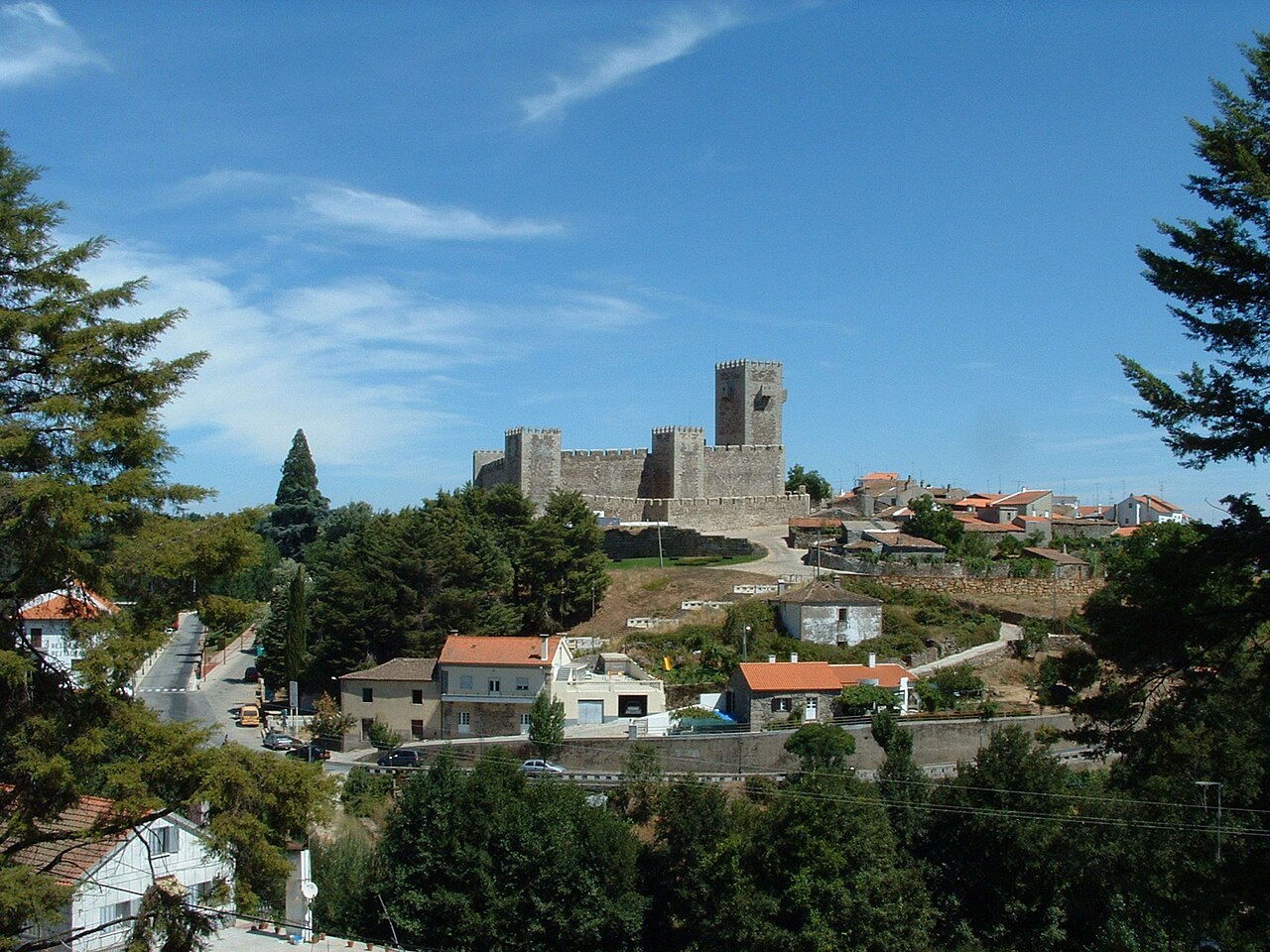
Perched on a commanding hill overlooking the village of Santo Estêvão and the nearby Tâmega River, the Castle of Santo Estêvão stands as a significant high medieval hill castle in the Vila Real district of northern Portugal. Its strategic location near the border with Spain highlights its historical importance in the defense and administration of the Portuguese frontier during the Middle Ages. The castle's origins trace back to the 11th century, initially as a large rural estate that was later fortified amid the Christian Reconquest of the Iberian Peninsula.
The earliest known references to the site date from the 11th century, indicating a substantial rural property that underwent fortification to serve defensive and residential purposes. This transformation was closely linked to the efforts of knights Rui and Garcia Lopes, who reclaimed the territory from Muslim control in 1160, pledging allegiance to the first Portuguese king, Afonso I (1112-1185). Construction of the castle began under King Afonso I and continued during the reign of his son, Sancho I (1185-1211), reflecting the castle's role in consolidating Portuguese sovereignty in the region.
Historical significance and royal connections
The Castle of Santo Estêvão played a pivotal role in the political and royal affairs of medieval Portugal. It was the venue for the marriage of Infanta Teresa, daughter of Sancho I, to Alfonso IX of León, underscoring its importance as a site of dynastic alliance between Portugal and León. The castle also served as a residence for other notable royal family members, including D. Mafalda, D. Sancha, and Infante D. Afonso.
In 1212, the castle was captured by Alfonso IX of León, who held it for 19 years until it was returned to Portuguese control under the Peace of Sabugal treaty in 1231. Throughout the 13th century, the castle functioned as a strategic border fortress, facilitating diplomatic activities such as the reception of Infanta Beatriz in 1253. The granting of a foral (charter) to the village of Santo Estêvão by King Afonso III in 1258 formalized the settlement's administrative status, further cementing the castle's role in regional governance.
During the reign of King Dinis, the castle was held by his brother Martim Afonso, nicknamed "Chichorro", and awaited the arrival of his bride, Isabel of Aragon. These royal associations emphasize the castle's continued relevance in the political landscape of medieval Portugal.
Military conflicts and decline
The castle endured damage during several military conflicts, notably in 1385 during the Portuguese Interregnum, a period of civil strife over the Portuguese throne. Further harm occurred in 1666 amid hostilities with Spain, reflecting the ongoing strategic significance of the fortress in border defense. By the 16th century, the castle's military function diminished, leading to its repurposing as a rectory. Subsequently, it served the community as a center for social and medical functions before gradually falling into disrepair.
Restoration initiatives began in the mid-20th century, with the Directorate-General for National Buildings and Monuments (DGEMN) undertaking significant repairs between 1940 and 1946. These efforts focused on consolidating the masonry and preserving the structural integrity of the castle. The site was declared a National Monument in 1939 and transferred to state ownership in 1951, ensuring its protection and maintenance. Additional restoration work in the late 20th century addressed the castle walls, terraces, and access points, preserving its historical character.
Architectural features and layout
Keep tower and fortifications
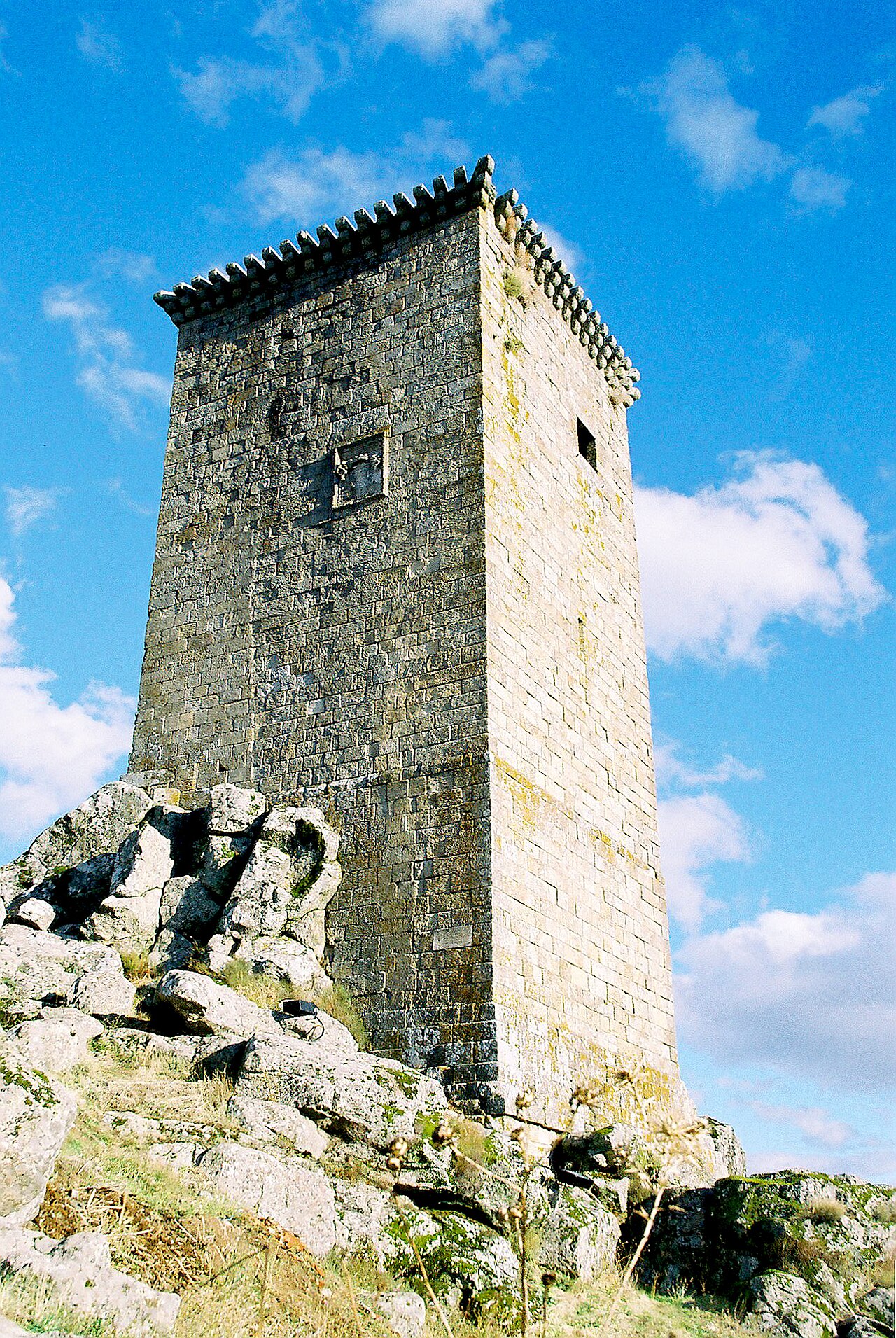
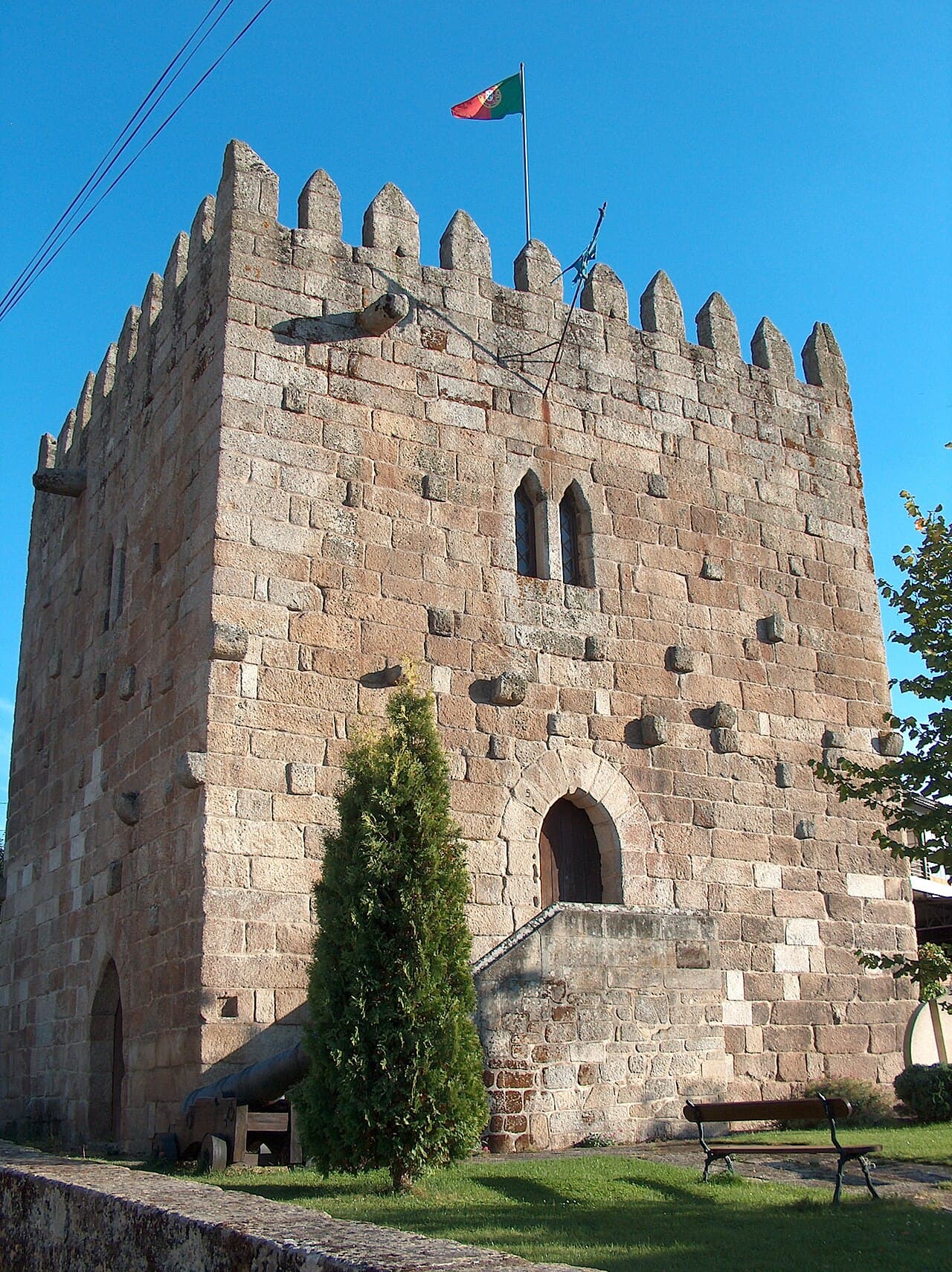
The castle is characterized by a simple rectangular keep tower approximately 14 meters tall, constructed using opus vittatum, a masonry technique featuring horizontal layers of stone blocks. The tower is crowned with distinctive pyramidal merlons of varying sizes, a notable feature of medieval fortifications designed for defense and aesthetic prominence. The surrounding stone walls enclose the castle grounds and are accessed through an iron gate, reinforcing the fortress's defensive capabilities.
Defensive and residential elements
Later additions to the castle include a bathroom on the eastern side, indicating adaptations for residential comfort over time. Adjacent to the castle lies the parochial Church of Santo Estêvão and a belltower constructed from the ruins of a chapel that once formed part of the fortified courtyard. The belltower's thick walls and narrow openings suggest it served defensive functions in addition to its ecclesiastical role.
Façades and interior layout
The western façade of the keep features a first-floor entrance reached by stone stairs with a stone guardrail and covered porch. Above this entrance, a twin window with narrow trilobate glass panels and a central cylindrical gargoyle likely served as a water spout, blending functional and decorative elements. The southern façade includes three simple slits on the first floor and a similar twin window with a gargoyle on the second floor. The eastern façade presents small slits on the lower floors and an arched portico topped by a gargoyle.
Inside, the castle's granite walls divide the interior into multiple rooms. The ground floor contains a central chamfered rectangular granite pillar supporting the structure, with stone slab flooring and wooden beams supporting the first floor. The first floor features wooden flooring, a narrower central granite pillar, and a two-flight wooden staircase leading to the second floor. The upper floor offers spacious rooms with wooden floors and ceiling supports, a small trapdoor with a movable iron staircase, four twin window openings, and a granite fireplace in the southeast corner.
Cultural heritage and current status
Today, the Castle of Santo Estêvão stands as a well-preserved example of medieval military architecture in northern Portugal. Its designation as a National Monument underscores its cultural and historical significance. The castle's preserved keep tower, walls, and associated structures provide valuable insight into medieval fortification techniques and the region's turbulent history on the Portuguese-Spanish border.
The castle is accessible to visitors interested in exploring its architectural features and historical context. Its proximity to the Tâmega River and the border enhances its appeal as a site of both natural beauty and historical intrigue. Preservation efforts continue to maintain the castle's condition, ensuring that it remains a prominent landmark in the Vila Real region.
Frequently asked questions (FAQ)
- How do I get to the Castle of Santo Estêvão?
- The Castle of Santo Estêvão is located in the village of Santo Estêvão in Vila Real district, northern Portugal. It is accessible by car and local roads from nearby towns, with parking available near the site.
- What is the historical significance of the Castle of Santo Estêvão?
- The castle played a key role during the Christian Reconquest and served as a strategic border fortress between Portugal and Spain. It hosted royal weddings and was involved in several military conflicts, reflecting its importance in medieval Portuguese history.
- When was the Castle of Santo Estêvão built?
- Construction began in the 11th century, with major development during the reigns of King Afonso I and King Sancho I in the late 12th and early 13th centuries.
- Can I visit the interior of the castle?
- Yes, visitors can explore the castle's interior, including the keep tower with its rooms, wooden floors, and architectural features such as the granite pillars and fireplaces.
- What architectural style is the castle built in?
- The Castle of Santo Estêvão exhibits characteristics of high medieval military architecture, with features typical of hill castles including a rectangular keep tower, stone walls, and battlements.
- Is the Castle of Santo Estêvão open year-round?
- Visiting hours may vary seasonally, so it is recommended to check local tourist information for current opening times before planning a visit.
Photo gallery

Public domain
Information
Sources & official resources
Verify the information above using these authoritative references.
Loading map...
Visitor reviews
No reviews yet. Been here? Write the first review and help other travelers!
Write the first reviewVisited this castle? Share your experience
Your review helps other travelers and adds first-hand knowledge to our encyclopedia.