Castle of Santa Catalina
The initial fortification was built between 1554 and 1560 following a devastating raid by French pirates in 1553, which exposed the vulnerability of Santa Cruz de La Palma. This first structure featured an elliptical platform and a circular tower, designed to provide a strong defensive position. The military engineer Leonardo Torriani later modified the design in 1585, enhancing its defensive capabilities. Despite these improvements, the castle suffered significant damage from severe sea storms and flooding in the mid-17th century, leading to its ruin between 1666 and 1681. The remains of this original fortification were eventually dismantled to make way for a new and more robust fortress.
Construction of the current castle
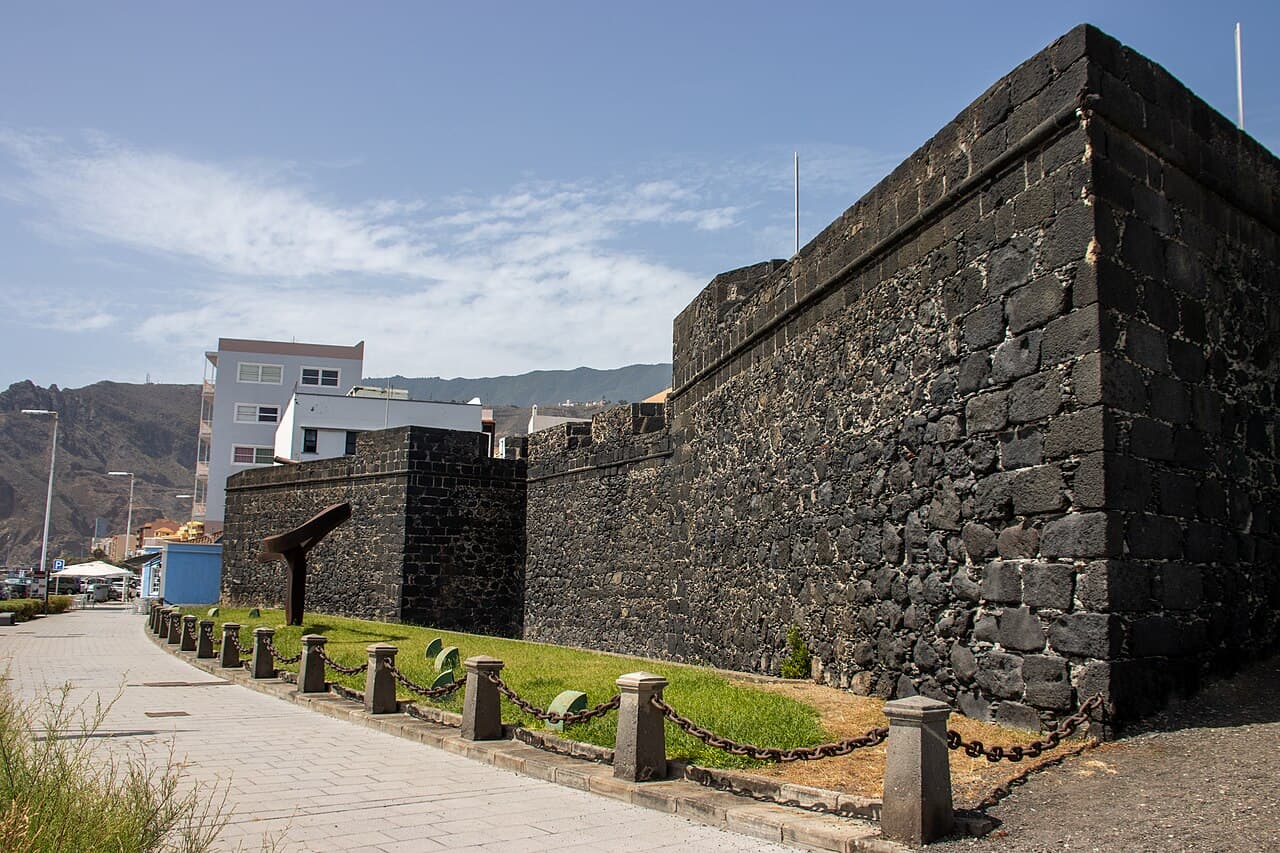
The present-day Castle of Santa Catalina was constructed between 1685 and 1692 on an adjacent site to the original ruins. This reconstruction was driven by ongoing military needs to defend the island against external threats. Funding for the new fortress came from a public subscription that raised 30,000 silver reales, supplemented by contributions from the island's government in 1686. The castle was designed with a quadrangular plan featuring triangular bastions at each corner, a hallmark of Italian Renaissance military architecture. This design allowed for effective coverage of all sides and improved defense against attackers.
Architectural features
The fortress is surrounded by a broad embankment and a moat, crossed by a wooden bridge that serves as the main entrance. The entrance portal is adorned with the coat of arms of the Catholic Monarchs of Spain, underscoring the castle's royal connections. Inside, the castle contains various functional spaces including weapon and gunpowder storage rooms, dungeons used as prison cells, warehouses, and living quarters for the garrison and the commanding governor. These features highlight the castle's dual role as a military stronghold and a place of incarceration.
Historical significance and use
Throughout its history, the Castle of Santa Catalina served as the main defensive structure of Santa Cruz de La Palma. It housed a permanent garrison and was actively manned until 1808. The castle also functioned as a prison, with notable detainees such as the lawyer Anselmo Pérez de Brito. By 1883, the castle was officially inventoried, reflecting its recognized historical importance. However, by 1924, it was declared unsuitable for modern military use, marking the end of its active defensive role.
In 1949, the castle was sold to private owners who initially planned to demolish it. These plans were halted by a government decree that placed the castle under legal protection the same year. In 1951, the Castle of Santa Catalina was declared a Historic Monument, making it the only preserved fortification from the Habsburg era in the Canary Islands. Since then, it has remained privately owned but accessible to the public through agreements with local authorities, except for brief closures such as in early 2020.
Cultural and artistic elements
In 1999, the sculpture "El Alisio", created by the artist Martín Chirino, was installed in front of the castle. This artwork represents the characteristic trade winds of the Canary Islands, linking the fortress symbolically to its maritime environment. The sculpture was restored between 2014 and 2016, further enhancing the cultural significance of the site.
Location and surroundings
The castle's location is defined by natural features such as ravines and rock formations, with beaches nearby. These geographic elements not only provided natural barriers but also contributed to the strategic defensive position of the castle. Overlooking the sea, the castle's elevated site offered commanding views that were vital for early warning and defense against naval threats.
Preservation and current status
Today, the Castle of Santa Catalina remains in well-preserved condition due to ongoing preservation efforts. It stands as an important example of Renaissance military architecture in Spain and is a significant cultural monument within the Canary Islands. Its accessibility to the public allows visitors to explore its historic walls, bastions, and internal chambers, offering insight into the military history and architectural advancements of the period.
Frequently asked questions (FAQ)
- What are the visiting hours for the Castle of Santa Catalina?
- The Castle of Santa Catalina is generally open to the public through agreements with local authorities. Visitors should check with local tourism offices for current opening hours, as they may vary or include temporary closures.
- What is the historical significance of the Castle of Santa Catalina?
- The castle served as a key defensive fortification against pirate attacks and seaborne threats from the 16th century through the early 19th century. It is the only preserved Habsburg-era fortification in the Canary Islands, reflecting important military and political history.
- Can visitors explore the interior of the castle?
- Yes, visitors can explore the castle's interior, including its bastions, dungeons, storage rooms, and living quarters. These areas provide insight into the castle's military functions and historical use as a prison and garrison.
- Is the Castle of Santa Catalina accessible to people with mobility challenges?
- Due to its historic nature and terrain, accessibility may be limited in some areas of the castle. Visitors with mobility challenges are advised to contact the site management or local tourism offices for specific accessibility information.
- When was the current castle constructed?
- The current Castle of Santa Catalina was constructed between 1685 and 1692, replacing the original 16th-century fortification that was damaged by storms and flooding.
- Are there any notable artworks at the castle?
- Yes, the sculpture "El Alisio" by Martín Chirino, representing the trade winds of the Canary Islands, is installed in front of the castle and was restored between 2014 and 2016.
Photo gallery

Information
Current owner
Private owner
Loading map...
Visitor reviews
No reviews yet. Been here? Write the first review and help other travelers!
Write the first reviewVisited this castle? Share your experience
Your review helps other travelers and adds first-hand knowledge to our encyclopedia.