Castle of Rocca Calascio
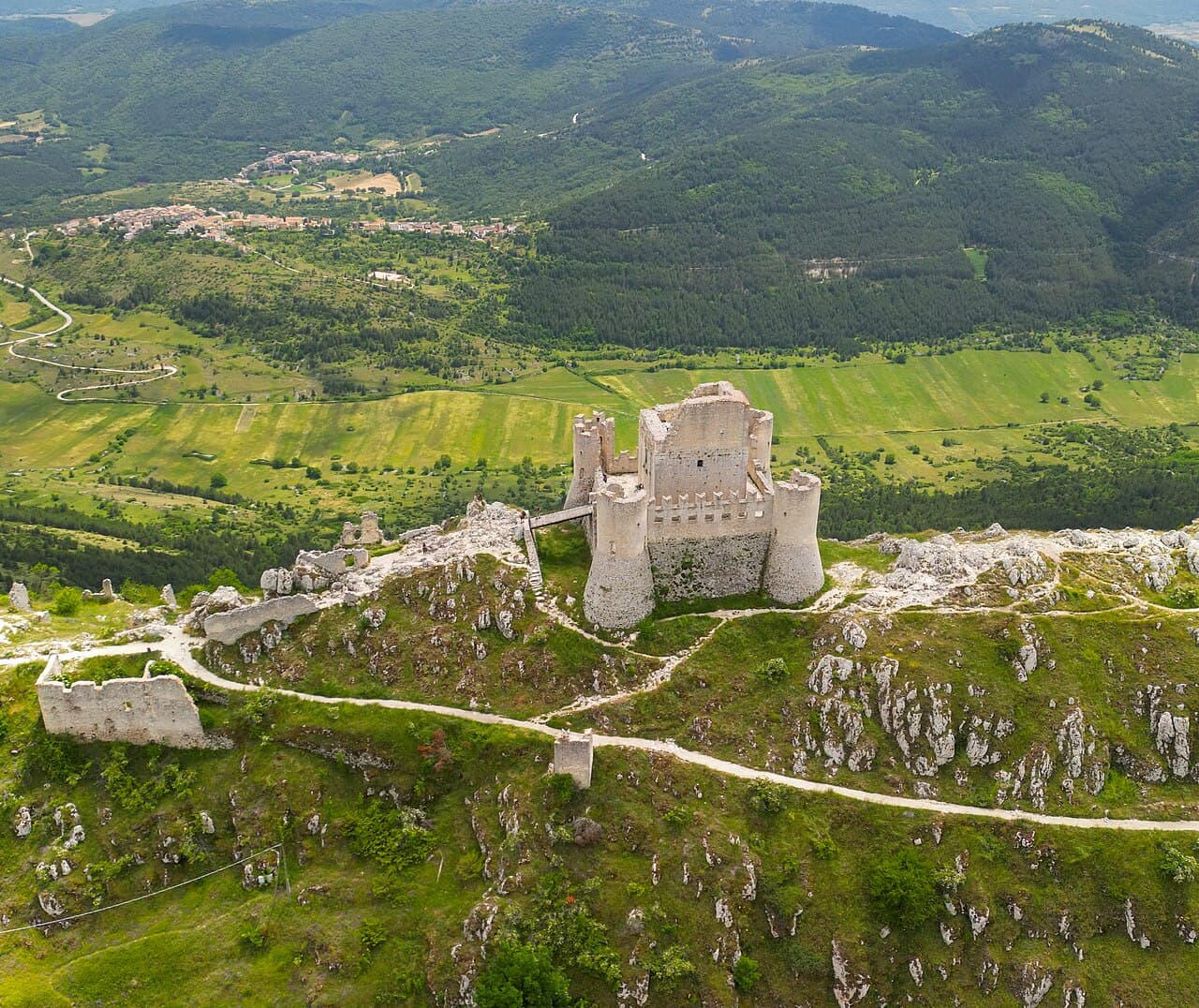
The Castle of Rocca Calascio stands as a remarkable example of medieval military architecture perched atop one of the highest points in the Apennine Mountains. Located in the municipality of Calascio within the Province of L'Aquila, Abruzzo, Italy, this hill castle commands expansive views over the Plain of Navelli and the surrounding mountainous terrain. At an altitude of approximately 1,460 metres (4,790 feet), it is recognized as the highest fortress in the Apennines, a distinction that underscores its strategic importance during the High Medieval period.
Originally constructed in the 11th century as a solitary watchtower, the castle's primary function was military surveillance rather than residential use. Its isolated position and robust stone construction reflect its purpose as a defensive outpost designed to monitor and control the surrounding valleys and passes. The initial tower was later expanded in the 13th century into a more complex fortress featuring a walled courtyard and four cylindrical corner towers surrounding a taller central keep.
Architectural design and structure
The fortress is built predominantly of stone and masonry, materials chosen for durability and defensive strength. One of its most notable architectural features is the use of larger stones in the lower half of the structure, a deliberate design choice intended to reinforce the base and make it resistant to siege tactics and attempts at breaching. The upper sections employ smaller stones, which was typical in medieval construction to reduce weight while maintaining strength.
The castle's layout includes a central tower or keep, which rises above the surrounding curtain walls and corner towers. These cylindrical towers provided vantage points for archers and lookouts, enabling defenders to cover all approaches. The enclosed courtyard would have accommodated troops and supplies, emphasizing the fortress's role as a purely military installation rather than a noble residence.
Defensive features
The Castle of Rocca Calascio was strategically positioned to oversee the Barony of Carapelle and the Campo Imperatore plateau, allowing early warning of any approaching threats. Its elevated location and robust construction made it a formidable stronghold despite never being tested in battle. The fortress's design reflects typical High Medieval military architecture focused on surveillance, defense, and control of territory.
Historical context and significance
Though the castle was never involved in combat, its history is marked by natural events that shaped its fate. In November 1461, a powerful earthquake, estimated between 7 and 8 on the Richter scale, struck the region causing significant damage to the fortress. While the nearby town of Calascio was rebuilt, the castle itself was left largely unrestored, leading to its current state of partial preservation.
The castle's military importance diminished over time as the political landscape of the region evolved and newer forms of defense emerged. Nonetheless, it remains a symbol of medieval fortification techniques and the strategic use of terrain in castle construction.
Natural surroundings and cultural heritage
The Castle of Rocca Calascio is situated within the boundaries of the Gran Sasso e Monti della Laga National Park, an area known for its rich biodiversity and stunning landscapes. The proximity to the Campo Imperatore plateau adds to its scenic and environmental value, attracting visitors interested in both history and nature.
Its striking silhouette against the backdrop of the Apennines has made it a popular subject for photography and film, contributing to its recognition beyond Italy. The castle was notably featured in various films and has been included in the Windows Spotlight image collection, enhancing its visibility to a global audience.
Preservation and current condition
Today, the Castle of Rocca Calascio stands as a partially preserved medieval fortress. While some structural elements remain intact, others show signs of the earthquake damage and centuries of exposure to the elements. Conservation efforts have focused on stabilizing the ruins to prevent further deterioration and to maintain its historical and cultural significance.
Visitors to the site can explore the remains of the towers, walls, and courtyard, gaining insight into medieval military architecture and the challenges of constructing fortifications in high-altitude environments. The castle's remote location and commanding views continue to draw tourists, historians, and architecture enthusiasts alike.
Visiting information
The castle is accessible by hiking trails from the village of Calascio and nearby areas. Due to its elevation and rugged terrain, visitors are advised to wear appropriate footwear and prepare for variable weather conditions. The site is open to the public, offering a unique opportunity to experience a significant piece of medieval history set within one of Italy's most picturesque natural parks.
Frequently asked questions (FAQ)
- How do I get to the Castle of Rocca Calascio?
- The castle is accessible via hiking trails from the village of Calascio in Abruzzo. Visitors should prepare for steep and uneven paths due to its mountaintop location.
- What is the historical significance of the Castle of Rocca Calascio?
- Built in the 11th century and expanded in the 13th, the castle served as a military fortress for surveillance and defense in the Apennines, though it was never involved in battle.
- When was the castle damaged and why was it not rebuilt?
- The castle was badly damaged by a powerful earthquake in November 1461. Unlike the nearby town, it was not rebuilt, leading to its current partially preserved state.
- Can visitors explore the castle ruins?
- Yes, visitors can explore the partially preserved ruins, including towers, walls, and the courtyard, to learn about medieval military architecture and enjoy panoramic views.
- Is the castle open year-round?
- The castle is generally open year-round, but access may be limited during harsh weather due to its high elevation and terrain. It is advisable to check local conditions before visiting.
Photo gallery

Information
Loading map...
Visitor reviews
No reviews yet. Been here? Write the first review and help other travelers!
Write the first reviewVisited this castle? Share your experience
Your review helps other travelers and adds first-hand knowledge to our encyclopedia.