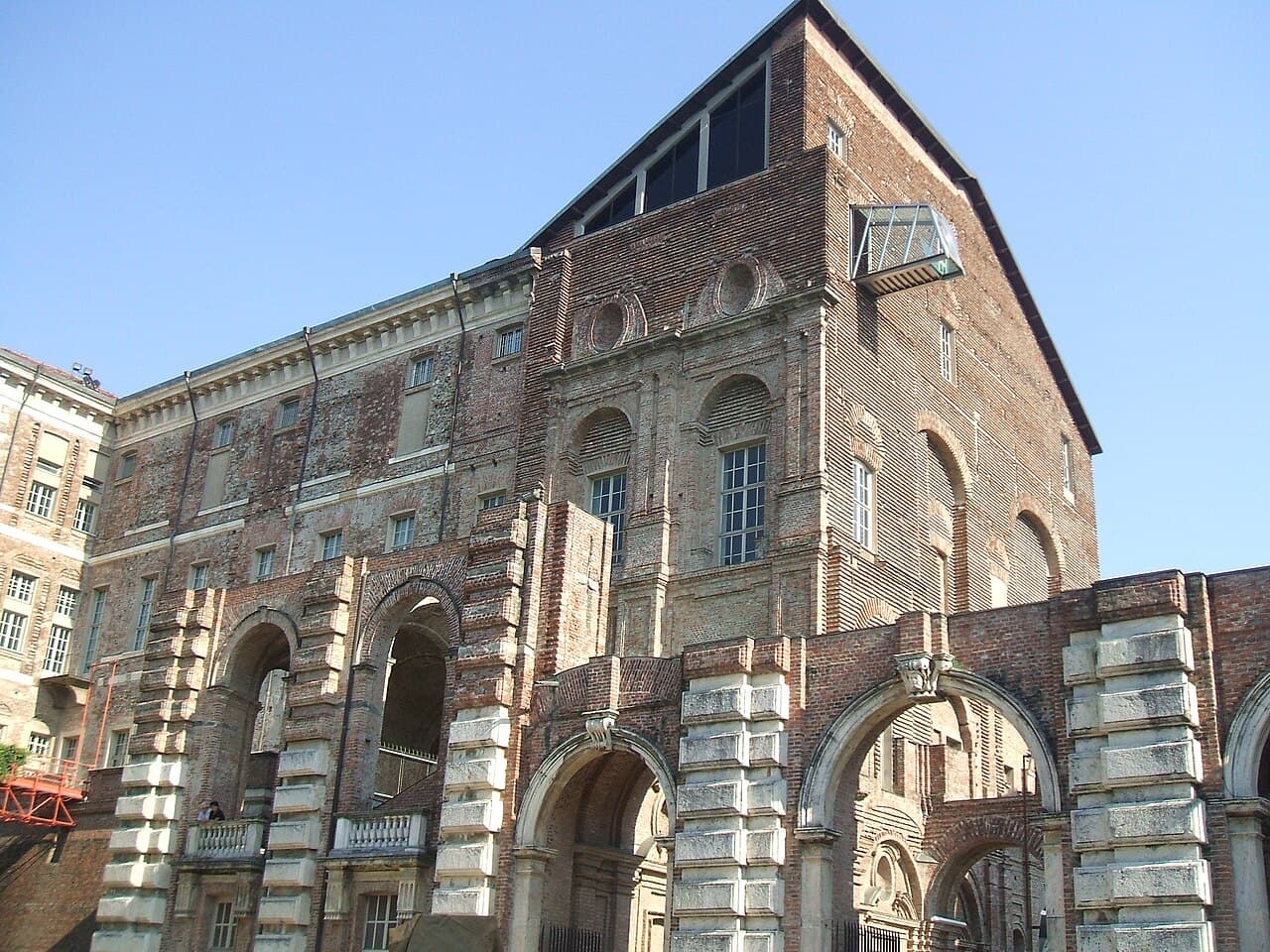
Castle of Rivoli
The Castle of Rivoli, located in Rivoli near Turin, Italy, stands as a monumental testament to the region's rich medieval heritage and its dynamic evolution into a modern cultural landmark. Originally constructed in the 9th or 10th century, the castle has witnessed centuries of political intrigue, architectural transformation, and artistic patronage, culminating in its current role as the Castello di Rivoli – Museo d'Arte Contemporanea, Italy's first museum dedicated to contemporary art.
Strategically positioned on a hilltop overseeing the passage between Turin and the Susa Valley, the castle was initially a fortified stronghold under the House of Savoy, a dynasty that shaped much of Piedmont's history. Its earliest documented mention dates to 1159, when Emperor Frederick I Barbarossa granted the region to the bishops of Turin, highlighting its early political significance. The castle's military and administrative importance grew throughout the High Medieval period, serving as a defensive bastion and a symbol of Savoyard power.
Early history and medieval significance
The origins of the Castle of Rivoli trace back to the early medieval period, with archaeological and historical evidence suggesting a construction phase in the 9th or 10th century. The castle's location was chosen for its strategic vantage point, controlling key routes through the Alps and the Piedmont region. By the 11th century, the House of Savoy had acquired the castle, integrating it into their expanding territorial domain.
Throughout the 12th and 13th centuries, the castle was embroiled in regional conflicts, notably a feud with the bishops of Turin that led to damage in 1184. Its defensive capabilities were enhanced under the direction of Amadeus IV of Savoy around 1247, who constructed a fortified building to secure the vital passage between Turin and the Susa Valley, underscoring the castle's military significance.
The castle also played a role in the political and social fabric of the region, hosting the Consiglio dei Principi in 1330, the senior administrative council of the Savoyard countryside. It was also the site of the notable wedding of Bianca of Savoy to Galeazzo Visconti in 1350, reflecting its status as a noble residence.
Religious and cultural importance
The Castle of Rivoli holds religious significance as the first public site for the veneration of the Shroud of Turin in the Piedmont region. This early display of the shroud highlights the castle's role beyond military and political functions, extending into the spiritual and cultural realms of the Savoyard territories.
Renaissance transformations and ducal residence
The castle underwent significant changes during the Renaissance and early modern periods, particularly under the patronage of Duke Emmanuel Philibert of Savoy in the mid-16th century. Following the 1559 Treaty of Cateau-Cambrésis, which restricted his residence in Turin, Emmanuel Philibert made Rivoli his home. He commissioned architect Ascanio Vitozzi to restore and enhance the castle, reflecting Renaissance architectural principles and the growing emphasis on comfort and representation in noble residences.
The birth of Charles Emmanuel I at the castle in 1562 further cemented its status as a ducal residence. Subsequent expansions were carried out by architects Carlo and Amedeo di Castellamonte between 1606 and 1644, including the construction of the Manica Lunga, a long wing intended to house the Savoy Gallery. This addition represents the only surviving 17th-century structure visible today and exemplifies the castle's transition towards a cultural hub.
Architectural features and innovations
The castle's original rectangular plan featured four tall towers, which were damaged and demolished following military conflicts in the late 17th century. The Manica Lunga remains a distinctive architectural element, connected to the main building by a narrow corridor approximately 120 meters long. This wing was designed as an art gallery, showcasing the Savoy family's growing collection and their patronage of the arts.
Restoration efforts in the early 18th century under Victor Amadeus II introduced new architectural elements, including a double staircase inspired by Leonardo da Vinci's concepts, facilitating vertical movement without disrupting the main halls. Although architect Filippo Juvarra was commissioned to design a new façade, the project remained unfinished, leaving the castle with an incomplete yet historically layered appearance.
Decline, military use, and modern restoration
The castle's fortunes waned in the late 17th and 18th centuries, suffering damage during the War of the Spanish Succession when French troops attacked in 1690 and 1693. It later served as a place of confinement for Victor Amadeus II after his abdication, with modifications such as barred windows and restricted access to the Manica Lunga emphasizing its prison function.
By the 19th century, the castle was repurposed for military use by the municipality of Rivoli, becoming barracks in 1863. Portions of the building were adapted as a library from 1883. The site sustained heavy damage during World War II bombings, leading to a period of abandonment and decay.
Restoration efforts commenced in 1979, spearheaded by architect Andrea Bruno, who addressed structural repairs, water damage, and the restoration of lost architectural features. The castle reopened in 1984 as the Castello di Rivoli – Museo d'Arte Contemporanea, marking a new chapter as a cultural institution dedicated to contemporary art.
Contemporary cultural significance
Today, the Castle of Rivoli is renowned as a leading center for contemporary art, hosting a permanent collection that includes pivotal works from the Arte Povera movement and internationally acclaimed artists such as Giovanni Anselmo, Alighiero Boetti, Maurizio Cattelan, and others. The acquisition of the Cerruti Collection in 2017, featuring masterpieces by Francis Bacon, Giorgio de Chirico, René Magritte, Pablo Picasso, and Andy Warhol, has further enriched the museum's offerings.
The castle's adaptive reuse includes modern architectural interventions such as a steel and glass roof over the Manica Lunga, a suspended staircase, and an elevator, all designed to enhance visitor experience while respecting the historic fabric. The grounds preserve historical features like a 16th-century nymphaeum and the Cherutti Villa gardens, which combine monastic meditation spaces with panoramic views of the Alps.
As a UNESCO World Heritage Site since 1997, the Castle of Rivoli exemplifies the integration of historical preservation and contemporary cultural innovation, making it a unique destination for both history enthusiasts and art lovers.
Frequently asked questions (FAQ)
- What is the historical significance of the Castle of Rivoli?
- The Castle of Rivoli is a significant historical landmark that dates back to the 10th century. It served as a royal residence and a strategic military outpost, playing a crucial role in the history of the region and the Savoy dynasty.
- When was the Castle of Rivoli built?
- The construction of the Castle of Rivoli began in the 10th century, with various renovations and expansions occurring over the centuries. Its architectural style reflects the evolution of military and residential design from the medieval period to the Renaissance.
- What are the opening hours for the Castle of Rivoli?
- The Castle of Rivoli is typically open to visitors from 10 AM to 6 PM, Tuesday through Sunday. It is closed on Mondays and certain public holidays, so it's advisable to check the official website for the most current information before planning your visit.
- Can I purchase tickets in advance for the Castle of Rivoli?
- Yes, tickets for the Castle of Rivoli can be purchased in advance through the official website. This is recommended to avoid long lines and ensure entry, especially during peak tourist seasons.
- Is the Castle of Rivoli accessible for visitors with disabilities?
- Yes, the Castle of Rivoli is committed to providing accessibility for all visitors. There are ramps and designated paths to ensure that individuals with mobility challenges can enjoy the historical site.
- What is the best time to visit the Castle of Rivoli?
- The best time to visit the Castle of Rivoli is during the spring and fall months when the weather is mild and pleasant. Additionally, these seasons tend to have fewer crowds, allowing for a more enjoyable experience.
- Are there any nearby attractions to visit after the Castle of Rivoli?
- Yes, nearby attractions include the beautiful Parco della Tesoriera and the historic district of Turin, which boasts numerous museums, restaurants, and shops. Exploring these areas can enhance your visit to the Castle of Rivoli.
- What are the ticket prices for the Castle of Rivoli?
- Ticket prices for the Castle of Rivoli vary, with reduced prices available for students and seniors. It is advisable to check the official website for the latest pricing information and any special discounts that may be offered.
Photo gallery

Information
Website
Visit websiteSources & official resources
Verify the information above using these authoritative references.
Loading map...
Visitor reviews
No reviews yet. Been here? Write the first review and help other travelers!
Write the first reviewVisited this castle? Share your experience
Your review helps other travelers and adds first-hand knowledge to our encyclopedia.



