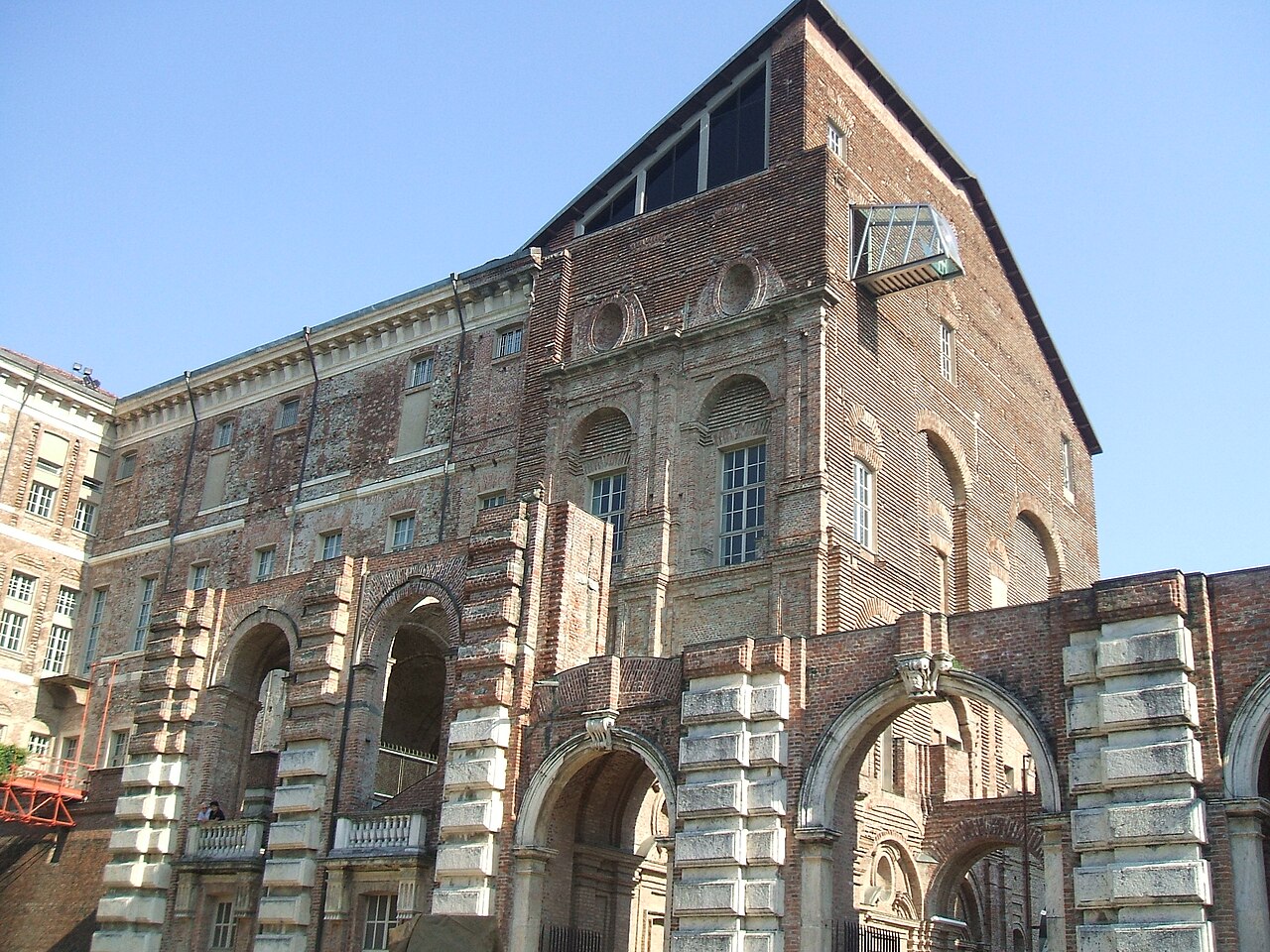
Avigliana Castle
Avigliana Castle stands as a prominent medieval fortress in the town of Avigliana, located in the Piedmont region of northern Italy. Nestled atop Mount Pezzulano at an elevation of 467 meters, the castle commands sweeping views of the surrounding landscape, including the Avigliana lakes, the morainic hills near Rivoli, and the distant Sacra di San Michele monastery. This strategic vantage point allowed the castle to serve as a crucial defensive stronghold guarding the entrance to the Susa Valley and protecting the approaches to the city of Turin.
The castle's origins trace back to the early 10th century, with construction traditionally attributed to the Marqueses Arduinici of Turin, particularly Arduino Glaber (also known as Arduino the Hairless), who likely established the first fortification around 942 AD. This early medieval fortress was built as a hill castle, utilizing the natural topography of Mount Pezzulano to create a formidable defensive position. Over the centuries, Avigliana Castle evolved from a military outpost into a noble residence and administrative center, reflecting its importance in the power dynamics of the region.
The strategic role and early history
During the Early Medieval period, Avigliana Castle played a pivotal role in resisting incursions, particularly from Saracen raiders threatening northwestern Italy. It was frequently mentioned in chronicles of the time as a key military base. The castle was home to several notable figures, including Margrave Arduin V, who resided there in the late 10th and early 11th centuries, underscoring its status as both a defensive structure and a noble domicile.
In 1091, the castle passed into the hands of the Counts of Savoy through the dowry of Adelaide of Susa. This transition marked an important phase in the castle's history, as it became a favored residence and administrative hub for the Savoy family. Notably, Amadeus III and his son Humbert III were closely associated with Avigliana Castle, with Humbert III born there in 1136. The castle's location on a vital trade route to France and Flanders also allowed it to collect tolls, adding an economic dimension to its military and residential functions.
Medieval expansions and architectural features
Between the 11th and 14th centuries, Avigliana Castle underwent significant expansions. It was rebuilt after destruction during the military campaigns of Emperor Frederick Barbarossa, notably under the direction of Thomas I of Savoy. The castle's layout adapted to the hill's natural contours, forming an irregular elliptical enclosure that maximized defensive capabilities.
Fortifications and towers
The castle featured a massive square keep serving as the central stronghold. A distinctive semi-circular defensive tower was positioned at the southern corner, functioning as a false tower designed to mislead attackers. The defensive perimeter included a main gate and a pit or ditch, which served as additional obstacles to invaders. The walls were robustly constructed to withstand siege warfare and cannon fire, although the latter would later contribute to damage during the 16th century.
Residential and religious structures
The eastern side of the castle housed a residential wing, which included a chapel dedicated to St. Mary Magdalene, first documented in 1212. This chapel highlights the integration of religious life within the castle complex. The living quarters rose multiple stories, containing reception rooms and private chambers on upper floors, while service areas and cellars were located at ground level.
Administrative and communal spaces
Documents from the 13th and 14th centuries mention a courtroom (aula castri) from 1268 and a governmental hall (sala castri) from 1307, indicating the castle's role as a center of local governance and justice. The upper courtyard contained essential utility buildings such as stables, a bread oven, and a granary used for storing taxes paid in kind, demonstrating the castle's administrative and economic functions.
Historical events and notable figures
Avigliana Castle witnessed numerous historical events that shaped its legacy. It was the birthplace of Amedeo VII, the Red Count, in 1360, a significant figure in the House of Savoy. The castle also served as a prison for Philip II of Piedmont in 1368, an episode remembered in local tradition and folklore.
The castle suffered damage during various military conflicts, including destruction by cannon fire inflicted by the French in 1536. Its strategic importance waned after the 15th century as newer fortifications took precedence in the region. Ultimately, in 1691, the French Marshal Catinat ordered the castle's demolition using mines, ensuring it would no longer serve as a military stronghold. Subsequent defensive responsibilities were transferred to fortresses like Brunetta di Susa (built in 1708) and the Fort of Exilles.
Ruins and preservation
Today, Avigliana Castle remains as ruins accessible via a pleasant walk from the town's medieval center near Piazza Conte Rosso. The remnants reveal the castle's robust construction, including portions of the manor house, defensive walls, and towers. Visitors can appreciate the impressive views once commanded by the castle's occupants, overlooking the Lago Grande and the surrounding Piedmontese landscape.
The site was transferred to the local municipality in 1882 and underwent restoration efforts in the early 20th century. It was incorporated into a public park in 1927 and saw some use during World War II. Local legends enrich the cultural heritage of Avigliana Castle, including tales of buried treasures left by French soldiers and ghost stories, particularly involving the spirit of Philip II of Piedmont.
Avigliana Castle exemplifies the evolution of medieval hill castles in northern Italy, reflecting centuries of military, residential, and administrative use. Its ruins remain a testament to the region's turbulent history and architectural ingenuity, offering visitors a tangible connection to Piedmont's medieval past.
Frequently asked questions (FAQ)
- How do I reach Avigliana Castle from the town center?
- Avigliana Castle is accessible by a short walk from the medieval town center of Avigliana, starting near Piazza Conte Rosso. The path is well-marked and offers scenic views along the way.
- What is the historical significance of Avigliana Castle?
- Avigliana Castle was a strategic defensive fortress guarding the entrance to the Susa Valley and served as a residence for the Counts of Savoy. It played a key role in regional military conflicts and local administration from the 10th to the 17th centuries.
- Can I visit the interior of Avigliana Castle?
- Today, only ruins remain of Avigliana Castle, so visitors can explore the exterior remains and foundations. There are no intact interior rooms, but the site offers informative signage and panoramic views.
- When was Avigliana Castle demolished and why?
- The castle was demolished in 1691 by order of French Marshal Catinat to prevent its use as a military fortress. Mines were used to destroy the structure, and it was never rebuilt.
- Are there any legends associated with Avigliana Castle?
- Local folklore tells of French soldiers burying stolen officers' pay near the castle entrance, marked by a boulder with an arrow. Ghost stories, including the spirit of Philip II of Piedmont, add to the castle's cultural mystique.
Information
Sources & official resources
Verify the information above using these authoritative references.
Loading map...
Visitor reviews
No reviews yet. Been here? Write the first review and help other travelers!
Write the first reviewVisited this castle? Share your experience
Your review helps other travelers and adds first-hand knowledge to our encyclopedia.