
Castle of Pornic
The Castle of Pornic, also known as the Château de Barbe Bleue (Bluebeard Castle), is a historic fortress located in the coastal town of Pornic, France. Positioned on the northern edge of the town's port, the castle commands a strategic view over the Atlantic Ocean and the harbor, reflecting its original purpose as a defensive stronghold. Its origins trace back to the 10th century when it was first established as a wooden fortification by Alan Barbetorte (Alan Wrybeard), Duke of Brittany. This initial structure was intended to protect the entrance to the settlement and secure the vital port area.
In the 12th century, the wooden fortress was replaced with a robust stone castle by the Lords of Rais, marking a significant advancement in its defensive capabilities. The stone construction utilized traditional medieval masonry techniques, creating thick curtain walls and imposing towers designed to withstand siege warfare common in the High Medieval period. The castle's location on a rocky promontory overlooking the sea enhanced its natural defenses, making it a formidable obstacle to potential invaders.
Medieval history and ownership
The castle's history is closely linked with notable figures and turbulent events. In the 15th century, it came under the ownership of Gilles de Rais, a controversial nobleman and military leader who was later tried and executed for crimes that have since become part of his dark legend. During his trial, the castle was confiscated by John V, Duke of Brittany, reflecting the political upheaval of the time.
By the 18th century, the castle was owned by Marquis Alexandre de Brie-Serrant. However, the French Revolution led to the confiscation of his properties, including the castle, which subsequently fell into disrepair and ruin. The decline continued through the 19th century as the castle changed hands among various creditors, reflecting the financial difficulties surrounding its maintenance.
19th-century restoration and architectural transformation
The castle experienced a revival in the late 19th century when it was purchased by Joseph Le Breton, a local merchant and founder of the seawater baths in Pornic. He initiated restoration efforts to preserve the castle's structure. The most significant restoration was undertaken in 1886 by the architect François Bougoüin, who introduced elements inspired by Italian Renaissance architecture. This included the addition of fully rounded, arched windows framed with brickwork, a stylistic choice influenced by the nearby Château de Clisson.
These renovations blended the castle's medieval fortress character with decorative Italianate features, creating a unique architectural synthesis. Despite these changes, the restoration respected the original medieval fabric by preserving much of the curtain walls and towers, which remain prominent features of the castle today.
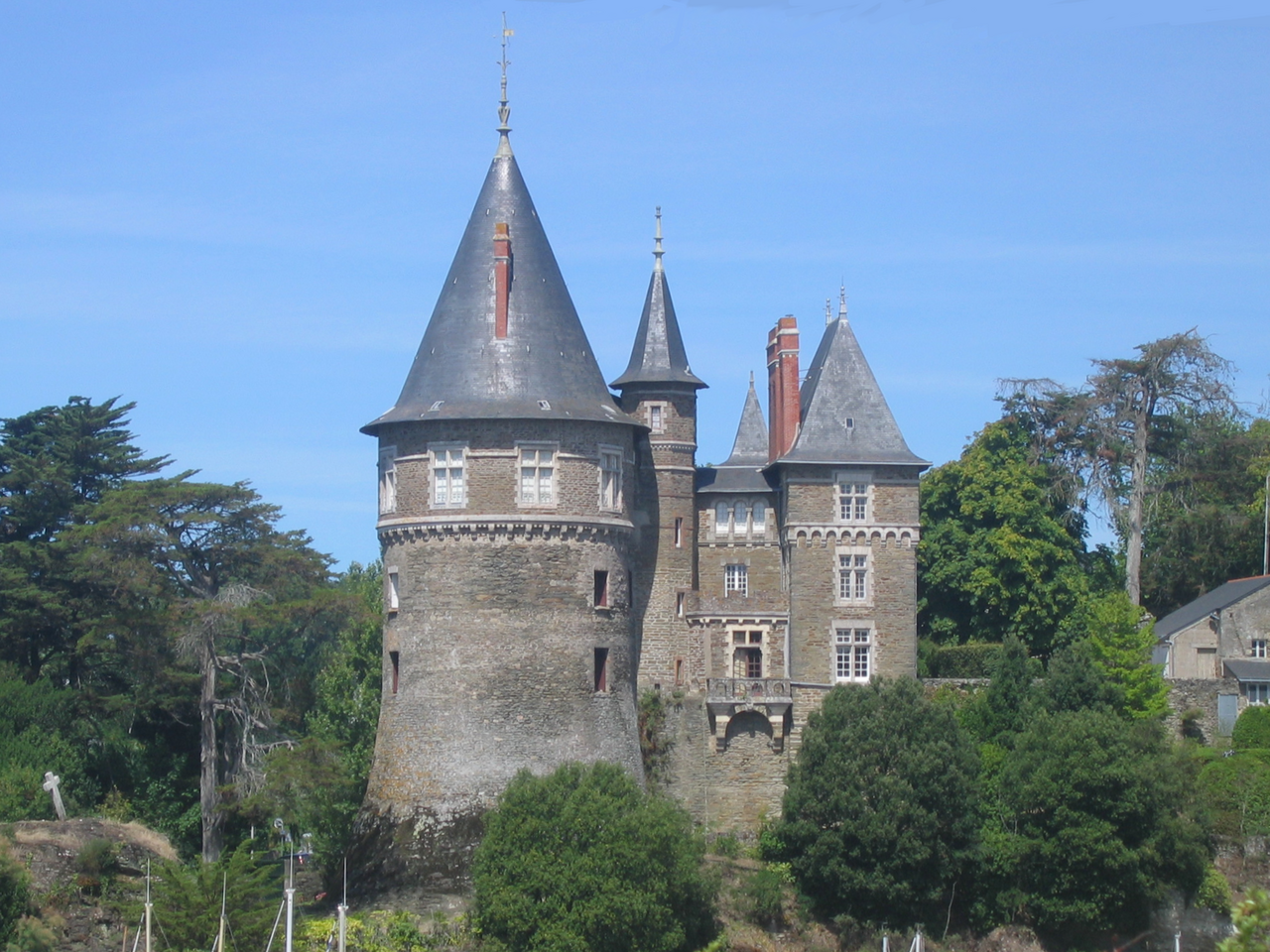
Photo by Pierre Dargham • CC BY 2.5
Architectural features and defensive elements
The Castle of Pornic is classified as a hill castle due to its elevated position overlooking the sea and port. Its defensive design includes thick stone curtain walls that enclose the main courtyard and protect the inner buildings. Several towers punctuate the walls, serving as lookout points and defensive bastions.
One side of the castle is naturally protected by the Atlantic Ocean, while the other sides are fortified with ramparts and access ramps, which were designed to control entry and facilitate the movement of troops. The castle's layout reflects typical medieval military architecture, combining natural landscape advantages with man-made fortifications.
The surviving medieval structures exhibit robust stone masonry, with arrow slits and battlements that provided defenders with vantage points for archery and surveillance. The 19th-century restorations introduced large arched windows that softened the fortress's austere appearance and added an element of elegance inspired by Italian palatial architecture.
Modern status and cultural significance
Today, the Castle of Pornic remains a private property and is not open to the public. Despite this, it stands as a prominent symbol of the town's rich history and maritime heritage. Since 1986, several parts of the castle, including its medieval towers, curtain walls, and access ramps, have been protected by the French Ministry of Culture as historic monuments. This status ensures the preservation of the castle's essential medieval and 19th-century architectural features for future generations.
The castle's nickname, Château de Barbe Bleue, connects it indelibly to the infamous Gilles de Rais, whose legacy adds a layer of intrigue and legend to the site. Its strategic location and enduring structure make it a significant example of medieval military architecture adapted and transformed through centuries of French history.
Though not accessible to visitors, the castle's exterior and its commanding presence over the Pornic harbor continue to attract interest from historians, architects, and tourists exploring the region's cultural landmarks. The blend of medieval fortifications and 19th-century Italianate restoration exemplifies the evolving nature of castle architecture in France, reflecting broader historical and artistic trends.
Recommendations for visitors
While the castle itself is privately owned and closed to the public, the town of Pornic offers a charming historic port area with picturesque views of the castle from the waterfront. Visitors can enjoy walking tours along the harbor, capturing photographs of the castle's impressive silhouette against the sea. Nearby attractions include local museums, beaches, and traditional Breton architecture, providing a well-rounded cultural experience.
Frequently asked questions (FAQ)
- Is the castle of Pornic open to the public?
- The castle of Pornic is privately owned and not open to visitors. However, its exterior can be viewed from the harbor area in Pornic.
- What is the historical significance of the castle of Pornic?
- The castle of Pornic dates back to the 10th century and played a crucial defensive role for the port. It is also known as Château de Barbe Bleue due to its association with Gilles de Rais.
- When was the castle of Pornic built?
- The original wooden fortress was built in the 10th century, but the current stone structure largely dates from the 12th century.
- What architectural styles are represented in the castle of Pornic?
- The castle primarily features medieval defensive architecture from the High Medieval period, with later 19th-century Italianate restoration elements.
- Where is the castle of Pornic located?
- The castle is located in the town of Pornic, in the Pays de la Loire region of France, overlooking the Atlantic Ocean.
Photo gallery

Information
Sources & official resources
Verify the information above using these authoritative references.
Loading map...
Visitor reviews
No reviews yet. Been here? Write the first review and help other travelers!
Write the first reviewVisited this castle? Share your experience
Your review helps other travelers and adds first-hand knowledge to our encyclopedia.