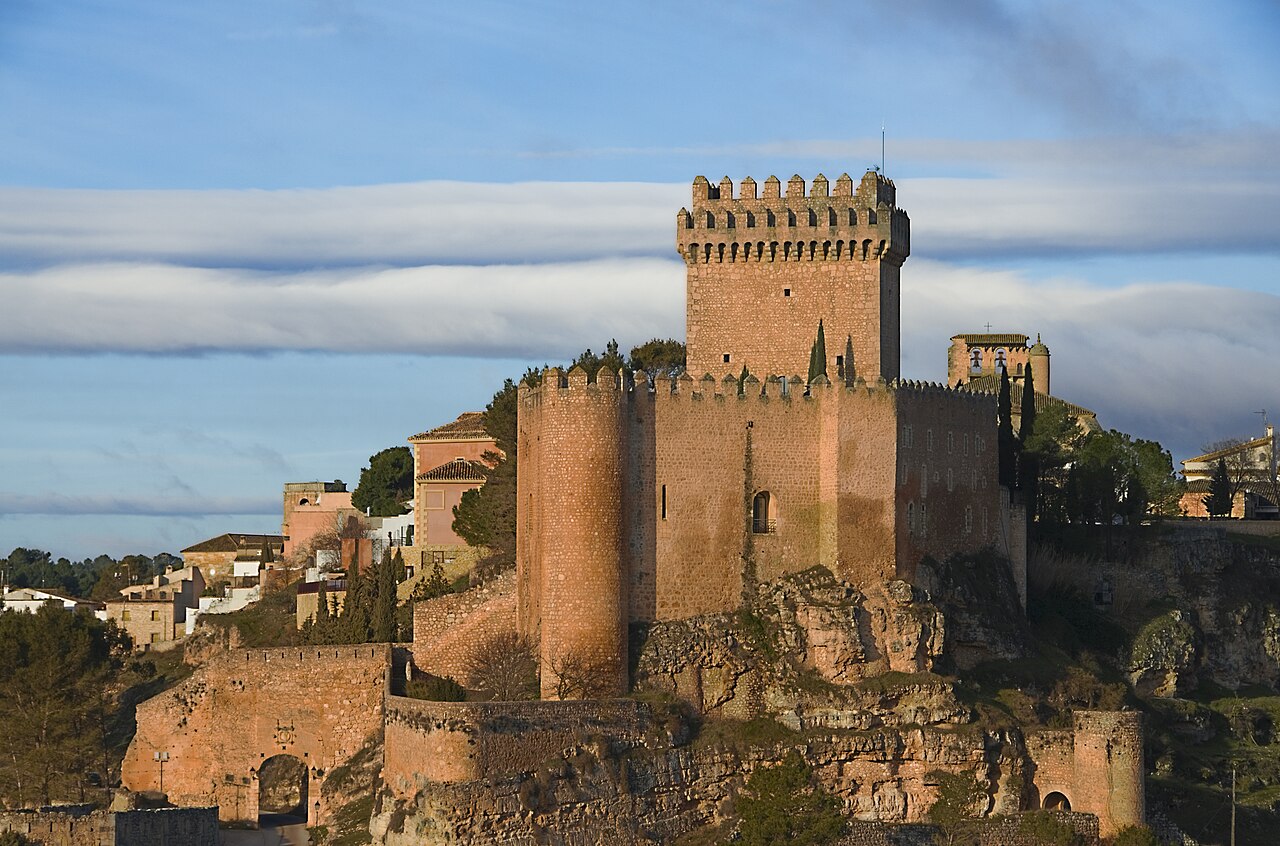
Castle of Paracuellos de la Vega
The Castle of Paracuellos de la Vega is a notable hill castle located in the municipality of Paracuellos within the autonomous community of Castile-La Mancha, Spain. Constructed during the late 12th century following the Christian reconquest of Cuenca, this fortress played a strategic role in securing newly acquired territories during the High Medieval period. Its position overlooking a valley ravine provided a natural defensive advantage despite the modest elevation of its hill.
Historical background and strategic importance
The castle was established as part of a broader defensive network initiated by King Alfonso VIII of Castile after his successful capture of the city of Cuenca in 1177. This network aimed to protect the frontier zones and consolidate Christian control in the region during the Reconquista. The Castle of Paracuellos de la Vega served as a stronghold that monitored and defended the surrounding valley, controlling access routes and providing a refuge in times of military threat.
In 1187, King Alfonso VIII granted ownership of the castle, alongside the nearby fortress of Monteagudo de las Salinas, to the Cathedral of Cuenca and its bishops. This transfer linked the castle to ecclesiastical authority, which often played a dual role in both spiritual and temporal governance during the Middle Ages. The church's involvement likely influenced the castle's maintenance and the surrounding settlement's development.
By the 16th century, a small village had formed at the base of the castle hill. This settlement included the church of Nuestra Señora del Castillo, constructed between 1529 and 1537, which served the local population. The village and its church mark the last significant phase of habitation connected to the castle, reflecting a transition from purely military use to a more community-oriented presence in the area.
In the late 20th century, recognition of the castle's cultural and historical value led to preservation efforts. The site was officially declared a Cultural Heritage Site in 1992, following a process initiated in 1988. Restoration and conservation work have since focused on stabilizing the remaining structures and promoting the site's historical significance.
Architectural features and layout
The Castle of Paracuellos de la Vega exhibits a trapezoidal layout adapted to the natural contours of the hill. The approach to the fortress is via a path cut directly from the rock, emphasizing the integration of the castle with its terrain. This design reflects medieval military architecture principles aimed at maximizing defense through natural and constructed means.
The castle's walls and towers are predominantly constructed from sillarejo esgrafiado, a masonry technique using rough-cut, uneven stone blocks. The corners and structural reinforcements employ squared stone blocks known as sillares, which provide stability and durability. Functional openings such as doors, window lintels, arches, and arrow slits are carefully crafted from these local stones, balancing defensive needs with usability.
The fortress is organized into three concentric enclosures, a design that allowed for layered defense. The outer enclosure encompasses the entire base perimeter and features two battlemented towers, commonly referred to as cubos. These towers provided vantage points for surveillance and defense against attackers.
Within this outer ring lies a second walled area, accessible through a single gate. Although much of this middle enclosure has been reduced to foundations, three towers remain prominently visible, indicating the scale and complexity of the fortification system.
The innermost enclosure houses the principal tower or keep (torre maestra), which is architecturally distinctive. The keep has a pentagonal external shape contrasting with a square interior, a rare feature that may have enhanced its defensive capabilities and internal spatial organization.
Current condition and preservation efforts
Today, the castle remains in a partially preserved state, with substantial portions of the wall bases and tower foundations still visible. Some battlements survive atop certain towers, offering insight into the original military design aimed at layered defense. These remnants allow visitors to appreciate the castle's strategic construction and medieval military architecture.
Preservation efforts have concentrated on stabilizing the ruins to prevent further deterioration. The designation as a Cultural Heritage Site has facilitated funding and expertise for restoration projects, ensuring the castle's historical integrity is maintained for future generations. Interpretive signage and controlled access paths help visitors understand the site's significance and layout.
Architectural significance and military design
The Castle of Paracuellos de la Vega exemplifies typical High Medieval military architecture in Spain, combining natural topography with constructed defenses. Its use of rough-cut stone masonry and the presence of multiple defensive layers reflect the period's evolving siege warfare tactics.
The three concentric enclosures allowed defenders to fall back progressively if outer defenses were breached, a common medieval strategy to prolong resistance. The pentagonal keep is an unusual architectural element that may have provided improved angles of defense and reduced blind spots compared to traditional square or circular keeps.
The castle's location overlooking a valley ravine was strategically chosen to control movement through the landscape, a critical factor in medieval territorial control. Its integration with the local terrain and the use of local materials demonstrate practical and resourceful medieval construction methods.
Visiting the castle and cultural context
Visitors to the Castle of Paracuellos de la Vega can explore the ruins and appreciate the historical layers visible in the masonry and layout. The site offers a tangible connection to the Reconquista period and the role of ecclesiastical authorities in territorial governance.
The nearby village and the church of Nuestra Señora del Castillo provide additional cultural context, illustrating how military sites often became focal points for community development. The castle's preservation as a cultural heritage site ensures that this history remains accessible and informative for both scholars and the general public.
Frequently asked questions (FAQ)
- When was the Castle of Paracuellos de la Vega built?
- The castle was constructed in the late 12th century following the Christian reconquest of Cuenca by King Alfonso VIII of Castile.
- What is the architectural layout of the castle?
- The castle features a trapezoidal layout with three concentric enclosures, including an outer perimeter with battlemented towers and a distinctive pentagonal keep in the innermost enclosure.
- What materials were used in the castle's construction?
- The castle was primarily built using rough-cut stone blocks known as sillarejo esgrafiado, with squared stone blocks called sillares reinforcing corners and openings.
- Is the castle open to visitors today?
- The castle is partially preserved and accessible to visitors, with ongoing conservation efforts to stabilize the ruins and provide educational information on site.
- What was the castle's historical role?
- The castle served as a strategic defensive fortress in a network protecting the newly conquered territory of Cuenca during the Reconquista, later coming under ecclesiastical ownership.
Information
Website
Visit websiteSources & official resources
Verify the information above using these authoritative references.
Loading map...
Visitor reviews
No reviews yet. Been here? Write the first review and help other travelers!
Write the first reviewVisited this castle? Share your experience
Your review helps other travelers and adds first-hand knowledge to our encyclopedia.