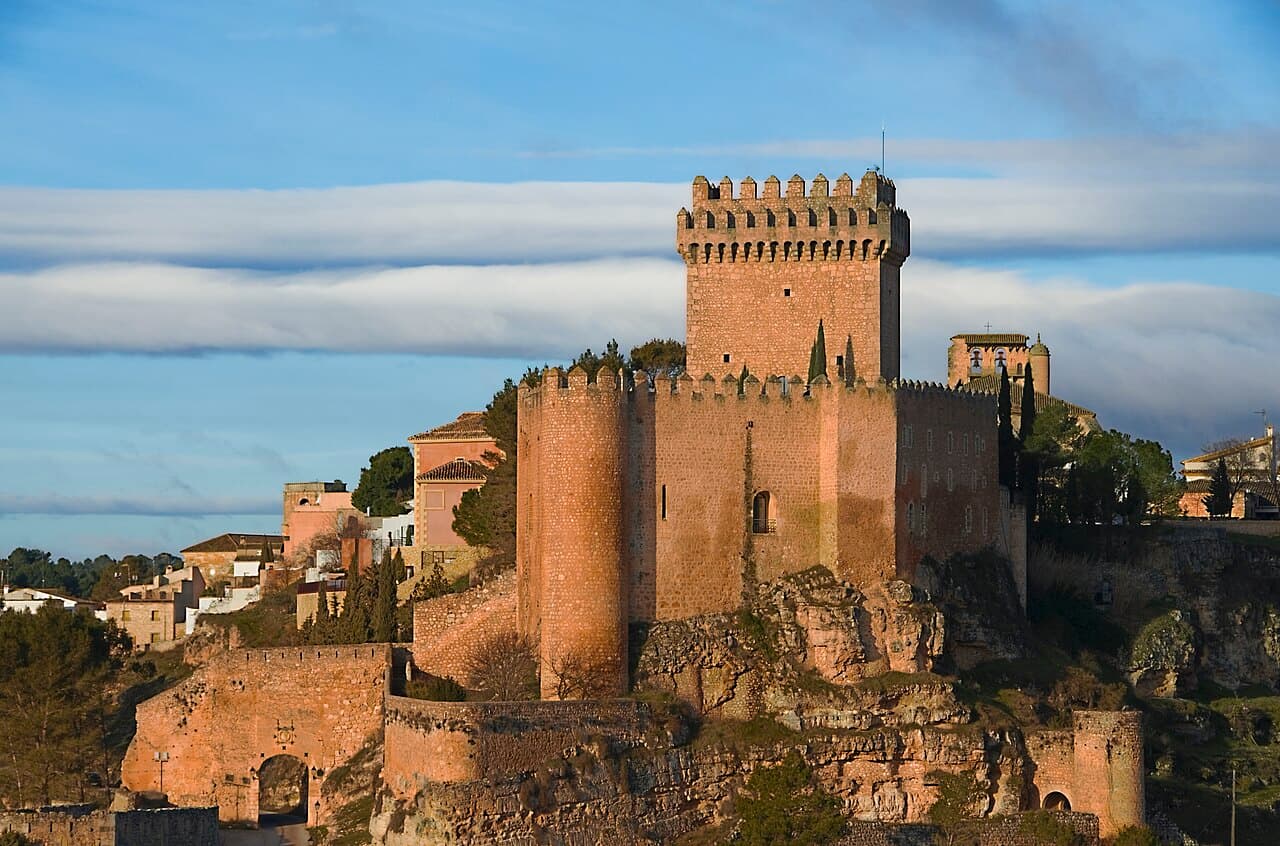
Castillo de Alarcón — Spain castle

Castillo de Alarcón

Castle of alarcón in cuenca, spain
Alarcón, Castilla-La Mancha, Spain
Early Medieval (5th–10th c.)
Well Preserved

The Castle of Alarcón is a prominent hill castle located in the province of Cuenca, Spain. This medieval fortress stands on a commanding rocky promontory overlooking the Júcar River, which provided it with a natural defensive advantage. The castle is an integral part of the fortified complex that surrounds the historic town of Alarcón, combining military architecture with the urban fabric enclosed within its walls.

Historical background and strategic importance

The origins of the Castle of Alarcón date back to the Islamic period in the Iberian Peninsula, with initial fortifications likely established during the 8th or 9th centuries. Following the Christian Reconquista, the castle was expanded and reinforced, especially during the 12th and 13th centuries, reflecting its vital role as a frontier fortress between Christian and Muslim territories. Its position atop a steep hill made it a formidable defensive structure, controlling key routes along the Júcar River valley.

Architectural features and layout

The castle complex is composed of a walled enclosure that protects the historic town core and the castle itself, creating a fortified urban settlement. The enclosure is punctuated by five exterior towers, which are separate but strategically placed to cover vulnerable approaches and enhance the defensive perimeter. These towers vary in shape and size, typically featuring thick stone walls and battlements designed for archers and artillery.

The keep and inner structures

Within the enclosure lies the main castle proper, dominated by a central keep or donjon, which served as the last line of defense and the residence of the castle's lord. The keep is a robust stone structure with narrow windows and crenellations, designed to withstand sieges and provide a vantage point over the surrounding landscape.

Walls and defensive elements

The curtain walls connecting the towers are constructed from local stone, often reinforced with buttresses and equipped with machicolations—openings through which defenders could drop projectiles on attackers below. The walls enclose a courtyard that historically contained essential facilities such as storage rooms, stables, and living quarters for soldiers and servants.

Cultural significance and preservation

The Castle of Alarcón is recognized as a cultural heritage site and is a key attraction in the region of Castilla-La Mancha. Its preservation allows visitors to experience a well-maintained example of medieval military architecture in Spain. The castle and its walls provide insight into the defensive strategies employed during the turbulent periods of the Reconquista and later conflicts.

Current condition and visitor experience

Today, the castle is well preserved and partially restored, with many original features intact. Visitors can explore the towers, ramparts, and inner courtyard, enjoying panoramic views of the surrounding countryside. The site often hosts cultural events and guided tours that highlight its historical context and architectural details.

Architectural style and construction period

The castle exhibits characteristics of medieval military architecture with influences from both Islamic and Christian builders. Its construction spans from the Early to High Medieval periods, with significant modifications made in the 12th and 13th centuries. The style reflects functional defensive needs rather than ornamental design, emphasizing thick walls, strategic positioning, and robust towers.

Frequently asked questions (FAQ)

How do I get to Castillo de Alarcón?
Castillo de Alarcón is located in the picturesque village of Alarcón, Spain. You can reach the castle by car, and it is approximately a two-hour drive from Madrid. Public transport options are limited, so driving is the most convenient way to visit.
What is the historical significance of Castillo de Alarcón?
Castillo de Alarcón is a medieval fortress that dates back to the 8th century and played a vital role in the defense against the Moors. It has witnessed numerous historical events and changes in ownership, contributing to its rich heritage. Today, it stands as a symbol of the region's turbulent history and architectural grandeur.
When was Castillo de Alarcón built?
The construction of Castillo de Alarcón began in the early 8th century, making it one of the oldest castles in the region. Over the centuries, it has undergone various renovations and expansions, reflecting different architectural styles. Its enduring presence tells the story of its historical significance over the centuries.
Can I take guided tours of the castle?
Yes, guided tours are available at Castillo de Alarcón, offering visitors a deeper understanding of its history and architecture. These tours typically include access to the main areas of the castle and insights from knowledgeable guides. It is advisable to check the schedule and book in advance, especially during peak seasons.
Is it possible to access all areas of the castle?
While many areas of Castillo de Alarcón are open to the public, some parts may have restricted access due to preservation efforts. Visitors can explore the main courtyard, towers, and walls, which provide stunning views of the surrounding landscape. Accessibility may vary, so it’s best to inquire upon arrival.
What are the opening hours for Castillo de Alarcón?
Castillo de Alarcón is typically open to visitors from 10 AM to 7 PM during the summer months and from 10 AM to 5 PM in the winter. It is closed on certain holidays, so it’s wise to check the official website for the most current information. Arriving early can help you avoid crowds and enjoy a more leisurely visit.
What are the ticket prices for visiting the castle?
Ticket prices for Castillo de Alarcón are generally affordable, with discounts available for children, seniors, and groups. As of the latest information, adult tickets are around €5, while children under a certain age may enter for free or at a reduced rate. It’s recommended to confirm current prices before your visit.
When is the best time to visit Castillo de Alarcón?
The best time to visit Castillo de Alarcón is during the spring and early autumn months when the weather is mild and pleasant. This timing allows you to enjoy the stunning views and surrounding landscapes without the summer crowds. Additionally, special events and festivals may be held during these times, enhancing your experience.
Are there any nearby attractions to visit after the castle?
Yes, there are several nearby attractions worth exploring after your visit to Castillo de Alarcón. The charming village of Alarcón itself offers picturesque streets and local cuisine. Additionally, you can visit the nearby natural parks and historical sites, making for a full day of sightseeing.

Photo gallery

Castillo de Alarcón
Click to view

Photo by emeritense from Madrid•CC BY-SA 2.0

1 photo • Click any image to view in full screen

Information

Hill Castle

Loading map...

Visitor reviews

No reviews yet. Been here? Write the first review and help other travelers!

Write the first review

Visited this castle? Share your experience

Your review helps other travelers and adds first-hand knowledge to our encyclopedia.

Write a review

(5/5)

0/2000 characters

Your review will be visible after admin approval

Nearby castles

0.3 km

Castle of Alarcon

Alarcon, Spain

The Castle of Alarcon is a remarkable example of a high medieval hill castle located in the historic town of Alarcon, in the province of Cuenca, Spain. This fortress, perched strategically atop a hill, dominates the surrounding landscape and forms a crucial part of the town's medieval fortifications. Its origins trace back to the 11th century during the period of Muslim control under the Emirate of Córdoba, making it a significant relic from the time of the Reconquista.The castle complex consists of a robust walled enclosure that houses the heart of the town and the castle itself. Surrounding this core are five exterior towers, each strategically positioned to maximize defensive capabilities. The stone walls, constructed with mortar that local legend claims bears bloodstains from a historical assassination attempt, add to the fortress's mystique and historical depth.Historical significance and military roleDuring the era of Muslim rule, the castle served as a vital defensive stronghold amid the internal conflicts that fragmented the Caliphate of Córdoba. Its strategic importance was highlighted in 1184 when it endured a prolonged siege lasting nine months. The siege was led by Fernán Martínez de Ceballos, a military captain under Alfonso VIII of Castile. After the castle's capture, Martínez de Ceballos earned the right to adopt the surname Martínez de Alarcón, marking a significant turning point in the castle's history as it transitioned into Christian hands.Following its capture, the castle was granted a fuero (charter) in 1186, which established its lordship over an extensive territory comprising 63 villages, including notable towns such as Albacete, La Roda, and Villarrobledo. In 1194, King Alfonso VIII donated the castle and its lands to the Military Order of Santiago, a religious and military order instrumental in the Reconquista efforts. This donation was reaffirmed multiple times, underscoring the castle's strategic and symbolic importance.The castle's military significance extended into the 13th century, with the local town council contributing troops to the pivotal Battle of Las Navas de Tolosa in 1212. This battle was a decisive victory for the Christian kingdoms during the Reconquista, marking the decline of Muslim power in the Iberian Peninsula.Lords and ownership through the centuriesIn the early 14th century, the castle and its lordship were granted by King Ferdinand IV to Juan Manuel, Prince of Villena, a prominent literary figure who composed some of his works within the castle walls. The lordship passed through his descendants before returning to royal possession under King Peter I.The castle's ownership changed hands several times during the late medieval period. In 1372, Henry II of Castile granted it to Alfonso I of Aragon, Marquis of Villena, but it was reclaimed by Henry III in 1395. During the 15th century, it was held by Juan Pacheco, Marquis of Villena, and later his son Diego López Pacheco. They notably supported Joanna la Beltraneja in her claim to the Castilian throne, maintaining control over Alarcon during this period of civil unrest.Decline and restorationFollowing the medieval period, the castle gradually fell into disrepair. By the early 18th century, reports from master builders highlighted urgent repair needs to prevent structural collapse. Ownership shifted among local nobility, including the Marquis of Aguilar and later Alejandro de Alarcón and Duchess Julia de Alarcón, who used the fortress as a refuge during regional conflicts.In the 19th century, the castle was sold to private owners, and by the mid-20th century, it was expropriated by the Spanish government. The castle underwent extensive restoration to preserve its historical fabric and was converted into a parador hotel, opening to the public on March 25, 1966. It was officially declared a Bien de Interés Cultural (Cultural Interest Site) in 1992, ensuring its protection and continued maintenance.Architectural features and layoutThe Castle of Alarcon is integrated within the fortified walls that enclose the historic town center of Alarcon. The fortress is characterized by a walled enclosure that includes the castle itself, surrounded by five separate exterior towers. These towers are positioned to provide overlapping fields of defense, a common strategic feature in medieval fortifications.The walls are primarily constructed from local stone, bonded with mortar. The unique mortar, reputed in local legend to contain bloodstains, adds an element of folklore to the castle's physical presence. The castle's design reflects the typical defensive architecture of the high medieval period, with thick walls, battlements, and towers designed to withstand sieges and attacks.Over the centuries, successive Castilian monarchs expanded and reinforced the castle, adapting it to evolving military technologies and needs. The castle's position on a hill provided a commanding view of the surrounding countryside, enabling early detection of approaching enemies.Towers and defensive structuresThe five exterior towers are a defining feature of the castle's defensive system. Each tower is distinct yet harmoniously integrated into the overall fortification scheme. These towers served multiple purposes, including lookout points, archery platforms, and strongholds in case of breach.The castle's main gate and entrance are fortified with defensive mechanisms typical of the period, including machicolations and arrow slits, designed to repel attackers while protecting the defenders.Interior spaces and adaptationsWithin the walls, the castle contains various chambers and halls that would have served administrative, residential, and military functions. While much of the original interior has been modified or restored, the castle retains elements that reflect its medieval origins and subsequent adaptations.Visitor experience and cultural importanceToday, the Castle of Alarcon stands as a well-preserved monument to Spain's rich medieval heritage. Its conversion into a parador hotel allows visitors to experience the castle's historic atmosphere while enjoying modern amenities. Visitors can explore the castle's walls, towers, and surrounding town, gaining insight into the strategic military and political history of the region.The castle's designation as a Cultural Interest Site underscores its significance as a heritage landmark. It attracts historians, architecture enthusiasts, and tourists alike, offering a tangible connection to the complex history of the Reconquista and medieval Spain.Visitors are encouraged to explore the castle's exterior fortifications, the strategic placement of its towers, and the scenic views from its elevated position. The castle's blend of military architecture and historical narrative makes it a compelling destination for those interested in medieval fortifications and Spanish history.

High Medieval (11th–13th c.)
Details
31.9 km

Castle of Paracuellos de la Vega

Paracuellos de la Vega, Spain

The Castle of Paracuellos de la Vega is a notable hill castle located in the municipality of Paracuellos within the autonomous community of Castile-La Mancha, Spain. Constructed during the late 12th century following the Christian reconquest of Cuenca, this fortress played a strategic role in securing newly acquired territories during the High Medieval period. Its position overlooking a valley ravine provided a natural defensive advantage despite the modest elevation of its hill. Historical background and strategic importance The castle was established as part of a broader defensive network initiated by King Alfonso VIII of Castile after his successful capture of the city of Cuenca in 1177. This network aimed to protect the frontier zones and consolidate Christian control in the region during the Reconquista. The Castle of Paracuellos de la Vega served as a stronghold that monitored and defended the surrounding valley, controlling access routes and providing a refuge in times of military threat. In 1187, King Alfonso VIII granted ownership of the castle, alongside the nearby fortress of Monteagudo de las Salinas, to the Cathedral of Cuenca and its bishops. This transfer linked the castle to ecclesiastical authority, which often played a dual role in both spiritual and temporal governance during the Middle Ages. The church's involvement likely influenced the castle's maintenance and the surrounding settlement's development. By the 16th century, a small village had formed at the base of the castle hill. This settlement included the church of Nuestra Señora del Castillo, constructed between 1529 and 1537, which served the local population. The village and its church mark the last significant phase of habitation connected to the castle, reflecting a transition from purely military use to a more community-oriented presence in the area. In the late 20th century, recognition of the castle's cultural and historical value led to preservation efforts. The site was officially declared a Cultural Heritage Site in 1992, following a process initiated in 1988. Restoration and conservation work have since focused on stabilizing the remaining structures and promoting the site's historical significance. Architectural features and layout The Castle of Paracuellos de la Vega exhibits a trapezoidal layout adapted to the natural contours of the hill. The approach to the fortress is via a path cut directly from the rock, emphasizing the integration of the castle with its terrain. This design reflects medieval military architecture principles aimed at maximizing defense through natural and constructed means. The castle's walls and towers are predominantly constructed from sillarejo esgrafiado, a masonry technique using rough-cut, uneven stone blocks. The corners and structural reinforcements employ squared stone blocks known as sillares, which provide stability and durability. Functional openings such as doors, window lintels, arches, and arrow slits are carefully crafted from these local stones, balancing defensive needs with usability. The fortress is organized into three concentric enclosures, a design that allowed for layered defense. The outer enclosure encompasses the entire base perimeter and features two battlemented towers, commonly referred to as cubos. These towers provided vantage points for surveillance and defense against attackers. Within this outer ring lies a second walled area, accessible through a single gate. Although much of this middle enclosure has been reduced to foundations, three towers remain prominently visible, indicating the scale and complexity of the fortification system. The innermost enclosure houses the principal tower or keep (torre maestra), which is architecturally distinctive. The keep has a pentagonal external shape contrasting with a square interior, a rare feature that may have enhanced its defensive capabilities and internal spatial organization. Current condition and preservation efforts Today, the castle remains in a partially preserved state, with substantial portions of the wall bases and tower foundations still visible. Some battlements survive atop certain towers, offering insight into the original military design aimed at layered defense. These remnants allow visitors to appreciate the castle's strategic construction and medieval military architecture. Preservation efforts have concentrated on stabilizing the ruins to prevent further deterioration. The designation as a Cultural Heritage Site has facilitated funding and expertise for restoration projects, ensuring the castle's historical integrity is maintained for future generations. Interpretive signage and controlled access paths help visitors understand the site's significance and layout. Architectural significance and military design The Castle of Paracuellos de la Vega exemplifies typical High Medieval military architecture in Spain, combining natural topography with constructed defenses. Its use of rough-cut stone masonry and the presence of multiple defensive layers reflect the period's evolving siege warfare tactics. The three concentric enclosures allowed defenders to fall back progressively if outer defenses were breached, a common medieval strategy to prolong resistance. The pentagonal keep is an unusual architectural element that may have provided improved angles of defense and reduced blind spots compared to traditional square or circular keeps. The castle's location overlooking a valley ravine was strategically chosen to control movement through the landscape, a critical factor in medieval territorial control. Its integration with the local terrain and the use of local materials demonstrate practical and resourceful medieval construction methods. Visiting the castle and cultural context Visitors to the Castle of Paracuellos de la Vega can explore the ruins and appreciate the historical layers visible in the masonry and layout. The site offers a tangible connection to the Reconquista period and the role of ecclesiastical authorities in territorial governance. The nearby village and the church of Nuestra Señora del Castillo provide additional cultural context, illustrating how military sites often became focal points for community development. The castle's preservation as a cultural heritage site ensures that this history remains accessible and informative for both scholars and the general public.

High Medieval (11th–13th c.)
Details
52.6 km

Belmonte Castle

, Spain

Belmonte Castle stands as one of the most remarkable and well-preserved medieval castles in Spain. Constructed in the 15th century by the powerful Marquis of Villena, this fortress is located in the province of Cuenca, within the historic region of Castilla-La Mancha, approximately ninety miles from Madrid. The castle’s strategic position and imposing architecture reflect its significance during a turbulent era marked by dynastic struggles and cultural transformation in Spain. Historical significance and royal connections Belmonte Castle has witnessed several pivotal moments in Spanish history. It served as a royal lodge for the Catholic Monarchs, Ferdinand and Isabella, who played a crucial role in the unification of Spain and the completion of the Reconquista. The castle was also a backdrop for battles related to the struggle for the Castilian crown, underscoring its military and political importance during the late medieval period. Additionally, the castle is linked to cultural history as the birthplace of the revered Renaissance poet Fray Luis de León, whose literary works contributed significantly to Spanish literature. In modern times, Belmonte Castle gained cinematic fame as a filming location for the epic film "El Cid", starring Charlton Heston and Sofia Loren, further cementing its place in popular culture. Architectural features and styles The castle’s architecture is a fascinating blend of Gothic and Moorish styles, evident in its interior decorations and structural elements. The interiors are renowned for their outstanding stucco works that showcase intricate Gothic and Moorish artistic influences, reflecting the cultural interplay characteristic of Spain’s medieval period. One of the castle’s distinctive features is its Neo-Gothic courtyard, which was added during a significant 19th-century restoration. This restoration was commissioned by its former owner, Empress Eugenie, who was the wife of Napoleon III of France. She passed the castle on to her nephew, the Duke of Peñaranda de Duero, ensuring the preservation and enhancement of the castle’s historical and architectural heritage. Fortifications and layout Belmonte Castle is a classic example of a hill castle, strategically built on elevated ground to maximize defensive capabilities. Its robust walls, fortified towers, and battlements were designed to withstand sieges and protect its inhabitants. The castle’s layout includes a series of defensive structures such as moats, gatehouses, and watchtowers, typical of medieval military architecture. Preservation and current status Today, Belmonte Castle is considered one of the best-preserved medieval castles in Spain, retaining much of its original structure and artistic decor. The castle’s condition is classified as well preserved, thanks to continuous conservation efforts over the centuries. Its historical authenticity and architectural grandeur make it a significant cultural landmark, attracting visitors interested in medieval history, architecture, and Spanish heritage. Cultural impact and tourism The castle’s rich history and stunning architecture make it a popular destination for tourists and scholars alike. It offers a unique glimpse into the late medieval period in Spain, combining military, royal, and cultural narratives within its walls. Visitors can explore the castle’s courtyards, halls, and chambers, admiring the detailed stucco work and the harmonious blend of Gothic and Moorish design elements. Belmonte Castle also hosts various cultural events and exhibitions that celebrate its heritage and the broader history of Castilla-La Mancha. Its connection to notable historical figures and events enhances its appeal as a site of educational and historical significance.

Late Medieval (14th–15th c.)
Details

