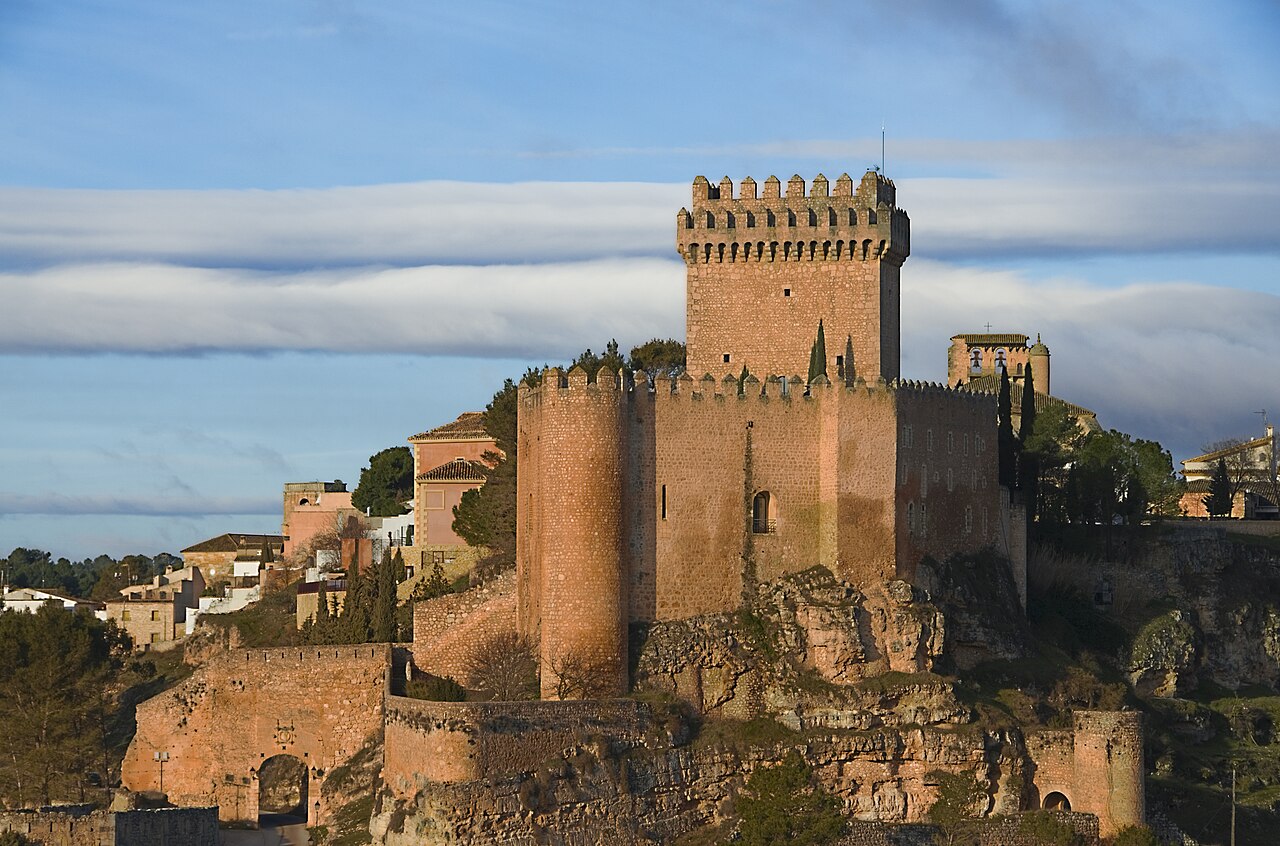
Castle of Alarcon
The Castle of Alarcon is a remarkable example of a high medieval hill castle located in the historic town of Alarcon, in the province of Cuenca, Spain. This fortress, perched strategically atop a hill, dominates the surrounding landscape and forms a crucial part of the town's medieval fortifications. Its origins trace back to the 11th century during the period of Muslim control under the Emirate of Córdoba, making it a significant relic from the time of the Reconquista.
The castle complex consists of a robust walled enclosure that houses the heart of the town and the castle itself. Surrounding this core are five exterior towers, each strategically positioned to maximize defensive capabilities. The stone walls, constructed with mortar that local legend claims bears bloodstains from a historical assassination attempt, add to the fortress's mystique and historical depth.
Historical significance and military role
During the era of Muslim rule, the castle served as a vital defensive stronghold amid the internal conflicts that fragmented the Caliphate of Córdoba. Its strategic importance was highlighted in 1184 when it endured a prolonged siege lasting nine months. The siege was led by Fernán Martínez de Ceballos, a military captain under Alfonso VIII of Castile. After the castle's capture, Martínez de Ceballos earned the right to adopt the surname Martínez de Alarcón, marking a significant turning point in the castle's history as it transitioned into Christian hands.
Following its capture, the castle was granted a fuero (charter) in 1186, which established its lordship over an extensive territory comprising 63 villages, including notable towns such as Albacete, La Roda, and Villarrobledo. In 1194, King Alfonso VIII donated the castle and its lands to the Military Order of Santiago, a religious and military order instrumental in the Reconquista efforts. This donation was reaffirmed multiple times, underscoring the castle's strategic and symbolic importance.
The castle's military significance extended into the 13th century, with the local town council contributing troops to the pivotal Battle of Las Navas de Tolosa in 1212. This battle was a decisive victory for the Christian kingdoms during the Reconquista, marking the decline of Muslim power in the Iberian Peninsula.
Lords and ownership through the centuries
In the early 14th century, the castle and its lordship were granted by King Ferdinand IV to Juan Manuel, Prince of Villena, a prominent literary figure who composed some of his works within the castle walls. The lordship passed through his descendants before returning to royal possession under King Peter I.
The castle's ownership changed hands several times during the late medieval period. In 1372, Henry II of Castile granted it to Alfonso I of Aragon, Marquis of Villena, but it was reclaimed by Henry III in 1395. During the 15th century, it was held by Juan Pacheco, Marquis of Villena, and later his son Diego López Pacheco. They notably supported Joanna la Beltraneja in her claim to the Castilian throne, maintaining control over Alarcon during this period of civil unrest.
Decline and restoration
Following the medieval period, the castle gradually fell into disrepair. By the early 18th century, reports from master builders highlighted urgent repair needs to prevent structural collapse. Ownership shifted among local nobility, including the Marquis of Aguilar and later Alejandro de Alarcón and Duchess Julia de Alarcón, who used the fortress as a refuge during regional conflicts.
In the 19th century, the castle was sold to private owners, and by the mid-20th century, it was expropriated by the Spanish government. The castle underwent extensive restoration to preserve its historical fabric and was converted into a parador hotel, opening to the public on March 25, 1966. It was officially declared a Bien de Interés Cultural (Cultural Interest Site) in 1992, ensuring its protection and continued maintenance.
Architectural features and layout
The Castle of Alarcon is integrated within the fortified walls that enclose the historic town center of Alarcon. The fortress is characterized by a walled enclosure that includes the castle itself, surrounded by five separate exterior towers. These towers are positioned to provide overlapping fields of defense, a common strategic feature in medieval fortifications.
The walls are primarily constructed from local stone, bonded with mortar. The unique mortar, reputed in local legend to contain bloodstains, adds an element of folklore to the castle's physical presence. The castle's design reflects the typical defensive architecture of the high medieval period, with thick walls, battlements, and towers designed to withstand sieges and attacks.
Over the centuries, successive Castilian monarchs expanded and reinforced the castle, adapting it to evolving military technologies and needs. The castle's position on a hill provided a commanding view of the surrounding countryside, enabling early detection of approaching enemies.
Towers and defensive structures
The five exterior towers are a defining feature of the castle's defensive system. Each tower is distinct yet harmoniously integrated into the overall fortification scheme. These towers served multiple purposes, including lookout points, archery platforms, and strongholds in case of breach.
The castle's main gate and entrance are fortified with defensive mechanisms typical of the period, including machicolations and arrow slits, designed to repel attackers while protecting the defenders.
Interior spaces and adaptations
Within the walls, the castle contains various chambers and halls that would have served administrative, residential, and military functions. While much of the original interior has been modified or restored, the castle retains elements that reflect its medieval origins and subsequent adaptations.
Visitor experience and cultural importance
Today, the Castle of Alarcon stands as a well-preserved monument to Spain's rich medieval heritage. Its conversion into a parador hotel allows visitors to experience the castle's historic atmosphere while enjoying modern amenities. Visitors can explore the castle's walls, towers, and surrounding town, gaining insight into the strategic military and political history of the region.
The castle's designation as a Cultural Interest Site underscores its significance as a heritage landmark. It attracts historians, architecture enthusiasts, and tourists alike, offering a tangible connection to the complex history of the Reconquista and medieval Spain.
Visitors are encouraged to explore the castle's exterior fortifications, the strategic placement of its towers, and the scenic views from its elevated position. The castle's blend of military architecture and historical narrative makes it a compelling destination for those interested in medieval fortifications and Spanish history.
Frequently asked questions (FAQ)
- When was the castle of alarcon originally built?
- The castle of alarcon was originally built in the 11th century during the period of muslim control under the emirate of córdoba.
- What is the architectural style of the castle of alarcon?
- The castle of alarcon features high medieval military architecture typical of hill castles, with thick stone walls, battlements, and five strategically placed exterior towers.
- Can visitors stay overnight at the castle of alarcon?
- Yes, the castle of alarcon has been converted into a parador hotel, allowing visitors to stay overnight and experience its historic atmosphere with modern amenities.
- Is the castle of alarcon open to the public year-round?
- The castle of alarcon, as a parador hotel, is open year-round, but visitors should check specific visiting hours and availability in advance.
- What is the significance of the castle of alarcon in spanish history?
- The castle of alarcon played a key role during the reconquista, serving as a strategic defensive fortress and later as a lordship center under various medieval rulers.
- How can visitors reach the castle of alarcon?
- Visitors can reach the castle of alarcon by traveling to the town of alarcon in cuenca province, which is accessible by road from major cities in castilla-la mancha.
Information
Website
Visit websiteSources & official resources
Verify the information above using these authoritative references.
Loading map...
Visitor reviews
No reviews yet. Been here? Write the first review and help other travelers!
Write the first reviewVisited this castle? Share your experience
Your review helps other travelers and adds first-hand knowledge to our encyclopedia.