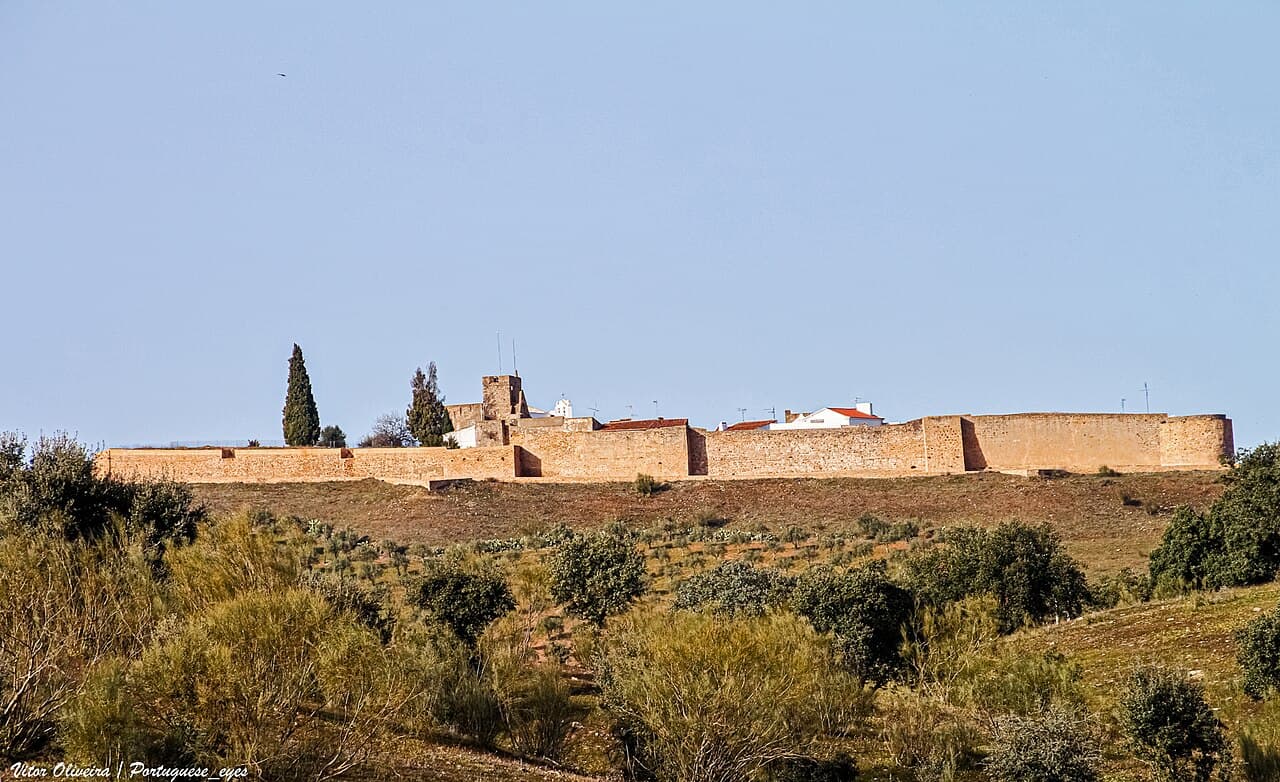
The Castle of Ouguela stands as a prominent example of layered military architecture in Portugal. Located in the municipality of Campo Maior within the district of Portalegre, this hill castle occupies a strategic escarpment overlooking the confluence of the Abrilongo and Xévora rivers. Its position 259 meters above sea level provided natural defensive advantages that were enhanced by successive fortifications spanning from the pre-Roman period through the 18th century.
The site’s earliest known occupation dates back to ancient times when pre-Roman peoples established a fortified settlement called Budua. This was succeeded by Roman control during their expansion into the Iberian Peninsula, followed by Visigothic occupation under the name Niguela. From the 8th century onward, Muslim rulers fortified the site, reflecting its ongoing military importance in the region.
Medieval origins and the reconquista
Following the Christian Reconquista, the castle changed hands multiple times. After 1230, it was definitively captured by Castilian and Leonese forces. In 1255, the territory including Ouguela was granted to the Chapter and Bishop of Badajoz, indicating its ecclesiastical as well as military significance. The Treaty of Alcañices in 1297 marked a pivotal moment when the castle and its lands were transferred to the Portuguese Crown. Shortly thereafter, King D. Dinis issued a charter in 1298 to encourage settlement and ordered major reconstruction works to reinforce the castle’s defenses, marking the beginning of its development as a fortified Portuguese stronghold.
Construction under the portuguese crown
The castle’s fortifications were expanded during the reigns of King D. Fernando and King D. João I (1385–1433), who also granted sanctuary rights to the town in 1420. The castle played a role in the conflicts surrounding the Battle of Toro in 1475, with its chief commander, João da Silva, dying from wounds sustained during the battle. His grandson later commemorated this event with a cross, underscoring the castle’s martial heritage.
Renaissance to restoration war enhancements
In the early 16th century, under King D. Manuel I, the castle was documented by the military engineer and artist Duarte de Armas, highlighting its significance and condition at that time. The Cunha family held the position of governors, overseeing the castle’s administration. During the Portuguese Restoration War in the 17th century, King D. João IV commissioned the French architect Nicolau de Langres to modernize the fortress. This modernization adapted the castle to the contemporary bastion fortification style, reflecting advances in military technology and the increasing importance of artillery.
Notable military engagements
One of the castle’s most famous military episodes occurred in 1644 when it successfully resisted a Spanish assault led by Carlo Andrea Caracciolo, marquês de Torrecuso. Among the defenders was Isabel Pereira, a local woman who became a symbol of the castle’s resilience. The castle’s defenses were further enhanced in the 18th century with the addition of bastions, demi-bastions, and ravelins, which enabled it to withstand another Spanish invasion attempt in 1762 led by cavalry captain Brás de Carvalho.
Architectural features and fortifications
The Castle of Ouguela is built on an irregular hexagonal plan, utilizing local granite and schist that provided robust and durable construction materials. The northern entrance is a notable feature, framed by two paired towers and protected by a demi-bastion equipped with four cannon openings and a barbican. This entrance includes a sally port and a portcullis system, demonstrating the integration of medieval defensive elements with gunpowder-era innovations.
The main gate bears the town’s coat of arms and is defended by a casemate with seven firing slits, allowing defenders to engage attackers while remaining protected. The preserved adarve or wall walk runs along the ramparts, bordered by low protective walls for patrolling soldiers. Over time, many original battlements were replaced by embrasures and barbicans designed for cannon defense, particularly on the main keep tower.
Surrounding the bastioned walls is a ditch with a tenaille-shaped layout, designed to slow and expose attackers. A chemin de ronde provides a protected walkway for defenders. Additional outworks include two lunettes at the southeastern and northwestern edges, constructed in the 18th century to provide flanking fire and absorb enemy assaults. These fortifications reflect the evolution of military architecture from medieval to early modern bastion systems.
Later developments and preservation
In the 19th century, the castle was militarily decommissioned. Some western fortifications were converted into a cemetery, marking a shift from military to civil use. Despite this, remnants of circular guardhouses and other defensive structures remained visible into the early 20th century, illustrating the site’s long-standing strategic importance.
Recognized as a Property of Public Interest in 1943, the castle has undergone several restoration campaigns during the late 20th century. These efforts focused on consolidating walls, bastions, and gates to preserve the fortress’s structural integrity. Current heritage management includes plans to promote research, education, and tourism, linking the castle’s history with nearby Spanish fortifications such as the fortress of Alburquerque.
Cultural and tourism significance
Today, the Castle of Ouguela is a key cultural landmark within the tourism promotion area of the Portuguese plains. Its well-preserved walls and bastions offer visitors insight into the development of military architecture over several centuries. The castle’s location provides panoramic views of the surrounding landscape, enhancing its appeal as a historical and scenic destination.
Visitors can explore the castle’s various defensive structures, including the ramparts, towers, and outworks, gaining a comprehensive understanding of how fortifications adapted to changing military technologies. The castle’s connection to significant historical events and figures enriches the visitor experience, making it a valuable site for both history enthusiasts and casual tourists.
Frequently asked questions (FAQ)
- When was the castle of ouguela originally built?
- The castle's origins date back to a fortified settlement established by pre-Roman peoples, with significant reconstruction under King D. Dinis in the late 13th century.
- What architectural styles are present in the castle of ouguela?
- The castle features a mixed architectural style, combining medieval military elements with later bastion fortifications from the 17th and 18th centuries.
- Can visitors explore the castle's defensive structures?
- Yes, visitors can walk along the ramparts, explore towers, gates, and outworks such as lunettes and bastions, gaining insight into the castle's evolving fortifications.
- What notable historical events took place at the castle?
- Key events include the Battle of Toro in 1475, the 1644 defense against a Spanish assault, and the 1762 Spanish invasion attempt, all highlighting the castle's military significance.
- Is the castle of ouguela accessible year-round?
- Visiting hours may vary; it is recommended to check with local tourism offices for current opening times and accessibility before planning a visit.
- Why is the castle of ouguela important for cultural tourism?
- The castle offers a well-preserved example of evolving military architecture and a connection to regional history, making it a significant cultural and educational site.
Photo gallery

Information
Architect
Nicolau de Langres
Loading map...
Visitor reviews
No reviews yet. Been here? Write the first review and help other travelers!
Write the first reviewVisited this castle? Share your experience
Your review helps other travelers and adds first-hand knowledge to our encyclopedia.


