Castle of Old Wick
The Castle of Old Wick stands as a remarkable example of a medieval Norse stronghold situated near the town of Wick in northern Scotland. Its strategic location on a promontory peninsula formed by rugged cliffs overlooking the sea highlights its defensive importance during the Norse earldom of Caithness and Orkney. The castle's origins trace back to the late 12th or early 13th century, firmly placing it within the High Medieval period and reflecting the architectural and military traditions of Norse settlers in Scotland.
Constructed primarily from stone, the castle was designed to serve both as a noble residence and a fortified defensive site. Its position on a hill castle site allowed it to command extensive views of the surrounding landscape and coastline, essential for early warning and defense against seaborne threats. The castle's layered fortifications, including moats, a drawbridge, and a gatehouse, illustrate the complexity and strength of its defensive arrangements.
Historical context and ownership lineage
The earliest recorded owner of the castle was Harald Maddadson, who held the joint title of Earl of Caithness and Orkney during the late 12th or early 13th century. This period was characterized by Norse influence in northern Scotland, with the earldoms governed by Norse earls who integrated local and Scandinavian customs. The castle thus served as a symbol of Norse authority and control in the region.
In the early 14th century, ownership passed to Reginald le Chen, marking a transition from Norse to Scottish noble hands. Upon Reginald's death in 1345, the castle was inherited by the Earl of Sutherland through marriage to Reginald's daughter, Mary. This alliance reflects the common medieval practice of securing territorial control through dynastic marriages.
The 15th century saw further dynastic shifts when Christian Sutherland, an heiress, married William Oliphant. The Oliphant family maintained possession for over a century, underscoring the castle's continued role as a noble residence. However, in 1569, John Sinclair, Master of Caithness, led a military campaign culminating in an eight-day siege that resulted in the castle's capture and transfer to the Sinclair family.
Following the death of George Sinclair, Earl of Caithness, who died without heirs, the estate passed to John Campbell, Lord Glenorchy. Lord Glenorchy sold the property in 1690 to the Dunbars of Hempriggs, who retained it into the early 20th century. By the late 17th century, the castle was already in a state of ruin, reflecting the decline of its military and residential importance.
Architectural features and defensive structures
Site and fortifications
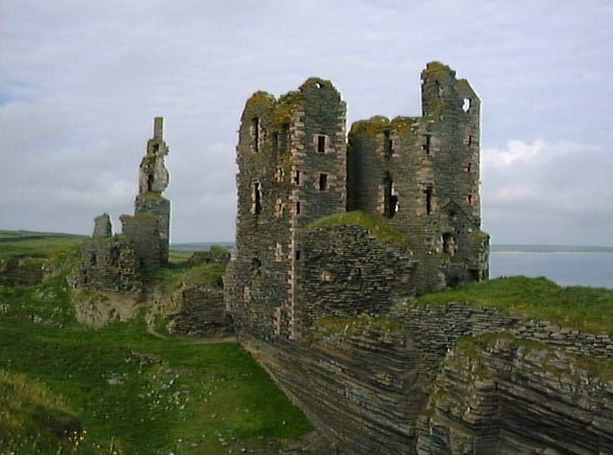
The castle is perched on a rocky peninsula with natural cliffs providing formidable protection on most sides. It was originally separated from the mainland by two moats, defensive ditches that were likely water-filled, enhancing its isolation and defensibility. Access was controlled by a drawbridge spanning a rock-cut ditch, leading to a gatehouse fortified by a defensive wall. This multi-layered defense made direct assault challenging.
The main tower
The central feature is a square stone tower originally built to four stories, of which three remain standing today. The tower's layout was functional: the ground floor served as the kitchen and storage areas, the first floor housed the main hall with its entrance facing southeast, and the upper floors contained the lord's private chambers. Notably, the tower lacked internal staircases, requiring movement between floors by ladders, and did not include fireplaces, an unusual aspect for buildings of its type and era.
Courtyard and ancillary buildings
Extending from the tower towards the peninsula's center is a narrow courtyard surrounded by the foundations of various outbuildings. Archaeological remains reveal structures such as barracks, a brewery, and a chapel, indicating the castle functioned as a self-sufficient complex supporting both military and domestic needs. These buildings were enclosed within the castle's defensive perimeter, which included a second moat and an additional protective wall that also served as a back wall for these structures.
Cultural significance and current status
Today, the Castle of Old Wick stands as a poignant historical monument, its ruins offering insight into the layered history of Norse and Scottish noble rule in northern Scotland. The surviving walls and foundations provide valuable evidence of medieval defensive architecture adapted to a coastal cliff environment. The castle's complex fortifications and carefully planned internal buildings reflect the dual priorities of noble residence and military defense.
Visitors to the site can explore the remains that illustrate the castle's strategic importance and architectural ingenuity. The castle's location offers dramatic views of the surrounding coastline and serves as a testament to the turbulent history of Caithness, marked by shifting allegiances and military conflicts.
Preservation efforts have focused on maintaining the structural integrity of the ruins to ensure that this significant cultural heritage site remains accessible for education and tourism. The castle's enduring presence enriches Scotland's historical landscape and continues to attract interest from historians, archaeologists, and visitors fascinated by medieval Norse and Scottish history.
Frequently asked questions (FAQ)
- How do I get to Castle of Old Wick?
- Castle of Old Wick is located near Wick in northern Scotland. It can be reached by car or local transport from Wick town center, followed by a short walk to the coastal promontory where the ruins stand.
- What is the historical significance of Castle of Old Wick?
- Castle of Old Wick is significant for its origins as a Norse stronghold and its role in the medieval history of Caithness, illustrating the transition from Norse to Scottish noble control.
- Can I explore the interior of the castle?
- As the castle is largely in ruins, visitors can explore the remains of the tower, courtyard, and outbuildings, but interior access is limited due to safety and preservation concerns.
- When is the best time to visit Castle of Old Wick?
- The best time to visit is during the late spring to early autumn months when weather conditions are favorable for walking and exploring the coastal site.
- Is there an entrance fee to visit Castle of Old Wick?
- There is typically no entrance fee to visit the Castle of Old Wick ruins, making it accessible for all visitors interested in history and architecture.
Information
Website
Visit websiteSources & official resources
Verify the information above using these authoritative references.
Loading map...
Visitor reviews
No reviews yet. Been here? Write the first review and help other travelers!
Write the first reviewVisited this castle? Share your experience
Your review helps other travelers and adds first-hand knowledge to our encyclopedia.