Castle of Obidos
The Castle of Óbidos stands as a remarkable example of a medieval hill castle in the Leiria region of Portugal. Its origins trace back to prehistoric times, with the area first inhabited by the Lusitanians in the 4th century BC. The site later became a Roman settlement known as Eburobrittium in the 1st century AD, referenced by Pliny the Elder, highlighting its early strategic importance. Following the Roman period, the castle's location was controlled by the Visigoths during the 5th and 6th centuries, who maintained its defensive role. In the 8th century, Muslim forces fortified the town, enhancing its defenses and laying the groundwork for the castle's medieval structure.
The castle's significance grew during the Christian Reconquista. In 1148, forces under King Afonso I of Portugal captured the settlement through a clever ruse, marking the beginning of Christian control. However, the castle was not fully secured until the reign of King Sancho I in 1195, who strengthened the fortifications and converted the Albarra tower into a jail. Subsequent monarchs continued to enhance the castle's defenses: King Denis expanded the dungeons and added barbicans near the main gate, fortifying the castle against siege warfare.
Historical significance and royal connections
In 1210, King Afonso II granted the castle and town to Queen Urraca, cementing its status as a royal possession. Throughout the 13th century, the castle remained loyal to the Portuguese crown during succession crises, earning the title "very noble and ever loyal", which is proudly displayed on the municipal coat-of-arms.
From the reign of King Denis until 1834, the castle and town were part of the dowry for Portuguese queens, linking the site intimately with the monarchy. One queen commissioned the construction of the Torre de D. Fernando, a keep tower that physically connected the dungeons to the nearby Church of Santiago. During the turbulent 1383–1385 succession crisis, the castle's governor initially sided with John I of Castile, but the fortress was ultimately surrendered to John I of Portugal following the decisive Battle of Aljubarrota.
Architectural features and structural layout
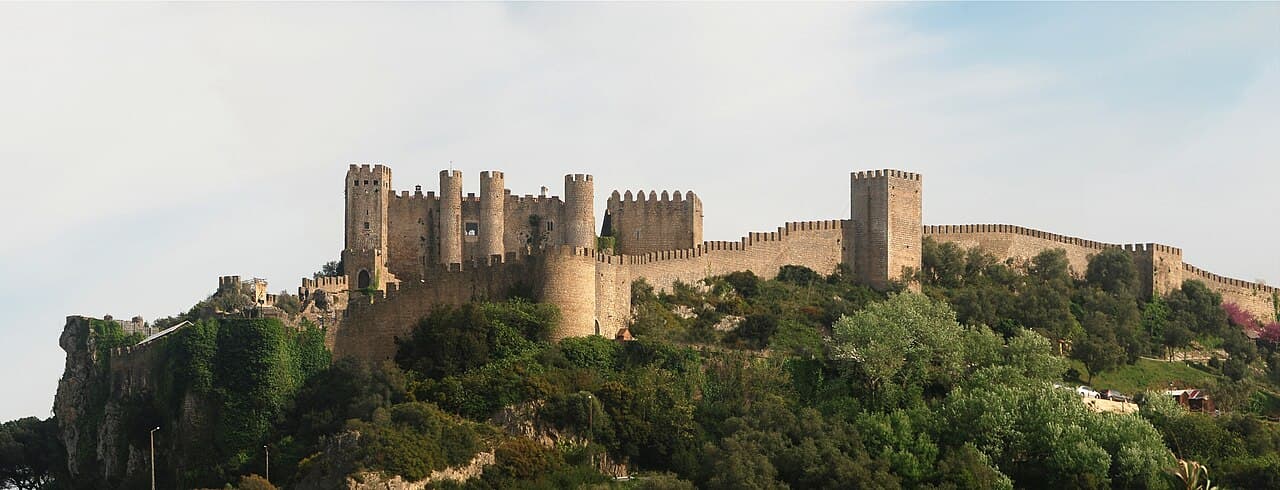
The Castle of Óbidos occupies a trapezoidal plan on the northwest edge of the walled town, situated approximately 79 meters above sea level. Its walls extend roughly 1,565 meters and are reinforced by a combination of square and cylindrical towers, some rising to 13 meters in height. The battlements feature square merlons atop crenellated walls, enclosing an irregular triangular courtyard that once served as the castle's inner bailey.
Defensive elements include three corbels on the northern side, both semi-circular and rectangular, designed for enhanced protection. The eastern and western walls are fortified with rectangular towers named after King Denis and King Fernando. The southern wall features two semi-circular corbels, one equipped with machicolations—openings through which defenders could drop projectiles on attackers.
Barbicans protect the northern and western sides, adding an extra layer of defense. The Albarrã tower, a rectangular corbel dividing two courtyards, was transformed into a clocktower in the 19th century, reflecting the castle's evolving use over time.
Architectural styles and influences
The castle's architecture is a blend of Romanesque, Gothic, Manueline (a uniquely Portuguese late Gothic style), and Baroque elements. These styles are evident in the Castelejo area, now functioning as a historic hotel, and in the intramural district within the castle walls. The Manueline style is particularly notable in the ornate windows and decorative stonework.
A significant engineering feat associated with the castle is the 3-kilometer aqueduct built by Queen Catherine of Austria, which channels water from the Usseira mountains to the town's fountains, demonstrating the importance of sustaining the settlement's water supply.
The palace of the alcaides and internal structures
Within the castle's walls, the Palace of the Alcaides (Paço dos Alcaides) occupies the north face of the old wall. This U-shaped building features a tiled roof and a three-story central wing. The ground floor is characterized by Gothic-arched doors, while the upper floors display rectangular friezes and Manueline windows. The northern façade aligns with the exterior wall and is supported by corbels.
The palace's internal layout was designed for both service and reception. The first floor housed service areas, the second floor contained reception rooms and a bar, and the third floor included formal dining and living rooms, a kitchen, and bedrooms. Two towers on the southern side—the Torre de D. Fernando with pentagonal merlons and the Torre de D. Dinis with pyramidal merlons—were adapted into guest rooms. A passageway above the door connecting two courtyards links the palace to the Church of Santiago, illustrating the integration of religious and residential functions.
Fortifications and surrounding defenses
The western walls of the castle follow the natural cliffs and include several gates such as the Cerca Gate and Talhada Gate. The watchtower of Jogo da Bola and the Facho Tower in the southwest mark the extent of the fortifications in this area.
The castle's defensive features reflect centuries of military adaptation, including the addition of machicolations, barbicans, and a combination of tower shapes to optimize defense against siege tactics. The well-preserved structures provide insight into the evolution of medieval military architecture in Portugal.
Later history and restoration efforts
The 1755 Lisbon earthquake caused damage to the castle, necessitating repairs and modifications in subsequent centuries. During the Peninsular War, Óbidos's fortifications played a role in firing the first artillery shots at the Battle of Roliça in 1808, marking the first defeat of Napoleonic forces in Portugal.
In the 19th century, the Albarrã tower was converted into a clocktower in 1842, and an external staircase was added to the D. Fernando Tower in 1869, reflecting changing functional needs.
Starting in 1932, restoration efforts were undertaken by the Directorate-General for National Monuments and Buildings to preserve the castle's historical and architectural integrity. Between 1948 and 1950, the castle was transformed into a historic hotel, with interior design contributions from notable architects and artisans. In 1951, the castle and its surrounding urban area were declared a National Monument, ensuring its protection and recognition as a cultural heritage site.
Today, the Castle of Óbidos remains one of Portugal's best-preserved medieval castles, attracting visitors with its rich history, architectural diversity, and scenic hilltop location overlooking the town and surrounding landscape.
Frequently asked questions (FAQ)
- How do I get to the Castle of Obidos?
- The Castle of Obidos is located in the charming town of Óbidos, easily accessible by car or public transport from Lisbon, which is about an hour's drive away. There are frequent bus services that connect Óbidos with major cities, making it convenient for visitors. Upon arrival, the castle is situated within the town's walls, just a short walk from the bus stop.
- What is the historical significance of the Castle of Obidos?
- The Castle of Obidos dates back to the 12th century and has played a pivotal role in Portugal's history, serving as a royal residence and a strategic military fortification. It was granted to the Portuguese queens as a wedding gift, highlighting its importance in royal tradition. The castle's well-preserved structure reflects the architectural styles of different periods, making it a valuable historical site.
- When was the Castle of Obidos built?
- The origins of the Castle of Obidos can be traced back to the Moorish period in the 8th century, but it was significantly rebuilt and fortified after the Reconquista in 1148. The castle has undergone various renovations over the centuries, showcasing medieval architecture with Gothic and Manueline influences. Today, it stands as one of the best-preserved castles in Portugal.
- Can I visit the Castle of Obidos year-round?
- Yes, the Castle of Obidos is open to visitors throughout the year, allowing you to explore its historic walls and enjoy stunning views of the surrounding countryside. However, it's worth checking specific opening hours during holidays or special events, as they may vary. The castle is particularly magical during the summer months when various cultural events and festivals take place.
- Why is the Castle of Obidos a popular tourist destination?
- The Castle of Obidos attracts visitors with its picturesque setting, rich history, and well-preserved architecture. The charming medieval town surrounding the castle, with its narrow streets and traditional shops, adds to the allure. Additionally, the castle hosts various events, such as the International Chocolate Festival and medieval fairs, enhancing its appeal to tourists.
- Is it possible to explore the interior of the Castle of Obidos?
- Yes, visitors can explore certain areas of the Castle of Obidos, including its battlements and some interior rooms that showcase historical artifacts. Guided tours are also available, providing insights into the castle's rich history and architecture. However, access may be limited in certain sections due to preservation efforts.
- What are the ticket prices for the Castle of Obidos?
- As of 2023, the entrance fee for the Castle of Obidos is approximately €2 per adult, with discounts available for children, students, and seniors. Admission is free for children under a certain age, promoting family visits. It's advisable to check the official website for any updates or special offers before your visit.
- What are the opening hours of the Castle of Obidos?
- The Castle of Obidos typically opens from 9:00 AM to 7:00 PM during the spring and summer months, while winter hours may be reduced. It's best to verify the current opening hours on the official website before planning your visit, as they can vary with the season and special events. Enjoying the castle during sunset can provide a breathtaking experience.
- What nearby attractions should I visit when at the Castle of Obidos?
- When visiting the Castle of Obidos, don't miss exploring the quaint streets of the town, the stunning Igreja de Santa Maria, and the picturesque aqueduct. Additionally, the nearby Óbidos Lagoon offers beautiful natural scenery and opportunities for outdoor activities. The town also features local shops and cafes where you can indulge in traditional Portuguese cuisine and sweets.
Photo gallery

Information
Website
Visit websiteSources & official resources
Verify the information above using these authoritative references.
Loading map...
Visitor reviews
No reviews yet. Been here? Write the first review and help other travelers!
Write the first reviewVisited this castle? Share your experience
Your review helps other travelers and adds first-hand knowledge to our encyclopedia.