Castle of Mytilene
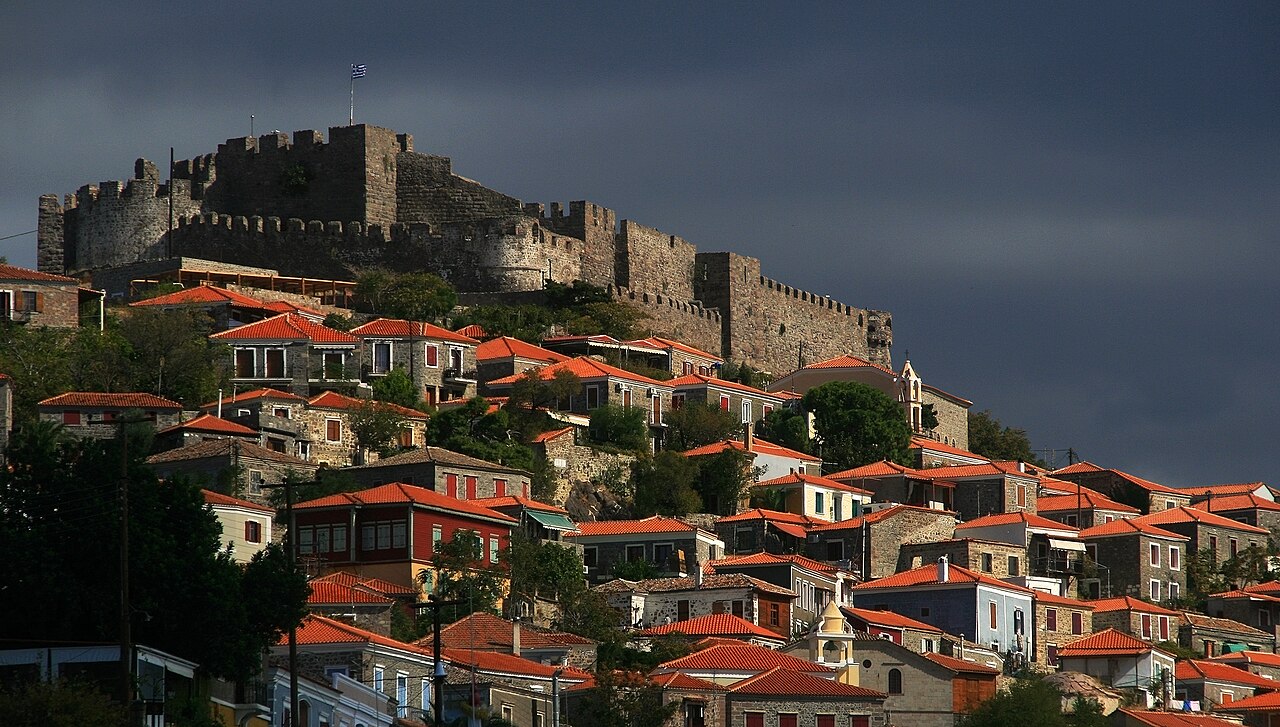
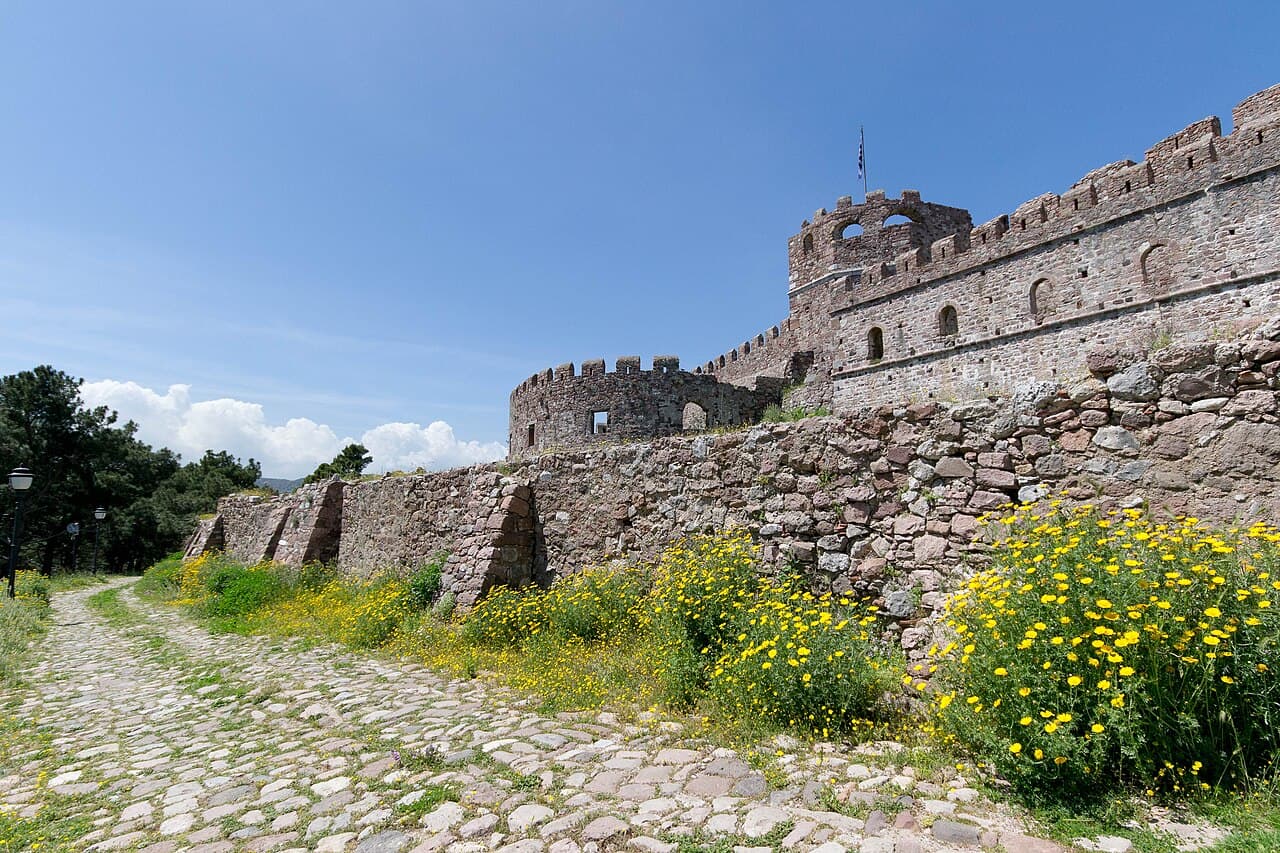
The Castle of Mytilene, also known as the Fortress of Mytilene, is a monumental hill castle located in the city of Mytilene on the Greek island of Lesbos in the North Aegean. Covering approximately 60 hectares, it ranks among the largest castles in the Mediterranean. The castle's strategic position atop a hill dominating the city and its harbors has made it a key defensive and administrative center throughout its long history.
The castle's origins trace back to the 6th century AD during the reign of Byzantine Emperor Justinian I (527–565), who ordered the construction of a fortress on the site of an ancient acropolis. This early fortification incorporated materials from classical structures, notably the ancient theater of Mytilene, reflecting the continuity of settlement and defense on this prominent hill. The fortress served as a crucial military stronghold and administrative hub for the Byzantine Empire, safeguarding the island and controlling maritime routes in the Aegean Sea.
Byzantine foundations and early medieval fortifications
The initial construction phase under Emperor Justinian I established the castle's core defensive walls and towers, designed to withstand sieges and protect the local population. The Byzantine builders skillfully reused stones from earlier classical buildings, integrating them into the new fortifications. The castle's layout included the Upper Castle or Acropolis, which housed the main defensive towers and administrative buildings, and the Middle Castle, which connected the fortifications to the city and port.
Throughout the early medieval period, the castle was periodically repaired and reinforced in response to regional conflicts and natural disasters. Notably, it endured a significant earthquake in 1384, which caused damage to the walls and necessitated restoration efforts. This resilience reflects the castle's strategic importance in the Byzantine defensive network across the Aegean islands.
The gattilusio family's influence and late medieval expansions
In the mid-14th century, the castle came under the control of the Genoese Gattilusio family, who ruled Lesbos as a semi-independent lordship. Around 1373, Francesco I Gattilusio initiated extensive reconstruction and expansion projects that transformed the fortress into a fortified noble residence. The Gattilusio enhancements included strengthening the walls, adding new residential quarters, and erecting symbolic features such as coats of arms and Latin inscriptions that asserted their authority.
The family's architectural contributions are evident in the Queen's Tower, also known as the Tower of Vassilopoula, which bears their heraldic emblems. They also adapted existing structures, such as the church dedicated to St. John, reflecting the castle's evolving religious and cultural functions during Genoese rule. Their tenure marked a period of relative stability and prosperity, with the castle serving as both a military bastion and a noble seat.
Ottoman conquest and architectural transformations
The castle was captured by the Ottoman Empire in 1462, ushering in a new era of architectural and functional changes. The Ottomans undertook significant modifications to the fortress, including the construction of religious and communal buildings such as a hammam (public bath), a tekke (Sufi lodge), and a madrasa (Islamic school). These additions reflect the integration of Ottoman cultural and religious practices within the castle complex.
Military infrastructure was also enhanced with the building of a powder magazine, a military hospital and prison, and the expansion of fortifications with the Lower Castle (Saplitza) in 1644 under Sultan Ibrahim Khan. The Lower Castle was strategically designed to protect the northern harbor, Epano Skala, featuring a large circular tower and multiple watchtowers guarding the harbor entrances.
Ottoman restoration efforts followed damage from natural disasters and conflicts, including the Venetian-Ottoman wars at the turn of the 16th century. Notable restorers included Sultan Bayezid II in 1501 and Bekir Pasha in the 1640s, who modernized the fortifications to meet contemporary military needs. The castle's Ottoman period is characterized by a blend of defensive, residential, and religious architecture, illustrating its multifaceted role.
Architectural features and layout of the castle complex
Upper castle (acropolis)
The Upper Castle occupies the southern and western sectors of the fortress, dominating the skyline with its five defensive towers and imposing walls. This area includes the Central Western Gate and the Tower of Vassilopoula, which prominently displays the Gattilusio coat of arms. The ruins of the Ottoman-era Kule Mosque stand on the site of a former Genoese church dedicated to St. John, highlighting the site's layered religious history.
At the highest point, known as the Great Enclosure or Acropolis, the castle was fortified with a moat and a drawbridge. The eastern tower served as the official residence, while the central courtyard, the plateia magna, hosted the curia or ruling council. Adjacent to this courtyard were the Loggia, a gathering place for the nobility, and the Chancellery, the administrative office. The Loggia site now contains an Ottoman powder magazine with a distinctive pent-style roof and a façade featuring five arches.
Beneath the southern defensive wall lies an extensive network of vaulted crypts covering approximately 600 square meters. These crypts, connected by arched openings and equipped with ventilation and lighting, were historically used as shelters and later repurposed as military barracks after 1912.
Middle castle
The Middle Castle is accessed through the Ottoman Orta Kapu gate, built in 1644 and flanked by a circular tower replacing an earlier square fortification. The Gattilusio Gate, dated to 1373, forms the northwest boundary of earlier fortifications and connects the port with the city. This gate is protected by a Byzantine square tower that incorporates a Roman relief of a gladiator, a unique decorative element symbolizing the site's ancient heritage.
Within the Middle Castle lies a large semi-subterranean cistern or kinsterna, originally Byzantine but rebuilt during the Ottoman period. This cistern, capable of holding around 400 cubic meters of rainwater, was ingeniously designed with three chambers to settle sediments and prevent overflow, ensuring a reliable water supply during sieges.
The Middle Castle also housed several Ottoman-era residences, including a near-square building arranged around a central courtyard with hearths, latrines, and storage facilities. The madrasa founded by Admiral Hayreddin Barbarossa in the 16th century was a prominent two-story U-shaped complex with domed rooms, a prayer hall with a mihrab, and an imaret or public kitchen, reflecting the castle's role as a center of religious education and social welfare.
Additional Ottoman structures included a bathhouse with a vaulted rectangular design and wall vents for heat distribution, and a Bektashi tekke distinguished by an octagonal dome and central hearth. The powder magazine near the road to the Upper Castle features a monumental arched entrance with a marble plaque inscribed with Quranic verses, emphasizing its sacred and military significance.
Opposite the powder magazine, a complex comprising a military hospital and prison is arranged around a courtyard and protected by a gate within a tower-like structure. The basement served as a detention area. This building is attributed to the architect Musa Baba, active in the mid-17th century.
Lower castle (saplitza)
The Lower Castle, known as Saplitza, was constructed primarily in the early 16th century and expanded in 1644 to defend the northern harbor. It features robust fortifications including a large circular tower overseeing harbor entrances and a main gate flanked by two smaller watchtowers. This section also contained a 17th-century Ottoman bathhouse, a fountain, and the chapel of Panagia Galousa.
Historically, the Lower Castle area supported a small community of about eighty houses, many inhabited by Greek refugees from Asia Minor, reflecting the castle's role as a living fortress with civilian populations. Secondary defensive towers such as Varvakana, Panagia, Loranda, and Kastreli (Bourtzi) guarded the harbor approaches, with Kastreli now marked by the Statue of Liberty at the southern harbor pier.
Archaeological discoveries and restoration efforts
Archaeological excavations beginning in 1913, led by Nikolaos Kyparissis and later by the Canadian Archaeological Institute in the 1980s, have uncovered significant remains within the castle, including the sanctuary of Demeter and Kore, the Gattilusio church, and numerous ceramic artifacts spanning from the Hellenistic through Ottoman periods. These finds highlight the castle's continuous occupation and cultural exchanges across centuries.
Since the 1930s, systematic restoration and conservation projects have been undertaken to stabilize the castle's walls, gates, and key buildings. Supported by the Greek government and the European Union, these efforts have preserved the fortress as a cultural landmark and tourist attraction, allowing visitors to explore its complex history and architectural evolution.
Today, the Castle of Mytilene stands as a well-preserved example of layered Mediterranean fortifications, reflecting Byzantine, Genoese, and Ottoman influences. Its vast area, diverse architectural features, and rich archaeological record make it a significant monument of medieval and early modern military architecture in Greece.
Frequently asked questions (FAQ)
- How do I get to the Castle of Mytilene?
- The Castle of Mytilene is located in the city of Mytilene on Lesbos island. It is accessible by foot from the city center, with clear signage directing visitors to the fortress entrance.
- What is the historical significance of the Castle of Mytilene?
- The castle has a long history dating back to the 6th century Byzantine period and showcases architectural layers from Byzantine, Genoese, and Ottoman rule, reflecting its strategic importance in the Aegean.
- When is the best time to visit the Castle of Mytilene?
- Spring and autumn offer mild weather and fewer tourists, ideal for exploring the extensive castle grounds and archaeological sites comfortably.
- Are there guided tours available at the Castle of Mytilene?
- Guided tours are offered by local tourism agencies and sometimes by the castle's managing authorities, providing detailed insights into the castle's history and architecture.
- Can I explore all parts of the Castle of Mytilene?
- Most sections of the castle are open to visitors, including the Upper, Middle, and Lower Castles, though some areas may be restricted for safety or conservation reasons.
Photo gallery

Information
Current owner
Greek government
Loading map...
Visitor reviews
No reviews yet. Been here? Write the first review and help other travelers!
Write the first reviewVisited this castle? Share your experience
Your review helps other travelers and adds first-hand knowledge to our encyclopedia.