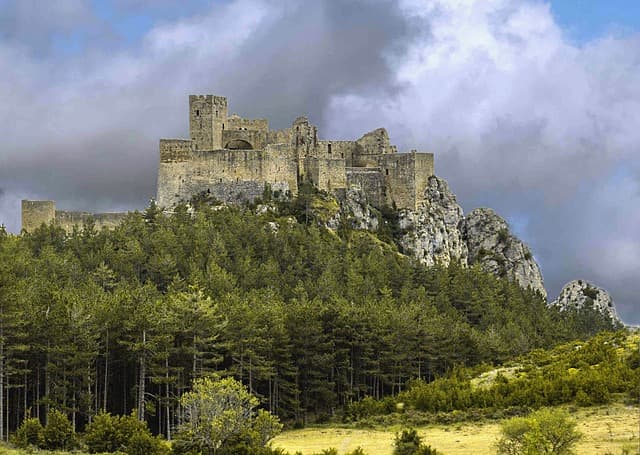
Castle of Loarre
The Castle of Loarre stands as a remarkable example of Romanesque military architecture in Spain, dating back to the 11th century. Perched on a prominent limestone outcrop near the town of Loarre in the Aragon region, this fortress commands sweeping views over the Hoya de Huesca plain. Its strategic location on the frontier between Christian and Muslim territories during the Reconquista imbued it with significant military importance. The castle's robust construction and excellent preservation make it one of the oldest and most impressive castles in Spain.
Construction of the castle began between 1033 and 1035 under King Sancho III of Pamplona, also known as Sancho Garcés III. It was designed as a defensive stronghold to protect Christian lands and to serve as a base for military campaigns against Muslim-held territories. The castle's position atop a rocky promontory provided natural defenses that were enhanced by formidable curtain walls and towers, making it difficult to besiege or undermine.
Architectural design and layout
The castle's layout is shaped by the rocky terrain, resulting in a complex rather than a single unified structure. It consists of multiple buildings enclosed within curtain walls that stretch approximately 172 meters in perimeter, enclosing an area of about 10,000 square meters. The walls are reinforced by semicircular towers spaced irregularly, each rising two to three stories high. These towers, measuring between 3.2 and 4.5 meters in diameter, provided vantage points for archers and defenders.
The main entrance, known as the Puerta de los Reyes, is a rectangular Romanesque gate featuring three stacked semicircular arches adorned with intricately carved capitals depicting plant motifs. Though the original tympanum once displayed a Pantocrator image symbolizing Christ as ruler of the universe, much of this detail was lost during restoration efforts in the 20th century. Beyond the gate, a grand staircase with a barrel vault ceiling and a checkerboard stone pattern leads visitors into the castle's interior.
Religious elements within the fortress
In addition to its military functions, the Castle of Loarre also served religious purposes. Around 1071, King Sancho Ramírez expanded the fortress by founding a monastery of Augustinian canons within its walls. This religious establishment received papal approval from Pope Alexander II, blending spiritual life with the castle's defensive role. The church of San Pedro, located above the crypt of Santa Quiteria, is a highlight of the complex. This Romanesque church features a single nave with a semicircular apse decorated with engaged columns and capitals carved with biblical and vegetal motifs. A striking dome, rising 26 meters high, connects the nave and apse, an unusual architectural feature for Romanesque buildings.
The crypt of Santa Quiteria, situated adjacent to the church, served as a burial place and is noted for its exceptional acoustics. This semicircular crypt includes a rectangular nave and apse, demonstrating the blend of religious and defensive architecture within the castle.
Historical significance and events
The Castle of Loarre played a pivotal role during the Reconquista, acting as a frontier fortress that safeguarded Christian territories. Its military importance waned as Christian forces advanced and expelled Muslim powers from the region. In the 15th century, the castle was involved in the revolt of the Count of Urgel. During the siege of 1413, the fortress was defended by Abbess Violante de Luna, who resisted royal forces for a time before the castle ultimately fell.
Following the decline of its military role, the population living near the castle relocated to the current village of Loarre, repurposing stones from the fortress for new construction. Despite this, the castle remained remarkably well-preserved, a testament to its sturdy Romanesque construction.
Archaeological layers and preservation
The site of the Castle of Loarre is rich in archaeological significance, with evidence of earlier Roman occupation indicated by coins and remains from the settlement of Calagurris Fibularia. Islamic influences are also present, reflecting the region's complex history of cultural transitions. These layers are integrated into the castle's structure, providing insight into the site's long-term strategic importance.
Declared a National Monument in 1906, the castle is currently under the care of regional authorities who aim to secure its designation as a UNESCO World Heritage Site. Its excellent state of preservation allows visitors to experience a vivid sense of medieval life and architecture.
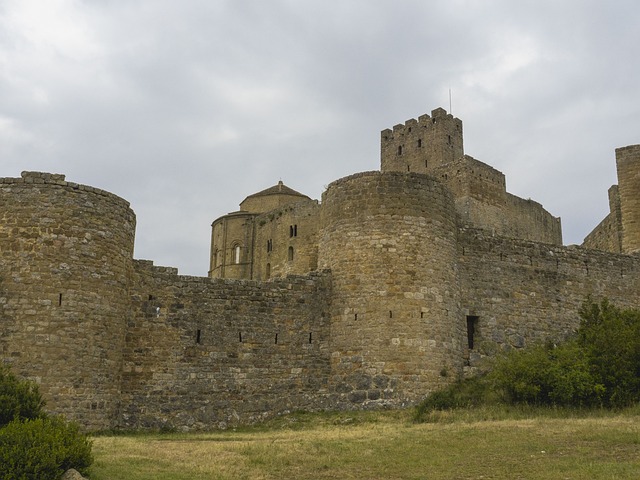
Photo by matressa_
Notable architectural features and visitor experience
The castle's defensive walls are punctuated by the Queen's Tower near the military entrance, which served as a stronghold. The main keep, or tower of homage, rises 22 meters tall with five floors and was once connected to the rest of the fortress by a drawbridge. This tower offers panoramic views of the surrounding landscape and the former village below.
Within the castle, visitors can explore the living quarters of canons and nobles, the dungeon that doubled as storage, an armory, and the older Church of Santa María. A large cistern capable of holding 8,000 liters of water ensured the fortress could withstand prolonged sieges. The castle's mullioned windows provide scenic views and natural light to the interior spaces.
For those interested in history and architecture, an audio guide is recommended to fully appreciate the castle's complex layout, artistic details, and historical context. The castle's dramatic silhouette against the landscape has also made it a popular filming location, notably featured in Ridley Scott's 2005 film "Kingdom of Heaven".
Surrounded by a small leafy forest and situated on a limestone promontory, the Castle of Loarre remains a captivating destination for visitors seeking to explore one of Spain's finest Romanesque fortresses.
Frequently asked questions (FAQ)
- What is the historical significance of Castle of Loarre?
- The Castle of Loarre is one of the best-preserved Romanesque castles in Spain, dating back to the 11th century. It played a crucial role in the defense of the Christian kingdoms against Muslim forces during the Reconquista, showcasing the military architecture of its time.
- When was the Castle of Loarre built?
- Construction of the Castle of Loarre began in the year 1020, and it was completed in the 12th century. Its strategic location and robust design were essential in protecting the region during the turbulent periods of medieval warfare.
- What are the opening hours for the Castle of Loarre?
- The Castle of Loarre is typically open to visitors from 10:00 AM to 6:00 PM daily, with extended hours during the summer months. It is advisable to check the official website for any seasonal changes or special closures before planning your visit.
- Can I access the Castle of Loarre with public transportation?
- Yes, the Castle of Loarre is accessible by public transportation, though options may be limited. Visitors can take a bus from nearby towns such as Huesca and then either walk or take a taxi to the castle.
- What are the ticket prices for visiting the Castle of Loarre?
- As of the latest information, tickets to the Castle of Loarre are priced at around €6 for adults, with discounts available for children and seniors. It's a good idea to check for any special promotions or free entry days before your visit.
- Is it possible to take guided tours of the Castle of Loarre?
- Yes, guided tours are available at the Castle of Loarre, providing visitors with a deeper understanding of its history and architecture. These tours often include access to areas that are not available to general visitors, making for a more enriching experience.
- When is the best time to visit the Castle of Loarre?
- The best time to visit the Castle of Loarre is during the spring and fall months when the weather is mild and pleasant for exploring. Additionally, these seasons tend to have fewer tourists, allowing for a more peaceful experience.
- Are there any nearby attractions to visit along with the Castle of Loarre?
- Yes, nearby attractions include the charming village of Loarre and the stunning landscapes of the Sierra de Guara Natural Park. Visitors can also explore other historical sites in the region that reflect the rich cultural heritage of Aragon.
- Is there parking available at the Castle of Loarre?
- Yes, there is designated parking available near the Castle of Loarre for visitors. It is advisable to arrive early during peak tourist seasons to secure a parking spot, as the area can become crowded.
Photo gallery

Photo by matressa_


Information
Website
Visit websiteSources & official resources
Verify the information above using these authoritative references.
Loading map...
Visitor reviews
No reviews yet. Been here? Write the first review and help other travelers!
Write the first reviewVisited this castle? Share your experience
Your review helps other travelers and adds first-hand knowledge to our encyclopedia.



