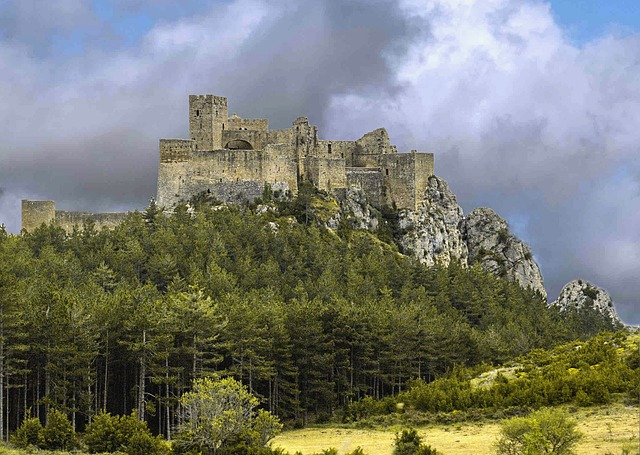
Castillo de la Corona
The Castillo de la Corona stands as a significant medieval fortress located in Almudévar, Spain. Its origins are deeply rooted in the Islamic period of the Iberian Peninsula, with its name deriving from the Arabic word meaning “The Round,” a reference to the original circular fortress built by Muslim occupants. This castle exemplifies the complex historical layers typical of many Spanish fortifications, where military, religious, and residential functions overlapped and evolved over centuries.
Initially established as a Muslim stronghold, the castle's strategic position atop a hill provided commanding views over the surrounding landscape, crucial for defense and control. By the late 11th century, specifically in 1083, the town of Almudévar recognized the authority of Sancho Ramírez, paying tribute to him during a period of shifting power dynamics between Muslim and Christian rulers. The Chronicle of San Juan de la Peña records that King Pedro I reached Almudévar during his southern military campaign near the end of the 11th century. However, the Christian reconquest of the castle itself was not completed until 1118, marking a pivotal moment in the region's transition from Muslim to Christian control.
Medieval transformations and religious significance
During the latter half of the 12th century, the castle and its surrounding settlement underwent significant administrative and religious changes. In 1170, Alfonso II granted a charter to Almudévar, elevating it to the status of a royal town governed by tenentes, royal representatives who administered the territory. This charter allowed the local population to repurpose the remains of the Muslim fortress for religious purposes. Between 1184 and 1231, a church dedicated to the Virgin of La Corona was constructed on the site, following the austere and functional architectural style of the Cistercian order, a reformist branch of the Benedictine monks known for their emphasis on simplicity and purity in design.
The church's architecture retains distinctive elements characteristic of Cistercian construction, such as the springing points of the vaults, where the arches begin to curve, indicating the original medieval vaulting system. This religious building was later enlarged in the 16th century with the addition of chapels accessible from a side nave, reflecting the continued importance of the site as a place of worship and community gathering.
Political importance and architectural evolution
The castle remained an important political and military site throughout the medieval period. In 1364, it was the venue for a secretive meeting involving Charles II of Navarre, Henry of Trastámara, and the Queen of Aragon. This meeting was part of a conspiracy to depose Pedro I of Castile, known as Pedro the Cruel, underscoring the strategic significance of the castle in the complex power struggles of 14th-century Iberia.
Over the following centuries, the castle complex saw architectural adaptations that reflected changing political, military, and religious needs. During the 16th century, expansions included the introduction of Renaissance features, such as a brick arcade gallery atop the castle's keep, which was a departure from the original medieval military architecture. Additionally, Baroque elements were incorporated, notably the construction of a hermitage dedicated to the Virgin of La Corona. This hermitage illustrates the site's gradual shift from a purely defensive fortress to a location with devotional and residential functions.
Architectural features and remains
Perched on a hill overlooking Almudévar, the Castillo de la Corona presents a complex architectural ensemble spanning from the 12th to the 16th centuries. The site combines military fortifications with religious and residential buildings, creating a distinctive silhouette visible across the surrounding countryside.
The keep and fortifications
The castle's defensive core is the keep, or torre del homenaje, a rectangular tower measuring approximately 13 by 5.5 meters at its base and rising to about 15 meters in height. The walls are constructed from roughly cut stone blocks known as sillarejo, providing a robust but irregular masonry surface. Critical structural points were reinforced with precisely cut ashlar blocks to enhance stability. The 16th-century addition of a brick arcade gallery atop the keep reflects Renaissance architectural influence and a shift towards more refined aesthetics and comfort.
The castle's defensive walls include two low rectangular towers that once formed part of the fortifications. The main entrance, located at the western end, features a semicircular arch made from large wedge-shaped stones called voussoirs. The keystone of this arch bears a coat of arms and the date 1584, marking the period of construction or renovation of this gateway.
Religious buildings
The former church, built in the Cistercian style, remains the most prominent surviving structure. Its original medieval vaulting elements are still visible, highlighting the simplicity and austerity typical of Cistercian architecture. The 16th-century chapels added to the church illustrate the evolving religious practices and the growing importance of the site as a place of worship.
The later Baroque hermitage dedicated to the Virgin of La Corona adds another architectural layer to the site. This hermitage reflects the devotional needs of the community during the Baroque period and demonstrates the castle complex's adaptation from military fortress to religious sanctuary.
Historical and cultural significance
The Castillo de la Corona is a valuable example of the layered history of Spanish castles, where Islamic, medieval Christian, Renaissance, and Baroque elements coexist. Its strategic location and role in significant historical events, such as the 14th-century political conspiracies, highlight its importance in regional history.
Today, the castle remains a partially preserved monument that offers insights into the military, religious, and social transformations that occurred in the region over several centuries. Its architectural features provide a tangible connection to the past, illustrating the evolution of castle construction and use from the 12th century through the 16th century.
Frequently asked questions (FAQ)
- How do I get to Castillo de la Corona?
- You can reach Castillo de la Corona by car or public transportation. The castle is located in Almudévar, which is easily accessible from major cities like Huesca and Zaragoza. There are also local bus services that connect to the nearby towns.
- What is the historical significance of Castillo de la Corona?
- Castillo de la Corona dates back to the 12th century and played a crucial role in the defensive architecture of the region during the Middle Ages. It has been a witness to various historical events, including conflicts between kingdoms. Today, it stands as a symbol of the cultural heritage of Almudévar.
- When was Castillo de la Corona built?
- Construction of Castillo de la Corona began in the early 12th century, making it one of the oldest structures in the area. Over the years, it has undergone several renovations and restorations to preserve its historical integrity. Its architecture reflects the military styles of its time.
- Can I take photographs inside Castillo de la Corona?
- Yes, photography is allowed inside Castillo de la Corona, but be mindful of any specific rules during special exhibitions or events. Capturing the stunning views from the castle and its architectural details is a great way to remember your visit. Just be sure to respect other visitors while taking photos.
- Why is Castillo de la Corona a popular tourist attraction?
- Castillo de la Corona attracts visitors for its rich history, impressive architecture, and picturesque surroundings. The castle offers stunning views of the surrounding landscape, making it a perfect spot for photography and exploration. Additionally, it hosts various cultural events that draw in tourists throughout the year.
- Is it possible to access Castillo de la Corona with a wheelchair?
- Yes, Castillo de la Corona has made efforts to improve accessibility for all visitors. While some areas may have limitations due to the castle's historical structure, there are pathways and ramps that allow wheelchair users to explore significant parts of the castle. It is advisable to check ahead for specific accessibility options.
- What are the opening hours for Castillo de la Corona?
- Castillo de la Corona is typically open to visitors from 10 AM to 6 PM, with extended hours during the summer months. However, it is recommended to check the official website or contact the castle directly for any seasonal changes or special closures. This ensures you plan your visit accordingly.
- What are the ticket prices for Castillo de la Corona?
- Tickets for Castillo de la Corona are generally affordable, with discounts available for students, seniors, and children. Adult tickets typically cost around €5, while children under 12 may enter for free. Special group rates and guided tours are also available, enhancing the overall experience.
- What is the best time to visit Castillo de la Corona?
- The best time to visit Castillo de la Corona is during the spring and fall when the weather is mild and pleasant. These seasons provide a comfortable environment for exploring the castle and enjoying the surrounding gardens. Additionally, fewer tourists during these times allow for a more intimate experience.
- Are there any nearby attractions to visit along with Castillo de la Corona?
- Yes, there are several attractions near Castillo de la Corona, including the charming town of Almudévar itself, known for its local cuisine and cultural sites. Nearby, you can also visit the natural parks and hiking trails that showcase the beautiful landscapes of the region. These attractions make for a full day of exploration.
Information
Loading map...
Visitor reviews
No reviews yet. Been here? Write the first review and help other travelers!
Write the first reviewVisited this castle? Share your experience
Your review helps other travelers and adds first-hand knowledge to our encyclopedia.