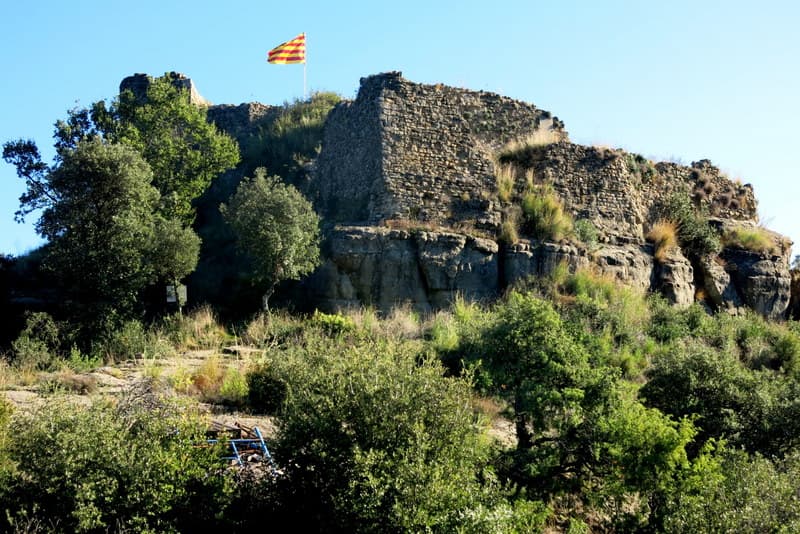
The castle of Hostoles stands as a remarkable example of a medieval rock fortress strategically perched atop the Puig de les Forques, a rocky outcrop in the municipality of Les Planes d’Hostoles, Catalonia, Spain. Constructed initially by early medieval Catalan builders between the 9th and 10th centuries, the castle occupies a commanding position overlooking the Hostoles valley along the Brugent river. Its location provided natural protection on nearly all sides, with only the southern approach fortified, making it a significant defensive stronghold in the region.
The fortress reflects a long history of architectural evolution and political significance, spanning several centuries of Catalan medieval history. It was a key site within the County of Girona during the early 11th century and later experienced shifting allegiances and ownership among prominent noble families such as the Hostoles lineage, the Counts of Besalú, and the Rocabertí family. The castle's history is intertwined with the feudal struggles, local conflicts, and broader Catalan political dynamics, including its role during the Catalan civil war (1462–1472) and the peasant revolts led by the remences.
Historical context and ownership
Initially, the castle was under the influence of the County of Girona, but it occasionally came under the sway of Bernard Taillefer, Count of Besalú. In 1017, the castellan Mir d’Hostoles pledged allegiance to the Count of Barcelona, marking the castle's integration into the expanding Catalan political framework. His son, Enees Mir, reaffirmed loyalty to Count Ramon Berenguer I and Countess Almodis, as documented in the Liber feudorum maior, a key medieval collection of feudal contracts. Throughout the 11th century, various members of the Hostoles family appear in records, including Galceran d’Hostoles who swore fealty to Bernard II, Count of Besalú.
By the 12th century, the lordship had passed to dapifer Guillem Ramon I and later to his son Ot around 1120, while descendants of Mir d’Hostoles continued to manage the castle's defenses. The 13th century saw the castle's ownership shift through marriage when Dolça d’Hostoles married Galceran de Cartellà, a prominent noble from Girona’s county. Their son, Guillem Galceran, held the lordship until approximately 1290.
The castle was a focal point of local conflicts, including assaults in 1259 involving the young Pere, a minor at the time. The lords of Hostoles were known for their harsh rule, which led to punishments such as excommunication and the loss of privileges related to peace and truce. Despite these tensions, in 1285, a lord of the castle fought alongside the Catalan king against invading French crusaders. By 1313, control passed through marriage into the Rocabertí family.
Religious significance and later history
Religious life at the castle is evidenced by the chapel dedicated to Saint Guerau, mentioned as early as 1319, though its physical remains have not yet been identified archaeologically. The castle maintained its strategic importance into the 15th century, notably during the Catalan civil war (1462–1472). In 1463, the fortress was occupied by remences peasants, rebellious serfs who challenged feudal authority. The castle was absorbed into royal possession in 1471, and in 1474 it was granted to Francesc de Verntallat, a leader of the remences. However, the Sentencia de Guadalupe of 1486 legally returned ownership permanently to the crown.
Following these events, the castle declined in military significance and gradually fell into ruin. Over subsequent centuries, it served as shelter for shepherds and smugglers, reflecting its diminished role in regional defense. Archaeological interest and restoration efforts began in 2011 under the auspices of the Girona provincial government, aiming to preserve and study the site’s rich historical layers.
Architectural features and fortifications
Location and defensive advantages
The castle of Hostoles is situated on a natural rocky outcrop, Puig de les Forques, which provides formidable natural defenses. The site’s steep cliffs and rocky terrain protect it on nearly all sides, with the only accessible approach from the south heavily fortified to control access and resist assault.
Multi-period fortifications
The fortress comprises three distinct enclosures, each constructed during different historical periods, illustrating the castle's architectural evolution and adaptation to changing military needs.
First enclosure: the keep and early structures
The oldest section, dating from the 11th to 15th centuries, includes the castle’s keep, originally circular but now semicircular, likely due to earthquake damage in the 15th century. At the base of the keep lies a rectangular cistern covered by a stone vault and sealed with opus signinum, a waterproof mortar made from crushed tiles and lime, designed to preserve water supplies vital during sieges.
Nearby are the remains of a rectangular building accessed by semicircular stairs, probably used as the lord’s residence. This structure likely contained one or two upper floors, providing living quarters within the fortified area. To the north, a long rectangular hall shows evidence of productive activity, including a millstone, indicating the castle was not only a military site but also a center of local economic activity.
The enclosure is surrounded by large defensive walls, some of which predate the 11th century, suggesting that earlier fortifications were incorporated into later medieval constructions.
Second enclosure: courtyard and defensive design
Connected to the first enclosure by a stone staircase carved into the bedrock, the second enclosure is a rectangular courtyard featuring a rectangular tower or hall on its western side. This tower is equipped with arrow slits, narrow vertical openings allowing defenders to shoot while remaining protected. The defensive layout forced attackers to follow a narrow, zigzagging path, exposing their unshielded right side and enhancing the defenders’ tactical advantage.
The oldest parts of this enclosure’s walls date to the 12th and 13th centuries, while the upper sections were reconstructed in the 14th and 15th centuries using stone quarried directly from the rocky base, integrating the fortress with its natural foundation.
Third enclosure: later fortifications and water management
About ten meters downhill from the main fortress lies the third enclosure, dating to the 14th or 15th centuries. This section was built to block passage and control access, forming an additional courtyard. Adjacent to this enclosure is a large cistern with a pointed stone vault, partially preserved despite some ruin.
The cistern’s water supply was ingeniously managed by gravity, with water entering through a side opening fed by the natural slope. This design ensured a reliable water source during sieges, a critical feature for sustaining the castle’s inhabitants.
Archaeological significance and preservation efforts
The castle’s layered construction phases and well-preserved defensive features provide valuable insights into medieval Catalan military architecture and feudal society. The integration of natural rock formations with man-made fortifications illustrates the strategic use of landscape in castle design.
Since archaeological investigations and restoration began in 2011, efforts have focused on stabilizing the ruins, uncovering architectural elements, and interpreting the site’s historical significance. These endeavors aim to enhance public understanding of the castle’s role in regional history and medieval fortification techniques.
Although the chapel dedicated to Saint Guerau has not yet been located, ongoing research may reveal further details about the castle’s religious functions. The castle of Hostoles remains a testament to the dynamic history of Catalonia’s medieval period, reflecting centuries of political change, military innovation, and social transformation.
Photo gallery

Information
Website
Visit websiteSources & official resources
Verify the information above using these authoritative references.
Loading map...
Visitor reviews
No reviews yet. Been here? Write the first review and help other travelers!
Write the first reviewVisited this castle? Share your experience
Your review helps other travelers and adds first-hand knowledge to our encyclopedia.



