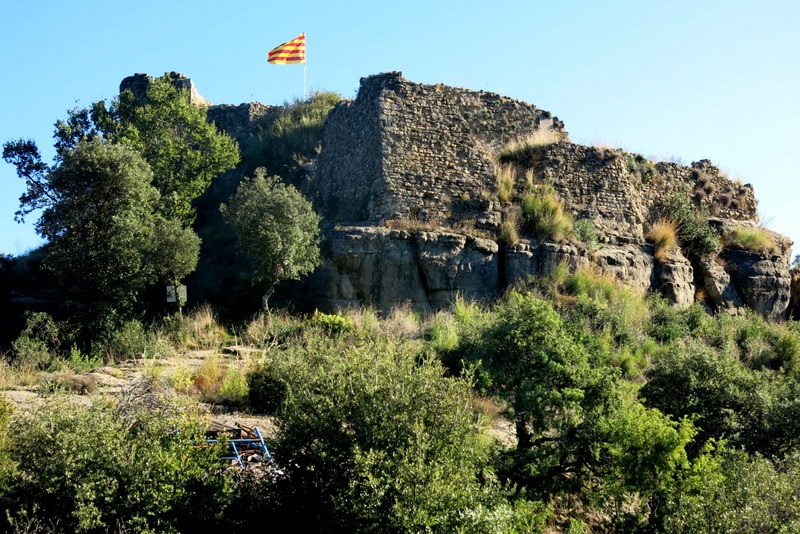
Castell de Rupit
Castell de Rupit is a significant medieval hill castle located in the municipality of Rupit i Pruit, within the Catalonia region of Spain. This fortress stands atop a rocky outcrop at the heart of the village of Rupit, offering commanding views of the surrounding landscape. Its origins trace back to the early medieval period, evolving through centuries of noble ownership and architectural adaptation.
Early history and origins
The castle succeeded an earlier fortification known as Castell de Fàbregues, first documented in 968. This original castle was part of the County of Osona, a territory reestablished by the nobleman Wifred the Hairy at the end of the 9th century. By the early 11th century, Castell de Fàbregues was abandoned, and its lands divided into two jurisdictions. One centered on the newly established Castell de Rupit, overseeing the parishes of Rupit, Pruit, and Sant Joan de Fàbregues, while the other was organized around Castell de Fornils, covering Sant Martí and Susqueda.
The first recorded mention of Castell de Rupit dates to 1040 in the will of Bishop-Viscount Eribau, a member of the influential Osona-Cardona family. The castle thus became a prominent seat of feudal power in the region, reflecting the complex political and territorial divisions typical of medieval Catalonia.
Ownership and noble lineage
For over two centuries, the castle was administered by the Viscounts of Cardona. In 1276, Ramon Folc V de Cardona transferred control to his son Bernat Amat, who later passed it to his own son, Ramon Amat. The castle then passed to Sibila, Ramon Amat's sister, married to Ramon Roger II of Pallars. This alliance brought the castle under the Counts of Pallars until 1369, when Gilabert VI de Cruïlles purchased Rupit and Fornils from his nephew Huguet de Pallars.
Subsequent centuries saw the castle pass through various noble families including Vilademany, Perapertusa, and by the mid-17th century, it came into the possession of Benjamin de Bournonville, Marquis of Risbourg. In 1681, King Charles II of Spain granted Antonio de Bournonville the title of Marquis of Rupit. Marriages later linked the estate with the Counts of Aranda and the Dukes of Híjar, embedding the castle's legacy into prominent noble lineages.
Military significance and decline
Castell de Rupit survived the Catalan Civil War (1462-1472) under King John II of Aragon, a turbulent period that tested many fortresses in the region. However, after this conflict, the castle gradually diminished in strategic importance and eventually fell into ruin. The exact date of its decline is unclear, but it faded from historical records in the late medieval period.
Documentation about the castle's administration is sparse. Notably, a woman named Guillerma, widow of Anglès de Rupit, and her son Anglès are recorded as castellans in 1286. The next known custodian was Juan de Malart, who transferred the keepership rights to Onofre Olmera in the 16th century.
Architectural features and remains
The castle ruins occupy a rocky, uneven outcrop behind the local parish church, surrounded by the tightly clustered houses of Rupit village. The archaeological remains reveal an enclosed area of approximately 300 square meters, defined by walls constructed of small but well-cut stones.
A particularly notable surviving feature is a massive wall approximately 5 meters thick, 8 meters high, and 2 meters deep. This wall is built of carefully cut ashlar stone blocks laid both lengthwise and crosswise, with no openings, and rests directly on the rocky foundation. An arch-shaped relieving structure helps distribute the wall's weight over a prominent rock protrusion beneath, demonstrating advanced medieval engineering techniques.
Additional fragments of defensive walls extend eastward from the main site, integrating into the village's street layout. These walls originally enclosed both the upper sovereign area and lower subordinate zones, forming a comprehensive fortification system. Various sections of the perimeter and interior walls remain visible at different heights, while others are buried beneath the village slope and buildings.
Some village houses incorporate parts of the castle's lower enclosure within their foundations, preserving hidden layers of the fortress's original defensive boundaries. The remains include all known components typical of medieval castles, such as towers, gateways, moats, and curtain walls, although many survive only as fragments or buried ruins.
Cultural and heritage significance
Today, Castell de Rupit stands as a testament to the medieval history of Catalonia and the feudal nobility that shaped the region. Its ruins offer valuable insights into medieval military architecture and the sociopolitical landscape of the time. The castle's integration into the village fabric highlights the evolving relationship between fortifications and community development.
Visitors to Rupit can explore the village's charming streets and observe the castle remains, appreciating the blend of natural rock formations and human craftsmanship that characterize this historic site. Although access to some parts of the castle is limited due to the surrounding buildings, the site remains a focal point for cultural heritage and historical study.
Visiting information
While Castell de Rupit is primarily a ruin, it is accessible to visitors interested in medieval history and architecture. The castle's hilltop location provides scenic views and a tangible connection to Catalonia's feudal past. Visitors should be prepared for uneven terrain and limited facilities at the site. The village of Rupit offers accommodations and amenities for tourists exploring the region.
Frequently asked questions (FAQ)
- How do I get to Castell de Rupit?
- Castell de Rupit is located in the picturesque village of Rupit i Pruit, accessible by car or public transport from major cities like Barcelona. The nearest train station is in the town of Manlleu, from where you can take a bus or taxi to reach the castle. Be sure to check the local bus schedules for the most convenient travel times.
- What is the historical significance of Castell de Rupit?
- Castell de Rupit dates back to the 11th century and served as a strategic fortress during the medieval period. It played a vital role in defending the region against invasions and has witnessed many historical events over the centuries. Today, it stands as a symbol of the rich cultural heritage and history of Catalonia.
- Can I visit Castell de Rupit year-round?
- Yes, Castell de Rupit is open to visitors throughout the year, though opening hours may vary by season. It’s best to check the official website or local tourist information for the exact times before your visit. This ensures you have the best experience exploring the castle and its surroundings.
- Is it possible to explore the architecture of the castle?
- Absolutely! The architecture of Castell de Rupit features a blend of Romanesque and Gothic styles, showcasing its historical evolution. Visitors can stroll through the castle grounds and admire the intricate stonework, towers, and panoramic views of the surrounding landscape, making it a perfect spot for photography enthusiasts.
- When is the best time to visit Castell de Rupit?
- The best time to visit Castell de Rupit is during the spring and early autumn when the weather is mild and pleasant. This allows for comfortable exploration of the castle and its scenic surroundings. Additionally, these seasons often feature fewer crowds compared to the summer months.
- What are the ticket prices for entering Castell de Rupit?
- Ticket prices for Castell de Rupit are typically affordable, with discounts available for students and seniors. Children under a certain age may enter for free. It’s advisable to check the official website for the most current pricing and any special offers that may be available during your visit.
- What are the opening hours of Castell de Rupit?
- Castell de Rupit generally opens at 10:00 AM and closes at 6:00 PM, but hours may vary by season. During public holidays, the castle may have extended hours or special events. Always confirm the timings before planning your visit to ensure you have ample time to explore.
- Are there any nearby attractions to visit when I’m at Castell de Rupit?
- Yes, visitors can explore the charming village of Rupit, known for its cobbled streets and traditional stone houses. Nearby, you can find stunning natural landscapes, including hiking trails and waterfalls, perfect for outdoor enthusiasts. The region also features other historical sites and cultural attractions worth exploring.
Information
Loading map...
Visitor reviews
No reviews yet. Been here? Write the first review and help other travelers!
Write the first reviewVisited this castle? Share your experience
Your review helps other travelers and adds first-hand knowledge to our encyclopedia.