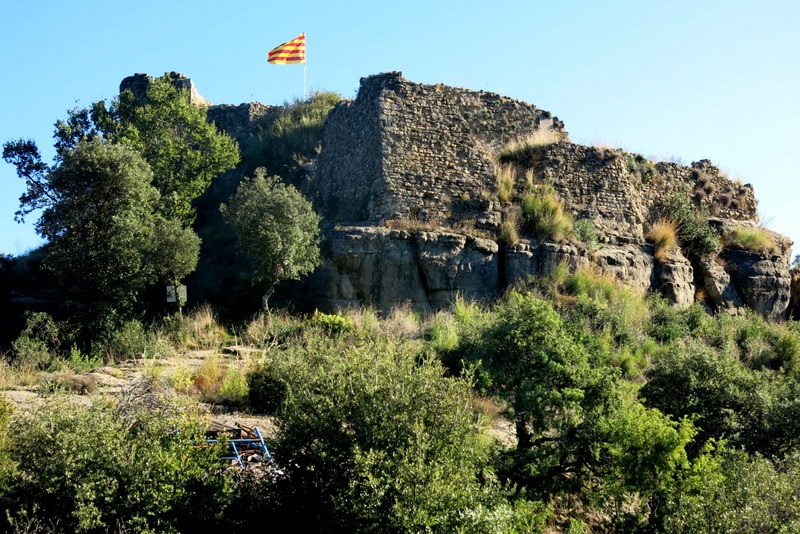
Castell de Colltort is a medieval hill castle located in the municipality of Santa Pau, in northeastern Spain. This fortress, dating back to the early Middle Ages, played a crucial role in the region's defensive network during the medieval period. Its strategic position atop a rocky elevation allowed it to oversee and control surrounding territories, marking it as a significant seat of power within the County of Besalú.
The early history and feudal significance
The earliest documentary evidence of Castell de Colltort appears in the year 1017, when it was mentioned in the foundation charter of the Bishopric of Besalú. At this time, a nobleman named Ermemir is recorded as the lord or veguer (an administrative official) of the castle. Shortly after, around 1020-1021, the fortress was referenced in the will of Count Bernard I of Besalú, who bequeathed it to his son William. This early documentation establishes the castle as a local power center within the feudal hierarchy of the region.
Throughout the 11th century, Castell de Colltort maintained a close strategic connection with the nearby Castell de Finestres, both situated along the same mountain ridge. These castles functioned as territorial markers, with Colltort cited as the southern boundary in a land transaction dated 1028. Their locations were instrumental in defining the political landscape between the County of Besalú and the dominant County of Barcelona.
In 1054, a significant treaty was signed wherein Count William II of Besalú accepted the overlordship of Count Ramon Berenguer I of Barcelona. Both Castell de Colltort and Castell de Finestres were returned to William II under an oath of loyalty, reinforcing the feudal ties between these counties. This event reflects the castle's importance in the broader political dynamics of the region.
Medieval ownership and feudal dynamics
The mid-11th century saw ongoing negotiations regarding the castle's control. In 1057, Count William II pledged Castell de Colltort as collateral to Bishop William of Vic following a peace agreement with Ramon Berenguer. By 1070, local nobility swore allegiance to Count Guillem Bernat of Besalú, who promised to uphold the rights of the Besalú count, indicating the castle's continued role as a feudal stronghold.
By the late 12th and early 13th centuries, the castle came under the administration of the Colltort family. In 1184, Oliver de Colltort is documented in a legal testament, marking the family's established presence. In 1210, Guillem de Colltort and his relatives sold property within the castle's domain under the authorization of their overlord, Mir d’Hostoles. Around 1212, Mir d’Hostoles divided the castle among his daughters and grandson, transitioning control to the Hostoles family.
Royal possession and decline
In the 14th century, Castell de Colltort became part of the royal holdings. By 1339, it was under the crown's possession. In 1342, King Peter IV of Aragon intervened to resolve a dispute involving the Santa Pau family, who held rights over Castell de Colltort and the nearby fortress known as Ça Cot. Despite its integration into royal jurisdiction by 1698, the castle had lost its military significance and was gradually falling into disrepair.
Architectural features and preservation
The main tower and defensive walls
The ruins of Castell de Colltort remain perched on a rocky outcrop, dominated by a rectangular tower dating to the 11th century. This tower measures approximately 6.4 meters wide and 9.4 meters long externally, with robust walls about one meter thick. Its construction involved masonry set directly on bedrock or large flat stones, combining lime mortar with stepped, elongated stones measuring roughly 18 by 35 centimeters. The tower's external corners are reinforced with larger, finely worked blocks of ashlar stone, approximately 30 by 70 centimeters, providing structural stability. Although the original southern doorway is only partially preserved, its location is inferred from remaining fragments.
Surrounding the tower is a defensive wall extending mainly along the east, south, and west sides, situated about eight meters from the tower. The southwest corner of this rampart still stands to a height of roughly 2.5 meters. Constructed with similar mortared stonework, this wall once enhanced the tower's defensive capabilities. Near the western side of the tower, about six meters away, remains of an additional outer wall built from finely cut ashlar blocks indicate later construction phases and an expanded defensive perimeter.
Additional structures and later modifications
On the southern side of the site, a later stone wall survives in sections reaching nearly three meters high. This wall likely served as an outer protective barrier and includes traces of a southern gate, suggesting controlled access to the castle grounds. Adjacent to these walls are remnants of a building featuring opus spicatum, a distinctive herringbone masonry pattern commonly employed in medieval construction for structural strength and aesthetic appeal. Nearby, the remains of a furnace have been identified, possibly used for metalworking or other essential activities supporting castle life.
Castell de Colltort in the context of medieval Catalonia
The castle's history reflects the complex feudal relationships and territorial disputes characteristic of medieval Catalonia. Its strategic location along a mountain ridge allowed it to serve as a boundary marker and military stronghold during periods of conflict and negotiation between competing counties. The castle's successive ownership by noble families and eventual integration into royal holdings illustrate the shifting political landscape of the region over several centuries.
Today, the ruins of Castell de Colltort provide valuable insights into medieval defensive architecture and the evolution of castle construction techniques. The site exemplifies the adaptation of fortifications to changing military needs and feudal power structures. Its preservation offers historians and visitors alike a tangible connection to the region's rich medieval heritage.
Visiting and cultural significance
While Castell de Colltort remains in a state of ruins, its commanding position and surviving structures make it a notable destination for those interested in medieval history and architecture. The castle's remains evoke the atmosphere of a bygone era, inviting exploration and study. Its cultural significance is recognized as part of the historical fabric of Santa Pau and the broader Catalonian region.
Visitors can appreciate the castle's architectural features, such as the sturdy rectangular tower, the enclosing defensive walls, and the traces of ancillary buildings. The site stands as a testament to the enduring legacy of medieval fortifications in shaping regional identity and history.
Frequently asked questions (FAQ)
- How do I get to Castell de Colltort?
- Castell de Colltort is located in Spain and is accessible by car or public transport. If you're driving, you can follow the local road signs to the castle, which is situated in a scenic area perfect for a day trip.
- What is the historical significance of Castell de Colltort?
- Castell de Colltort dates back to the medieval period and played a crucial role in the region's defense against invasions. Its strategic location and architectural features highlight the importance of the castle in local history.
- When was Castell de Colltort built?
- Construction of Castell de Colltort began in the 11th century, during a time of political turbulence in the region. Over the centuries, it has been modified and restored, reflecting various architectural styles.
- Can I take guided tours of Castell de Colltort?
- Yes, guided tours are available at Castell de Colltort, providing visitors with in-depth knowledge of its history and architecture. Tours are conducted by knowledgeable guides who bring the castle's past to life.
- Why is Castell de Colltort a popular tourist destination?
- Castell de Colltort attracts visitors due to its stunning architecture, rich history, and picturesque surroundings. The castle offers breathtaking views and a glimpse into the medieval life, making it a must-visit for history enthusiasts.
- Is it possible to access Castell de Colltort with a wheelchair?
- While Castell de Colltort has some accessible areas, the terrain can be uneven and challenging in certain parts. It is advisable to check in advance with the visitor center regarding accessibility options and available facilities.
- What are the best times to visit Castell de Colltort?
- The best times to visit Castell de Colltort are during the spring and fall when the weather is mild and the landscapes are stunning. These seasons also tend to have fewer crowds, allowing for a more enjoyable experience.
- What are the opening hours for Castell de Colltort?
- Castell de Colltort typically opens from 10 AM to 6 PM, but hours may vary based on the season. It's recommended to check the official website or contact the castle directly for the most current information.
- What are the ticket prices for visiting Castell de Colltort?
- Ticket prices for Castell de Colltort are generally affordable, with discounts available for students and seniors. Family passes may also be offered, making it a budget-friendly option for visitors.
- Are there any nearby attractions to Castell de Colltort?
- Yes, there are several nearby attractions, including beautiful hiking trails and quaint villages. Exploring the surrounding area can enhance your visit to Castell de Colltort and provide a fuller experience of the region's culture.
Information
Loading map...
Visitor reviews
No reviews yet. Been here? Write the first review and help other travelers!
Write the first reviewVisited this castle? Share your experience
Your review helps other travelers and adds first-hand knowledge to our encyclopedia.