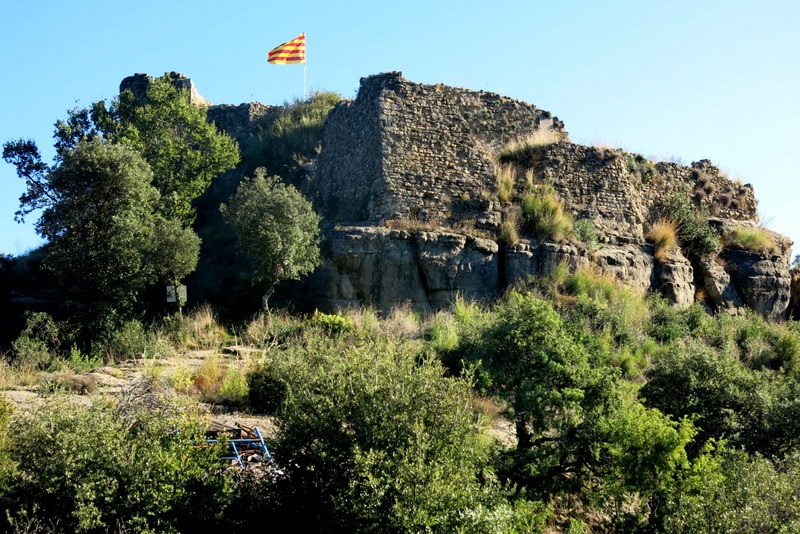
Castell de Santa Pau
The Castell de Santa Pau stands as a significant medieval fortress nestled in the historic town of Santa Pau in Catalonia, Spain. This hill castle has witnessed centuries of noble lineage, military events, and architectural evolution, embodying the feudal heritage of the region. Its origins trace back to the early Middle Ages, with documented mentions dating to 878 and 979 under the name “Sancta Pace,” highlighting its longstanding strategic and social importance.
Constructed primarily during the 12th and 13th centuries, the castle was originally established by local nobility connected to the nearby Castell de Finestres and the influential Porqueres family. The lords of Santa Pau, initially castellans of Finestres, rose in prominence to become barons, overseeing the fortress and expanding their domains. Key figures such as Ponç I, Arnau, Pere, and Ponç II played pivotal roles in the castle’s development and the consolidation of the barony.
The feudal lords and political alliances
By the early 13th century, the castle was under the control of Agnès, who managed both Santa Pau and Porqueres castles. Her son, Ramon Ademar, later sold Porqueres in 1251 to address financial obligations related to their estates. Following his death, the family's ties strengthened through marriage alliances, notably linking with the noble Foixà lineage. These alliances were crucial in maintaining and expanding their influence across the region.
Military significance and royal connections
The castle's strategic importance is underscored by its role in the military campaigns of the Crown of Aragon. In 1285, King Pere the Great stayed at Santa Pau following a battle against French forces, a prelude to his decisive victory at the Coll de Panissars. Later, in 1297, Ponç III of Santa Pau participated in King Pere’s Sicilian campaign, an involvement that earned the barony the privilege of holding a weekly market, formalized by the town charter in 1300.
Expansion and noble ownership through the centuries
The 14th and 15th centuries saw further expansion of the Santa Pau domain. In 1312, Huguet II paid homage to King Jaume II for several castles including Santa Pau, Finestres, and Sant Aniol. By 1433, Hug Ademar controlled an extensive territory incorporating Santa Pau, Finestres, Castellfollit, and other nearby lands. The Oms family later acquired the barony through a royal court sale in 1456, consolidating their control over Santa Pau and Finestres.
The remença peasant revolts and castle sieges
The castle witnessed significant turmoil during the 1462 remença peasant revolt, a conflict marked by peasant uprisings against feudal oppression. The rebel leader Francesc de Verntallat was active in Santa Pau, supporting the peasants against the noble procurator. Despite temporary peasant control, royal authority restored the castle to the noble Oms family by order of King Joan II in 1473. In 1486, remença forces briefly captured the castle again, imprisoning the noble mossèn Oms to force the surrender of nearby Finestres. This act was condemned by King Ferdinand the Catholic, who ensured the castles' return to noble hands.
Later history and restoration efforts
The 17th century brought further conflict with a French occupation in 1694. Spanish forces recaptured the castle, but it suffered partial demolition during the struggle. The fortress was subsequently rebuilt by Antoni IV d’Oms at considerable expense. By the late 18th century, debts led to the transfer of the lordship to the Marqueses de Moià de la Torre, and later the title passed to the Marqueses de Castelldosrius, with Félix II de Sentmenat i de Güell holding the baronial title in 1969.
In the 20th century, the castle was inhabited by a religious community of nuns for over fifty years before falling into disuse. In August 2023, the municipality acquired the property, initiating plans for a comprehensive restoration to address significant structural deterioration and preserve this emblematic monument.
Architectural features and layout
The Castell de Santa Pau is centrally located within the town and presents as a large rectangular manor house arranged around an inner courtyard. Its layout is essentially square, with construction phases spanning from the 12th to the 17th centuries, reflecting various adaptations and expansions over time. The castle integrates closely with the town’s streetscape, blending historical architecture into the urban fabric.
Keep and defensive structures
A defining feature is the tall, slender square keep, also called the tower of homage, positioned on the northeast corner. This tower projects slightly beyond the main building line and dominates the entrance, symbolizing both defense and lordly authority. The lower sections of the castle are built from finely cut ashlar stone blocks, providing strength and durability, while the upper portions utilize mortar construction. Although the original defensive walls and moats have mostly disappeared, their former presence is evident in the castle’s design.
Windows, courtyard, and chapel
The castle features several Gothic-style windows that offer insight into its architectural evolution. Other windows date from 1653, reflecting modifications by Baron Raimon d’Oms. The spacious courtyard includes a large staircase facilitating access between levels.
Attached to the northeast tower’s ground floor is a small baronial chapel, the oldest part of the castle. It features a semicircular arch doorway framed by regularly shaped stone blocks, accessed by two steps. Above the door, a narrow slit window provides limited light. The chapel once housed a 14th-century wooden altarpiece from 1340 and a precious relic, a piece of the true cross, donated by lord Hug Ademar. During the French occupation, the chapel’s silver was pawned, reflecting the hardships of the period. Restored in 1766, the chapel was later used by nuns as a coal storage and pantry.
Heraldry and symbolic elements
Above the main entrance, a large carved stone lintel displays the Santa Pau family coat of arms. This emblem includes three turbans symbolizing three captive kings, a bone with a flag, and twelve palm branches representing the victories of Arnau against Arab forces. These symbols commemorate the martial achievements and noble heritage of the Santa Pau family, embedding their legacy into the castle’s very fabric.
Santa Pau’s cultural and heritage significance
The Castell de Santa Pau is not only a testament to medieval military architecture but also a symbol of the region’s feudal history and noble lineages. Its preservation and restoration are vital for understanding the social, political, and architectural developments in Catalonia from the High Middle Ages through the early modern period. As a central feature of the town of Santa Pau, the castle continues to attract interest for its historical narratives, architectural features, and cultural importance.
Future restoration efforts aim to stabilize and rehabilitate the castle, ensuring that its rich history and architectural heritage remain accessible to visitors and scholars alike. The integration of the castle within the town’s urban landscape further enhances its role as a living monument, connecting past and present in the heart of Catalonia.
Frequently asked questions (FAQ)
- How do I visit Castell de Santa Pau?
- The castle is located in the town center of Santa Pau, Catalonia. Visitors can explore the exterior and some interior areas during opening hours set by the municipality. Check local tourist information for guided tours and restoration updates.
- What is the historical significance of Castell de Santa Pau?
- Castell de Santa Pau was a strategic medieval fortress linked to the Crown of Aragon and noble families like the Oms and Santa Pau barons. It played roles in military campaigns, peasant revolts, and regional governance from the 12th to 17th centuries.
- When was Castell de Santa Pau built?
- The castle was primarily constructed during the 12th and 13th centuries, with significant additions and modifications continuing into the 17th century.
- Can I see the baronial chapel at Castell de Santa Pau?
- Yes, the small baronial chapel attached to the northeast tower is one of the castle’s oldest parts. It features Gothic architectural elements and once housed a 14th-century altarpiece and a relic of the true cross.
- Is Castell de Santa Pau accessible for visitors with mobility issues?
- Due to the castle’s historic structure and ongoing restoration, accessibility may be limited. Visitors with mobility concerns should contact the local tourism office for current information on access and facilities.
Information
Current owner
Municipality
Loading map...
Visitor reviews
No reviews yet. Been here? Write the first review and help other travelers!
Write the first reviewVisited this castle? Share your experience
Your review helps other travelers and adds first-hand knowledge to our encyclopedia.