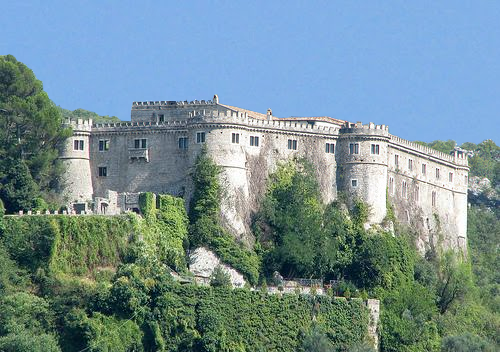
Castle of Fumone
The Castle of Fumone stands as a remarkable testament to medieval military architecture and religious history in central Italy. Perched over 800 meters above sea level in the municipality of Fumone, this hill castle was originally constructed as a strategic military stronghold within the Papal States. Its commanding position allowed it to dominate the surrounding landscape and serve as a critical lookout and communication point from the 11th through the 16th centuries.
Throughout its early history, the castle's primary function was defensive. It played a pivotal role in regional security by monitoring movements along the Via Casilina, a vital route connecting Rome to southern Italy. The castle's high tower was used to send smoke signals across the Campagna and Marittima territories, a system so effective that it inspired the local proverb, “When Fumone smokes, the whole countryside trembles.” This early warning mechanism underscored the castle's importance in deterring enemy advances and coordinating regional defense.
Medieval military significance and notable sieges
The castle's formidable defenses enabled it to withstand multiple sieges, including those led by the Holy Roman Emperors Frederick Barbarossa and Henry VI of Swabia. These attempts to seize the fortress were unsuccessful, highlighting its strategic resilience. It was only in the 13th century that the castle was peacefully surrendered to Pope Gregory IX through the payment of a substantial ransom, marking a significant moment in its military history.
Prison of antipopes and papal figures
The Castle of Fumone is historically renowned for its use as a prison for significant religious figures. In 1121, it became the site of imprisonment and subsequent death of the French antipope Maurice Bourdin, also known as Antipope Gregory VIII. His mysterious burial within the castle, with no known tomb found, adds an enigmatic layer to the fortress's history.
Perhaps the most famous prisoner was Pope Celestine V (born Pietro da Morrone), who was confined in the castle's prison cell in 1295. He spent approximately ten months in near isolation before his death on May 19, 1296. This event imbued the castle with profound spiritual significance, leading to the establishment of a cult venerating Celestine V and enhancing the site's religious heritage.
Transition to noble residence and garden development
By the 16th century, the castle's military relevance waned due to evolving political and military landscapes. Recognizing its religious importance, particularly its association with Celestine V, Pope Sixtus V entrusted the castle to the Roman noble Longhi family in 1584. Descended from Cardinal Guglielmo Longhi, an early protector of the Celestine monastic order, the family transformed the fortress into a noble residence.
The Longhi family unified the castle's four internal towers and ramparts to create one of Europe's largest hanging gardens at such an altitude during the 17th century. This garden is a rare example of classical Italian garden art, blending the fortress's defensive architecture with cultivated outdoor spaces, symbolizing the castle's shift from military stronghold to aristocratic estate.
Architectural features and interior spaces
The castle covers approximately 3,500 square meters, featuring four interconnected towers, ramparts, and moats. The 18th-century chapel on the noble floor is dedicated to Pope Celestine V, preserving the spiritual legacy of his confinement. Adjacent to the chapel is the preserved prison cell where Celestine V spent his final months, offering visitors a poignant glimpse into the castle's religious past.
The castle also houses a museum with archaeological artifacts spanning its varied history. Among the exhibits is the family archive containing a secretaire that holds the embalmed body of Francesco Longhi, a five-year-old child tragically murdered in a 17th-century family dispute. This somber relic adds a deeply human dimension to the castle's narrative.
Modern stewardship and cultural significance
In the 20th century, the castle's spiritual importance was reaffirmed when Pope Paul VI visited in 1966 and consecrated the site by placing a votive cross in honor of Celestine V. Since 1990, under the stewardship of owners Stefano and Fabio de Paolis, the castle has become more accessible to the public, allowing visitors to explore its rich history and architectural beauty.
Today, the Castle of Fumone stands as a layered historical monument that seamlessly blends its medieval military architecture, noble residence features, sacred memorials, and classical gardens. It offers a unique window into the evolving history of the Papal States and the cultural heritage of central Italy.
Frequently asked questions (FAQ)
- How do I visit the Castle of Fumone?
- The Castle of Fumone is privately owned but open to visitors by appointment or during special events. It is recommended to check ahead for visiting hours and guided tour availability.
- What is the historical significance of the Castle of Fumone?
- The castle served as a strategic military fortress and prison for notable religious figures, including Pope Celestine V. It played a key role in the defense of the Papal States from the 11th to the 16th centuries.
- Can I see the prison cell where Pope Celestine V was confined?
- Yes, visitors can view the preserved prison cell within the castle where Pope Celestine V spent his final months, providing a unique insight into the castle's spiritual history.
- What architectural styles are represented in the castle?
- The Castle of Fumone features a mixed architectural style, reflecting its evolution from a medieval military fortress to a noble residence with Renaissance and later additions.
- Is the castle accessible for visitors with mobility issues?
- Due to its historic structure and hilltop location, accessibility may be limited for visitors with mobility challenges. It is advisable to inquire in advance about accommodations.
- When is the best time to visit the Castle of Fumone?
- Spring and early autumn offer pleasant weather for visiting the castle and exploring its gardens, while avoiding the peak summer heat.
Information
Sources & official resources
Verify the information above using these authoritative references.
Loading map...
Visitor reviews
No reviews yet. Been here? Write the first review and help other travelers!
Write the first reviewVisited this castle? Share your experience
Your review helps other travelers and adds first-hand knowledge to our encyclopedia.