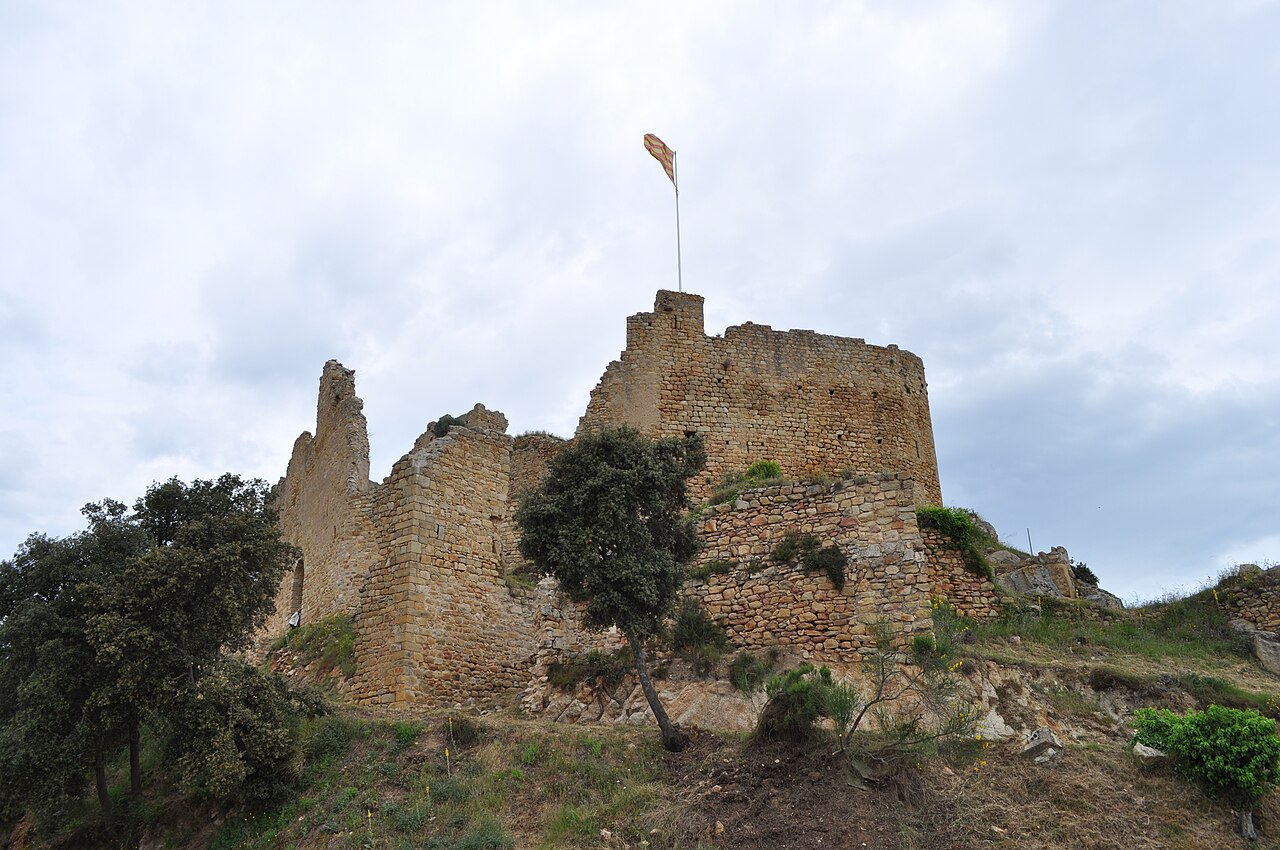
Castell de Torcafelló
The Castell de Torcafelló stands as a remarkable example of medieval military architecture nestled in the town of Maçanet de la Selva, Spain. Constructed in the late 11th century, around 1080, this hill castle served a critical defensive role marking the border of the possessions of the Count of Girona. Its strategic location and robust fortifications highlight its importance during the turbulent medieval period, particularly between the 11th and 13th centuries.
Historical significance and early ownership
The earliest documentary mention of the castle dates to 1106, affirming its establishment as a fortified stronghold by then. The castle's initial builders were medieval Christian forces aiming to secure territorial boundaries in the region. By the early 12th century, the fortress became closely tied to the influential Cabrera family, a noble lineage that played a pivotal role in Catalonia's medieval history. In 1106, Guillermo Ponce of the Cabrera family formally pledged allegiance, cementing the castle within the Cabrera domain.
By 1231, the castle had evolved from a purely military installation into an administrative center. It housed castellans or alcaldes who governed the surrounding lands as part of an alcaldía within the viscounty of Cabrera. This transition reflects the castle's role in local governance and law enforcement during the high medieval period.
Architectural features and fortifications
Layout and defensive structures
The castle's layout is a rectangular plan approximately 18 by 25.5 meters, enclosed by thick stone walls about one meter wide. These walls are slightly inclined, enhancing their defensive capability against siege engines and attackers. Encircling the main enclosure is a defensive ditch roughly 2.5 meters wide, a common medieval fortification technique designed to impede enemy approach.
Beyond this ditch, a second perimeter wall encloses the original fortress, indicating a phased expansion of the castle's defenses. This layered fortification system would have provided multiple lines of defense, a typical feature of medieval hill castles designed to withstand prolonged assaults.
The chapel of sant jordi and later modifications
One of the most distinctive surviving features is the Chapel of Sant Jordi, constructed in the 15th century directly atop the castle's original torre mestra or main tower. This chapel features a barrel-shaped vault painted white, contrasting with the exposed stone walls both inside and out, which preserves the medieval character of the structure.
Within the chapel's presbytery, visitors can find a painting of Saint George on horseback and a niche housing an alabaster statue of the saint, crafted by the artist Maurici Herraiz. The chapel's modest-sized openings are protected by several rows of wrought iron bars installed across different periods, balancing security with natural light and ventilation.
The main entrance to the chapel is a round arch framed by carefully cut voussoirs and fitted with double wooden and iron doors. A semicircular stone wall about 1.5 meters high shields the doorway from the left side, enhancing its defensibility. Above the entrance, a window with brick jambs allows additional light into the interior.
The chapel's terrace is paved with brick and bordered by crenellated battlements of the same material, echoing the castle's original defensive purpose. A bell tower, or campanar de cadireta, rises partly from stone and partly from an iron framework, housing a bell that continues the chapel's ecclesiastical function.
Archaeological discoveries and historical layers
Extensive archaeological excavations conducted between 1999 and 2006 revealed a rich stratigraphy of occupation at the site. Findings include ceramic fragments from the late Iberian period, Campanian pottery, dolia (large ceramic storage containers), and bronze coins dating to the 4th century. These artifacts demonstrate that the site was occupied and utilized through multiple historical phases, extending well before the medieval castle's construction.
The excavations also uncovered structural remains such as the original defensive ditch, a cistern for water storage, and the foundations of a central circular tower within the fortress. Inside the castle compound, remnants of internal buildings were found in both the upper enclosure (sobirà) and the lower enclosure (jussà), illustrating the complex layout and functional zoning typical of medieval fortifications.
Later history and restoration efforts
By the mid-15th century, the castle's military role had diminished significantly. In 1450, the fortress was dismantled, and the Chapel of Sant Jordi was erected on the site of the main tower, marking a shift from military to religious use. The chapel remained active through the 18th century, including a time when it was administered as a secular chapel.
The castle site saw renewed military importance during the Second Carlist War (1845-1849) when Valencian forces occupied the location. They reinforced the chapel's defenses and installed an optical telegraph tower for communication, though this structure no longer survives.
Following a period of abandonment in the 20th century, local historical associations initiated restoration efforts starting in 1983. These efforts continued into the early 1990s, culminating in the chapel's restoration by 1992. Today, the site stands as a testament to the layered history of medieval fortifications, religious transformation, and modern heritage preservation.
Visiting and cultural significance
The Castell de Torcafelló offers visitors a unique glimpse into the military and religious history of Catalonia. Its preserved walls, chapel, and archaeological remains provide insight into medieval defensive architecture, noble family dynamics, and the evolution of regional governance.
Visitors can explore the castle's terraces, admire the chapel's artistic features including the alabaster statue of Saint George, and appreciate the panoramic views afforded by its hilltop position. The site is a significant cultural landmark that reflects centuries of historical change and architectural adaptation.
Frequently asked questions (FAQ)
- What is the historical significance of Castell de Torcafelló?
- Castell de Torcafelló was a strategic medieval hill castle marking the border of the Count of Girona's possessions. It later served administrative functions and witnessed various historical phases including noble family control and military use during the Second Carlist War.
- Can I visit the Chapel of Sant Jordi at the castle?
- Yes, the Chapel of Sant Jordi is a key feature of the castle, restored and accessible to visitors. It contains notable artworks such as a painting and alabaster statue of Saint George and retains its medieval architectural character.
- When was the castle originally built?
- The castle was originally constructed around 1080 and first documented in 1106. It was built as a fortified stronghold during the high medieval period.
- Are there archaeological remains at the site?
- Yes, excavations have uncovered remains from Roman, late Iberian, and medieval periods, including pottery, coins, a cistern, and foundations of defensive structures, illustrating the site's long history of occupation.
- Is there an admission fee to visit the castle?
- Visiting Castell de Torcafelló is free of charge, making it accessible for tourists interested in medieval history and architecture.
- What are the opening hours for visitors?
- The castle is open daily from 10:00 to 18:00, allowing ample time for exploration and appreciation of its historical features.
Information
Opening hours
10:00-18:00, daily
Ticket prices
Free
Current owner
Municipality
Website
Visit websiteSources & official resources
Verify the information above using these authoritative references.
Loading map...
Visitor reviews
No reviews yet. Been here? Write the first review and help other travelers!
Write the first reviewVisited this castle? Share your experience
Your review helps other travelers and adds first-hand knowledge to our encyclopedia.