Castle of Elvas
The Castle of Elvas stands as a remarkable example of a hill castle with a rich history spanning from the Muslim rule in the 8th century through to modern times. Located in the civil parish of Alcáçova within the municipality of Elvas in Portugal’s Alentejo region, this fortress exemplifies centuries of military architecture adapted to evolving warfare technologies and border defense needs.
Originally constructed during the period of Muslim occupation between the 8th and 12th centuries, the castle was strategically positioned on the elevated site known as Costa da Vila Fria, providing commanding views over the surrounding landscape. The castle’s early purpose was to serve as a military stronghold, controlling the region and protecting key routes. During the Christian Reconquista, the fortress changed hands multiple times, reflecting the turbulent conflicts between Christian and Muslim forces. It was first briefly captured by forces loyal to Afonso Henriques around 1166, but permanent Christian control was only established under King Sancho II between 1226 and 1230.
In 1229, King Sancho II granted a foral (charter) to Elvas, formalizing its administrative status and encouraging settlement growth. This charter was reaffirmed by King Afonso III in 1263. The settlement’s importance increased over the centuries, culminating in its elevation to city status by King Manuel I in 1513. Reflecting its growing religious and administrative significance, Elvas became a bishopric in 1570.
Medieval sieges and strategic importance
Throughout the 14th and 15th centuries, the castle and town of Elvas endured several significant sieges, underscoring its strategic importance on the border with Castile. Notable attacks included those by Alfonso XI of Castile between 1325 and 1327, the forces of Infante John of Portugal supported by Castilian troops in 1381, and John II of Castile in 1385. These events highlight the castle’s role as a key defensive bastion during periods of Iberian conflict.
Architectural evolution and military adaptations
Late medieval modifications
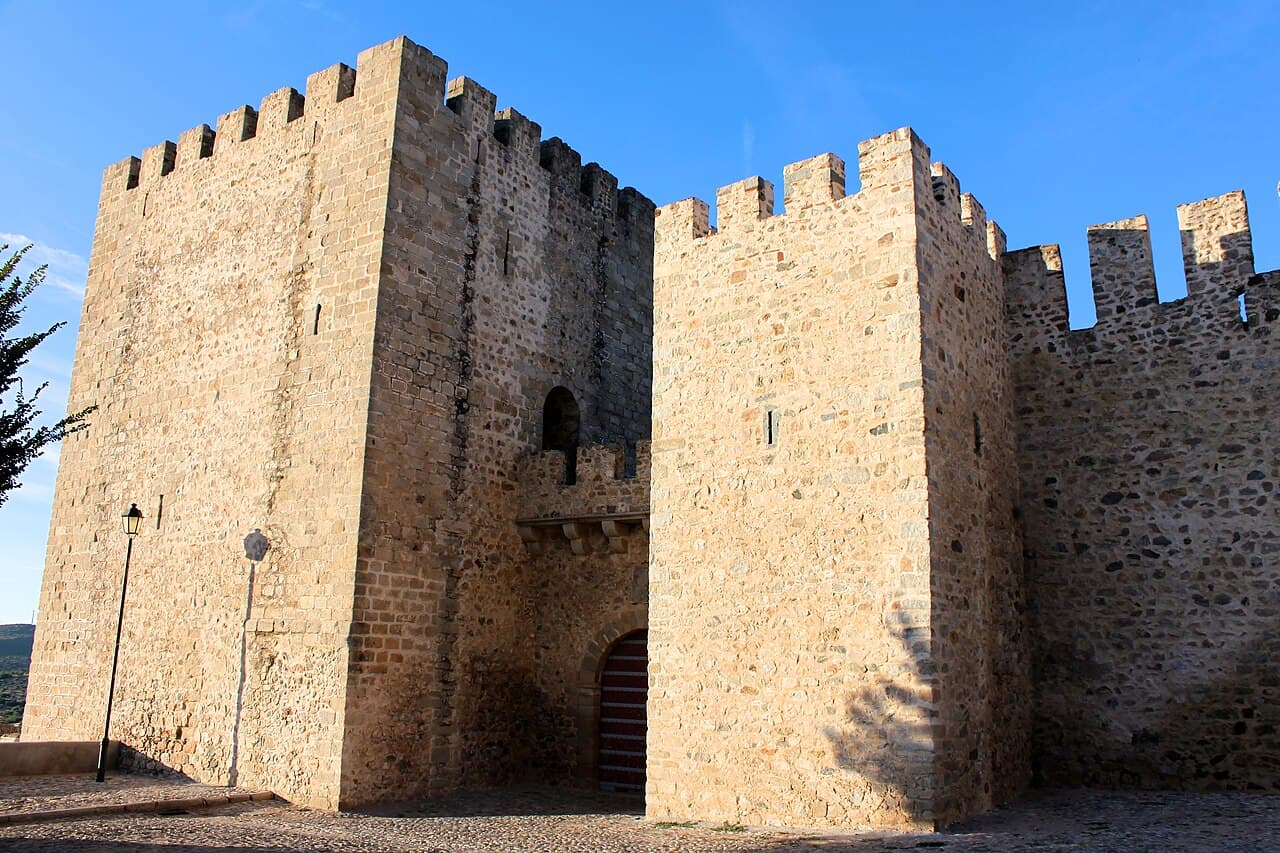
Between 1488 and 1490, the castle underwent major reconstruction to adapt to new military technologies. The existing hexagonal tower was modified, and a taller keep tower was constructed to support the use of artillery, marking a significant evolution in the fortress’s defensive capabilities. The residence of the castle’s alcalde (governor) was also renovated during this period, reflecting the dual military and administrative functions of the castle.
Restoration wars enhancements
During the Restoration Wars (1640–1668), the fortress was extensively repaired and expanded under the leadership of Governor Matias de Albuquerque. Starting in 1641, the castle’s defenses were strengthened with larger trenches and reinforced barbicans. This period culminated in the completion of the bulwarked Praça de Elvas in 1653, a star fortification that enhanced the castle’s ability to withstand sieges. The fortress notably resisted a Spanish siege during 1658–1659, shortly before the pivotal Battle of the Lines of Elvas in 1659.
18th and 19th century conflicts and upgrades
The War of Spanish Succession brought further military challenges, with Elvas besieged by Franco-Spanish forces in 1706 and 1712. These threats led to the construction of a gunpowder magazine in 1735 to improve the fortress’s defensive infrastructure. The Peninsular War also impacted Elvas, with attacks during the Guerra das Laranjas in 1801 and occupation by French forces in 1807. The castle was besieged by Anglo-Portuguese troops in 1808, reflecting its continued military relevance. Further modifications included the demolition of a tower in 1815 to protect a nearby warehouse and the addition of new battery emplacements with barbettes in 1823.
Architectural features and layout
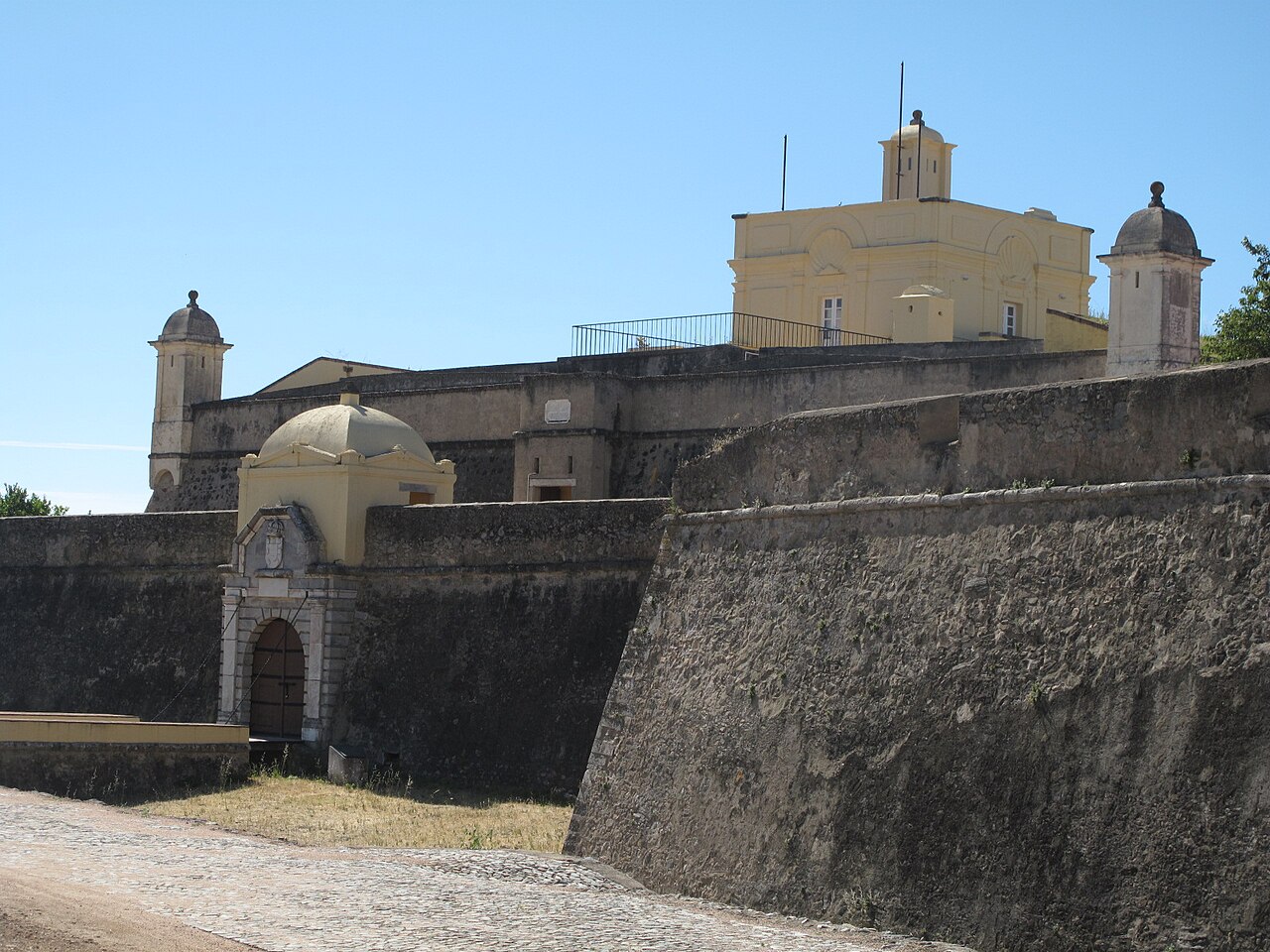
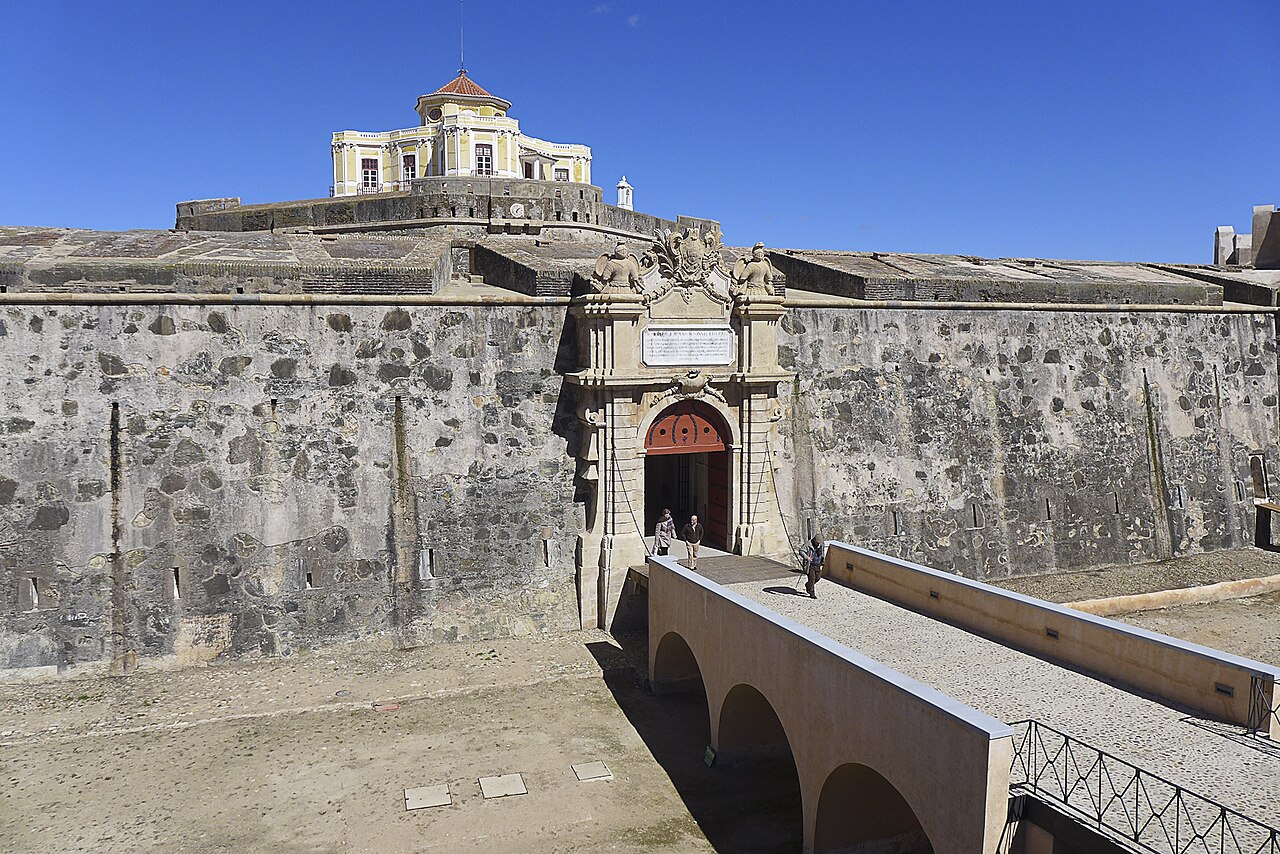
The Castle of Elvas occupies an irregular quadrilateral layout defined by four walls with towers positioned along the south, west, and north sides. The castle’s walls and towers follow the natural terrain, creating a formidable defensive structure. The main entrance, known as Porta da Vila or Town Gate, is on the southwest side and features a capstone bearing the coat-of-arms of King John II. This gate opens into a courtyard containing several older buildings.
Near the northeast wall to the south lies a cistern used for water storage, essential for sustaining the castle during sieges. The alcalde’s residence is a two-storey building along the northeast wall, notable for its vaulted porch ceiling decorated with a five-pointed star design. This residence includes Roman arch entrances leading to large vaulted halls, some with fireplaces and wooden ceilings. An exterior marble staircase supported by eight rectangular pillars provides access to the upper floors. The residence also contains a kitchen equipped with a stove and chimney.
Access to the battlements is gained via a staircase on the northwestern wall. This area is defended by three simple embrasures—openings for firing weapons—and a doorway with a broken arch leading to the Porta da Traição or Traitor’s Gate.
The keep tower, positioned at the western corner, is rectangular and accessed through a Roman arched gate. Inside, a principal hall features four narrow vertical openings called arrowslits for archers and a vaulted ceiling supported by four corner posts. Two flights of stairs lead to the upper floor beneath a tiled roof.
On the southwest battlements, a tower adjacent to the town gate includes a staircase to the roof. A nine-sided rooftop artillery emplacement flanks the southern angle, providing two levels for gunfire with twelve arrowslits. The upper level is covered by a vaulted semi-spherical ceiling added later.
The southeastern battlements connect to the northeast wall but are interrupted by the masonry of the alcalde’s residence. Outside this wall is a support structure believed to be a terrace. At the extreme end of the wall stands a circular construction topped by a semi-spherical cupola protecting the entrance to a circular staircase leading outside the castle.
Along the northern wall are a nearly square tower with a plain parapet and masonry bunk, a suspended cistern to the left of the keep tower, and a rectangular tower with a plain parapet to the right. All battlements are notably wide, allowing space for defense and artillery placement.
Modern renovations and heritage status
Between 1940 and 1948, the castle underwent significant renovations that altered many interior spaces, reflecting efforts to preserve and adapt the fortress for contemporary use. During this time, an azulejo tile depicting the Sagrada Família was removed from the castle gate.
The castle was declared a National Monument in 1906 and has been under the management of the Portuguese Institute for Architectural Heritage (IPPAR) since 1992. In recognition of its outstanding military architecture and historical significance, the castle became part of the UNESCO World Heritage designation for the fortifications of Elvas in 2012. This designation highlights the castle’s role as one of the most important examples of star fortifications and border defenses in Europe.
Today, the Castle of Elvas remains a well-preserved monument showcasing the evolution of military architecture from medieval fortifications to modern bastioned defenses. Its extensive walls, towers, and internal buildings offer valuable insights into centuries of Iberian history and the strategic importance of the Portugal-Spain border region.
Photo gallery

Information
Loading map...
Visitor reviews
No reviews yet. Been here? Write the first review and help other travelers!
Write the first reviewVisited this castle? Share your experience
Your review helps other travelers and adds first-hand knowledge to our encyclopedia.