Castle of Eger
The Castle of Eger stands as a monumental symbol of Hungarian resilience and medieval fortification, located prominently on a hillside in the city of Eger, Northern Hungary. This hill castle, built in the 13th century following the devastating Mongol invasion of 1241, was strategically constructed to guard the northern frontiers of the Kingdom of Hungary. Over centuries, it evolved architecturally and militarily, reflecting the turbulent history of the region and the shifting tides of power during the High medieval and early modern periods.
Originally established on the orders of the Bishop of Eger, the castle's site had religious significance dating back to the 11th century, with the construction of a Romanesque rotunda and a three-nave cathedral dedicated to Saint John the Evangelist. This ecclesiastical complex underscored Eger's importance as a bishopric founded by King Saint Stephen, Hungary's first king. The cathedral was later rebuilt in the Gothic style during the 14th century, illustrating the architectural transition and the growing influence of Gothic ecclesiastical design in Hungary.
Architectural evolution and fortifications
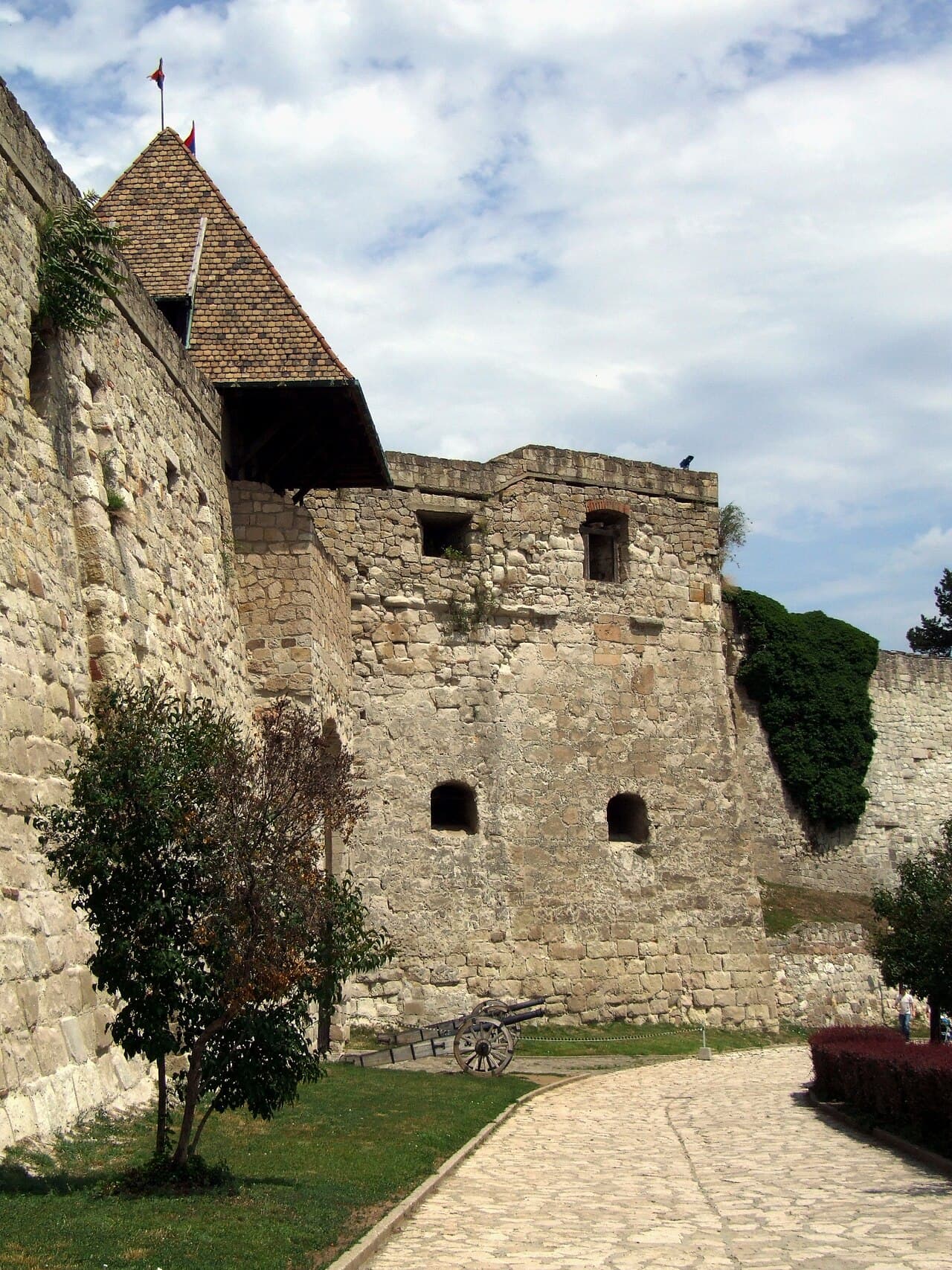
The stone castle itself was erected after the Mongol devastation, with successive expansions and reconstructions spanning several centuries. The fortress occupies an irregular pentagonal area roughly 240 meters west to east and 200 meters north to south, perched on a rocky hill overlooking the town. Its defensive system comprises two main curtain walls—the outer and inner walls—reinforced by multiple bastions constructed primarily in the mid-16th century. These bastions, including the Varkoch Bastion (1542), Gergely Bastion (1553-1555), and Sándor Bastion (1542-1548), were designed by renowned military architects such as Alessandro Vedani and Ottavio Baldigara, integrating Italian Renaissance military engineering principles to withstand artillery siege warfare.
The main entrance faces southeast towards Dobó Square, accessed through the Varkoch Bastion and the Hippolyt Gate tower, built between 1498 and 1520. This gatehouse features painted coats of arms and seating niches, indicating its dual role in defense and ceremonial functions. The castle's walls are primarily constructed from riolittufa, a volcanic stone that is soft and easily carved but vulnerable to frost damage, necessitating frequent repairs throughout the castle's history.
The episcopal palace and cathedral ruins
Within the inner castle stands the Gothic Bishop's Palace, built around 1470 by Bishop János Beckensloer. This one-story building features original Gothic elements such as cross vaulting and arcaded corridors, with an 18th-century upper floor addition showcasing a blend of Gothic and Renaissance styles. The palace houses the Hall of Heroes, dedicated to the defenders of the castle during the famous 1552 siege, including the tombstone of Captain István Dobó surrounded by symbolic statues and a commemorative plaque listing the names of the defenders.
Adjacent to the palace are the ruins of the medieval cathedral, once a three-nave structure combining Romanesque and Gothic architectural elements. The tallest surviving pillar shaft is crowned by a statue of Saint Stephen, installed in 1835, symbolizing the site's enduring religious significance. The castle grounds also include a ruin garden with restored remnants of the Romanesque, Gothic, and late Gothic cathedral phases.
The siege of 1552 and military history
The Siege of Eger in 1552 is the castle's most celebrated historical event, immortalized in Hungarian culture and literature, notably in Géza Gárdonyi's novel "Eclipse of the Crescent Moon". During this siege, a small force of approximately 2,100-2,300 Hungarian defenders, led by Captain István Dobó, successfully resisted an overwhelming Ottoman army numbering between 35,000 and 40,000 troops commanded by Kara Ahmed Pasha. The defenders endured intense bombardment and repeated assaults over five weeks, ultimately forcing the Ottoman army to retreat with heavy casualties. This victory became a symbol of national pride and resistance against Ottoman expansion in Europe.
Following the siege, the castle underwent extensive modernization to enhance its defenses. New bastions and strengthened walls were constructed, and the fortress was equipped to house a garrison of around 7,000 soldiers. Supporting infrastructure such as a gunpowder mill supplied by the town of Debrecen was established to sustain prolonged military engagements.
Despite these improvements, the castle fell to the Ottomans in a second siege in 1596. During the subsequent 91 years of Ottoman occupation, the fortress was maintained and expanded, incorporating Islamic architectural features including hamams (baths), mosques, and minarets. Today, one minaret remains as a testament to this period of Turkish rule.
Later history and decline
In 1687, the castle was recaptured by Habsburg forces after a prolonged siege. However, in 1701, the Austrians deliberately demolished much of the outer fortifications, particularly the Külső vár (outer castle), to prevent its future military use. This act marked the beginning of the castle's gradual decline.
Over the following centuries, the castle's stones were repurposed for local construction, and it served as military barracks until 1957. Archaeological excavations began in 1925, uncovering extensive underground tunnels and vaulted halls beneath the city, revealing the complex defensive system that had supported the fortress throughout its history.
Current status and museum exhibitions
Today, the Castle of Eger is home to the István Dobó Castle Museum, which offers several permanent exhibitions that showcase the castle's rich history and cultural heritage. These include the Gothic Bishop's Palace exhibition detailing the castle's history, the Hall of Heroes honoring the 1552 defenders, and the Kazamaták—the extensive underground passageways featuring Romanesque and Gothic lapidary collections.
The museum also features a ruin garden with restored cathedral ruins, an image gallery displaying works by 16th to 19th-century painters, and prison exhibits illustrating historical enforcement mechanisms and torture devices used in Hungary. Additionally, waxworks bring to life key historical figures and moments associated with the castle.
Thanks to its compelling history and diverse exhibitions, the Castle of Eger is one of Hungary's most visited tourist destinations, attracting visitors interested in medieval history, military architecture, and Hungarian cultural heritage.
Architectural details and preservation efforts
The castle's fortifications include embrasures, gun platforms, and bastions designed to resist cannon fire, although its defensive position was challenged by the nearby higher Almagyar Hill, which allowed attackers an elevated vantage point. Restoration efforts in the 20th and 21st centuries have focused on reinforcing the subterranean structures with modern materials such as reinforced concrete, reconstructing bastions like the Szép Bastion, and reopening collapsed sections of the tunnel system.
Additional buildings on the grounds include late 19th-century barracks, a Gothic house attached to the western wall, and remnants of chapels and a provisional palace near the cathedral ruins. The site's fortifications also encompass museum spaces, including a preserved powder magazine and former prison areas, all integrated within the bastions and underground casemates.
Frequently asked questions (FAQ)
- When was the Castle of Eger built and for what purpose?
- The Castle of Eger was built in the 13th century following the Mongol invasion to protect northern Hungary from further incursions.
- What is the significance of the 1552 siege at the Castle of Eger?
- The 1552 siege is famous for the small Hungarian force successfully defending against a much larger Ottoman army, symbolizing national resistance.
- What architectural styles are present in the Castle of Eger?
- The castle features Romanesque origins, Gothic cathedral and palace elements, and Renaissance military bastions from the 16th century.
- Can visitors explore underground tunnels at the Castle of Eger?
- Yes, the castle has an extensive system of underground passageways and vaulted halls open as part of the museum exhibitions.
- What can be seen in the István Dobó Castle Museum?
- The museum includes exhibitions on the castle's history, the 1552 defenders, a lapidary collection, prison exhibits, and waxworks.
Photo gallery

Information
Sources & official resources
Verify the information above using these authoritative references.
Loading map...
Visitor reviews
No reviews yet. Been here? Write the first review and help other travelers!
Write the first reviewVisited this castle? Share your experience
Your review helps other travelers and adds first-hand knowledge to our encyclopedia.