Acaya Castle
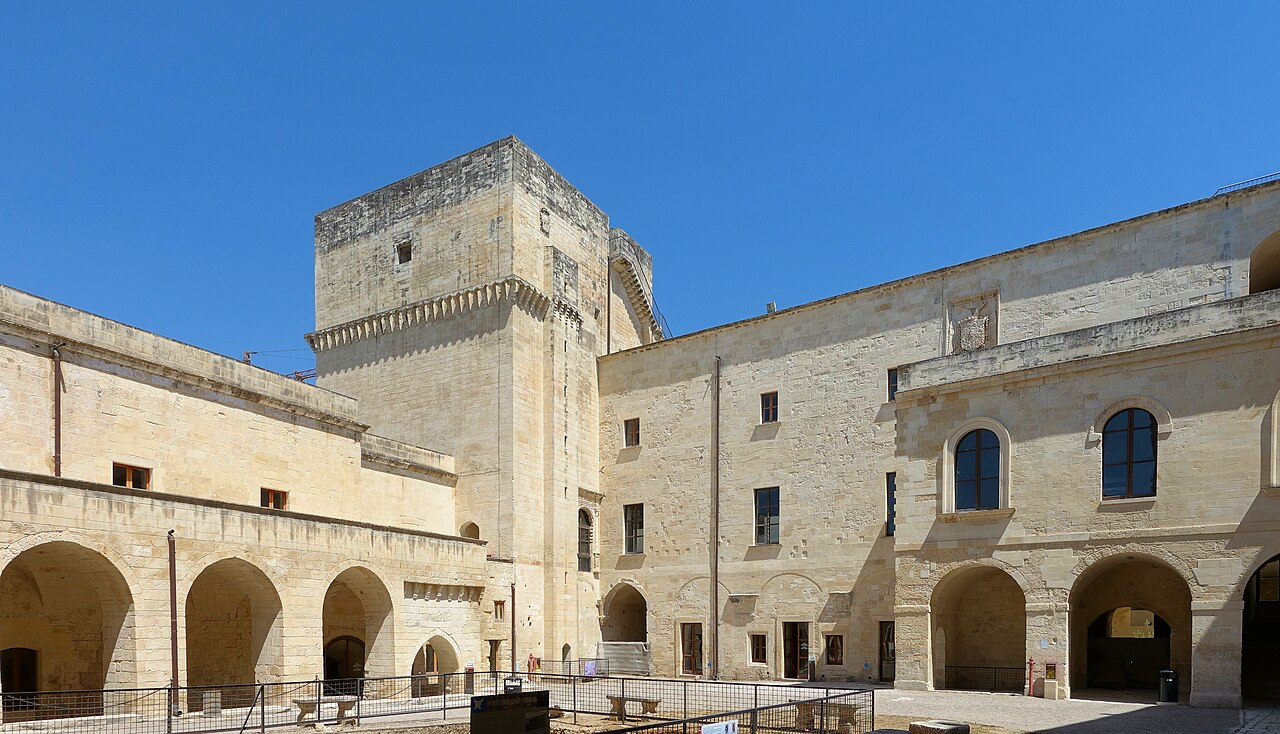
Acaya Castle is a remarkable example of Renaissance military architecture located in the village of Acaya, within the municipality of Vernole in Apulia, Italy. Originally built in 1506 by Alfonso di Acaya, the castle was extensively expanded and fortified by his son, Gian Giacomo dell'Acaya, a renowned architect and military engineer of the 16th century. The fortress not only served as a defensive stronghold but also as the administrative center of the Dell'Acaya family's estate, reflecting the evolving military technologies and architectural styles of its time.
The castle's strategic design features a trapezoidal star fort layout, a hallmark of Renaissance fortifications developed to counter the increasing use of artillery. Its robust walls are reinforced by cylindrical towers and bastions, including a pioneering lance-shaped bastion with sloped walls and layered cannon placements, which was among the earliest of its kind in Italy. This advanced fortification system allowed for enfilade fire, a defensive tactic that maximized coverage against attackers.
Historical background and ownership
The site of Acaya Castle has a history dating back to the medieval period when it was known as Segine. In 1294, Charles II of Naples granted the fief of Segine to Gervaso dell'Acaya, marking the beginning of the Dell'Acaya family's long tenure over the territory. The castle's construction began in the early 16th century and was part of a broader effort to consolidate and defend the family's holdings.
Following Gian Giacomo's death in 1570, the fiefdom returned to the royal treasury and subsequently passed through several noble families, including the De Montibus, De Montibus-Sanfelice, and Vernazza families. Each owner contributed to the castle's preservation and fortification, notably in response to threats such as Ottoman incursions and pirate attacks, including a significant Saracen assault in 1714 that temporarily captured the fortress.
Architectural features and fortifications
Star fort design and bastions
The castle exemplifies the 16th-century star fort design, characterized by a primarily rectangular plan with stout, low bastions at each corner. These bastions were engineered to support cannon defense and offense, reflecting the shift in military architecture necessitated by the advent of gunpowder artillery. The walls between bastions are recessed to reduce vulnerability to direct fire.
Notably, the northwest and southeast sides feature triangular salients that help deflect incoming artillery, while the opposite sides include large rounded rondelles, circular bastions providing wide fields of fire. The southeast lance-shaped bastion with its two-tier cannon placements represents an innovative design credited to Gian Giacomo dell'Acaya and dates to 1536, as inscribed on the bastion itself.
Towers, halls, and decorative elements
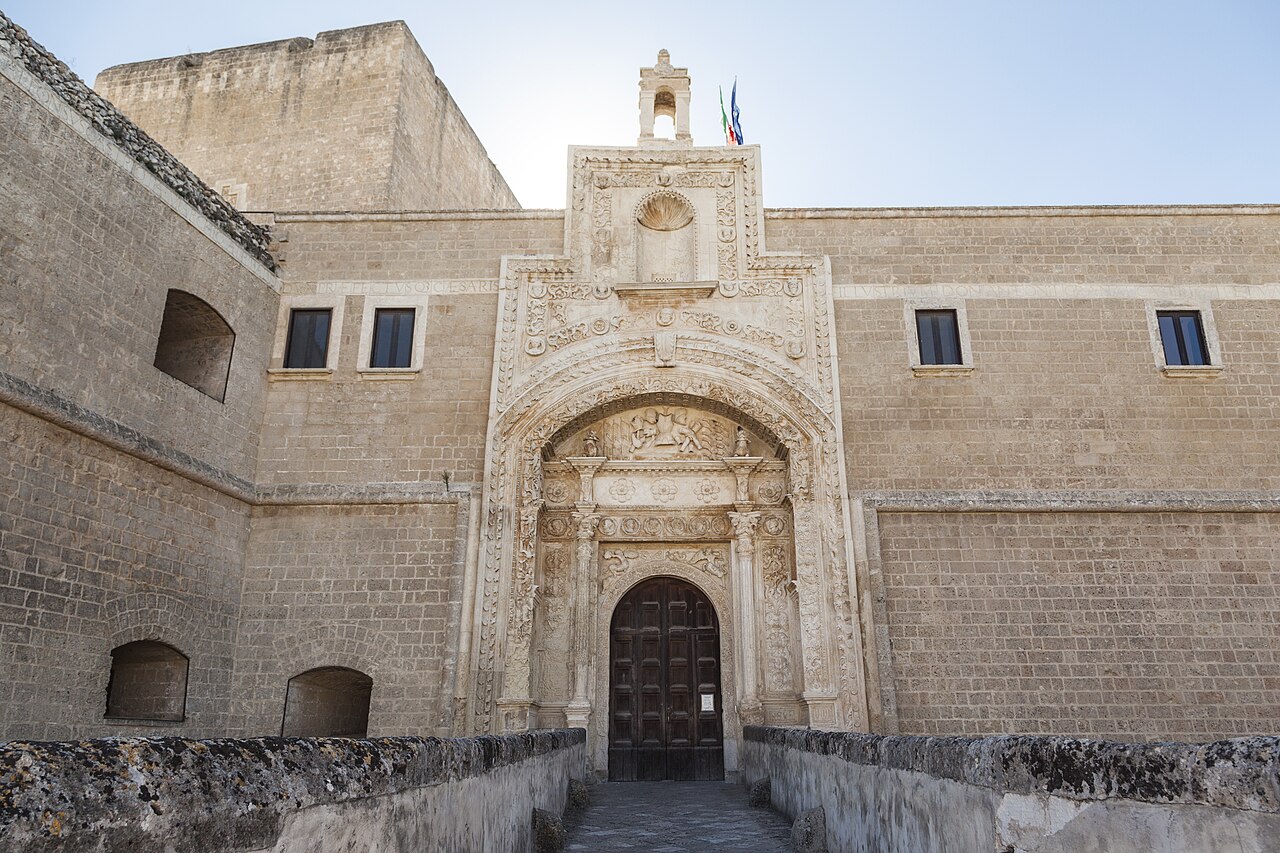
The castle's entrance is accessible via a single bridge leading into the fortified courtyard. The defensive walls include two prominent cylindrical towers that enhance the fortress's resilience. Inside the northeast tower, visitors find a rare enneagonal (nine-sided) hall adorned with decorative friezes, indicating the castle's dual role as a military and noble residence.
The upper floors contain the bastion hall, which features a painting of the Spanish Kings' coats of arms, symbolizing the castle's historical ties to the Spanish crown during the Habsburg period. Another room is decorated with classically styled motifs carved from Lecce stone, a local limestone prized for its workability and warm color.
Archaeological discoveries and religious heritage
Excavations around the castle have revealed significant archaeological finds that deepen our understanding of the site's long history. In 2001, graves and mass burial sites containing mainly young male remains were uncovered, possibly linked to military conflicts in the 13th century, though forensic studies are ongoing.
Underneath the northern side of the old manor, archaeologists discovered the remains of a small medieval Byzantine church. This chapel contained damaged tombs and a remarkable fresco approximately four by three meters in size depicting the Dormitio Virginis, or the symbolic death of the Virgin Mary. The fresco's iconography, featuring Christ and the apostles, follows apocryphal traditions and represents a rare example of Byzantine religious art in the region.
Modern significance and cultural role
Today, Acaya Castle is recognized as a well-preserved Renaissance fortress and a significant cultural landmark in Apulia. It hosts a permanent exhibition showcasing archaeological findings from nearby sites like Roca Vecchia, alongside temporary exhibitions that explore diverse themes, including contemporary architecture.
The castle's blend of military innovation, noble residence features, and religious art makes it a unique destination for visitors interested in Renaissance history, military architecture, and archaeology. Its preservation and ongoing research continue to enrich the historical narrative of southern Italy's fortified heritage.
Frequently asked questions (FAQ)
- How do I visit Acaya Castle?
- Acaya Castle is open to the public with guided tours available. Visitors can explore the fortress, its halls, and archaeological displays. It is advisable to check the official website or local tourist information for current opening hours and tour schedules.
- What is the historical significance of Acaya Castle?
- Acaya Castle is a prime example of Renaissance military architecture reflecting 16th-century advances in fortification design. It was built and expanded by the Dell'Acaya family and played a key role in defending the region against Ottoman and pirate attacks.
- Can I see the medieval Byzantine fresco at the castle?
- Yes, the castle houses the remains of a small Byzantine chapel with a fresco depicting the Dormitio Virginis. This rare artwork is part of the archaeological exhibits accessible to visitors.
- When was Acaya Castle built and by whom?
- Construction of Acaya Castle began in 1506 by Alfonso di Acaya and was significantly expanded by his son Gian Giacomo dell'Acaya in the 1530s.
- Is Acaya Castle accessible for people with mobility issues?
- While the castle has some uneven surfaces and stairs typical of historic fortifications, efforts have been made to improve accessibility. Visitors with mobility concerns should contact the site in advance to inquire about specific accommodations.
Information
Current owner
Provincial Administration of Lecce
Loading map...
Visitor reviews
No reviews yet. Been here? Write the first review and help other travelers!
Write the first reviewVisited this castle? Share your experience
Your review helps other travelers and adds first-hand knowledge to our encyclopedia.