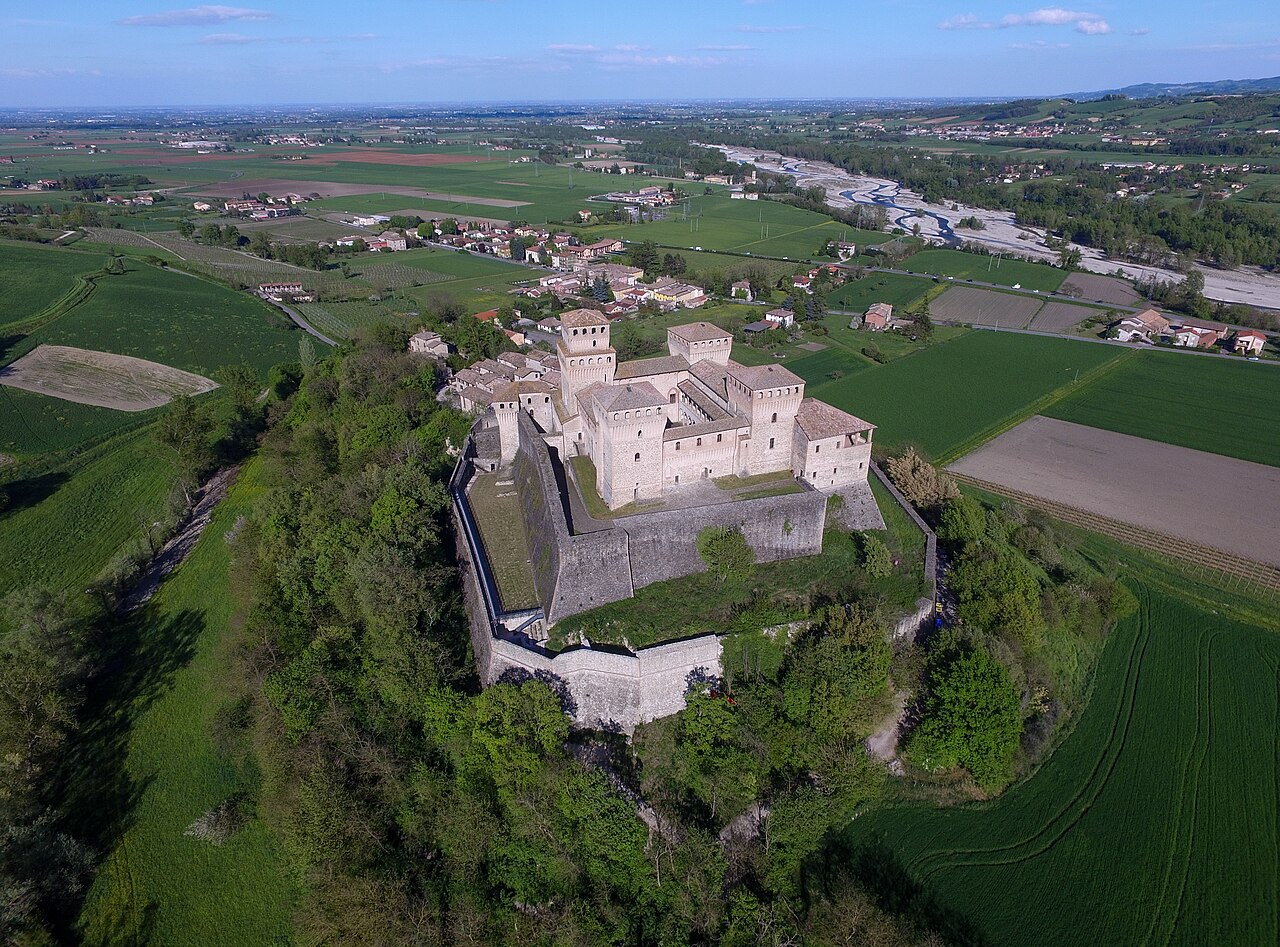
Castello di Montechiarugolo
The Castello di Montechiarugolo stands as a remarkable example of a medieval hill castle in the Emilia-Romagna region of Italy. Perched strategically on a natural escarpment overlooking the Enza valley, this fortress has witnessed centuries of military, noble, and social history, reflecting the turbulent and evolving landscape of northern Italy from the early 12th century onward.
Constructed initially by the influential Sanvitale family around 1121, the castle was designed as a defensive stronghold to control the vital valley routes and protect the surrounding territories. The original structure was part of a network of fortifications that underscored the Sanvitale's regional power. By the mid-13th century, ownership passed to the Guidanselmi family, descendants of Count Guido Anselmo, who further shaped the castle's role in local power struggles.
Throughout the 14th and 15th centuries, the castle endured sieges, destruction, and subsequent reconstructions, reflecting the shifting allegiances and military technologies of the period. Notably, the Visconti family of Milan undertook significant rebuilding after 1348, transforming the fortress into a military garrison. Later, under the Torelli family from 1406, the castle was rebuilt with a distinctive polygonal layout and enhanced fortifications adapted for artillery, marking its evolution from a medieval fortress to a Renaissance stronghold.
Architectural features and defensive design
The Castello di Montechiarugolo exhibits an irregular polygonal plan primarily constructed of brick, centered around two internal courtyards: the larger honor courtyard and a smaller well courtyard. Its position on a natural escarpment overlooking the Enza riverbed provided a commanding vantage point for defense and surveillance.
The castle's defensive system included a wide, deep moat on the valley side, originally spanned by two drawbridges connected to two ravelins, detached triangular outworks designed to protect the moat approaches. Although these ravelins have suffered damage over time, their remnants still testify to the castle's sophisticated defensive planning.
An outer line of defensive walls with bastions at each corner once encircled the castle, modified in the late 15th century to incorporate artillery embrasures for cannon defense. Traces of these fortifications survive near the adjacent historic village, highlighting the transition from medieval to early modern military architecture.
The castle's facades feature characteristic late medieval brickwork with well-preserved Ghibelline merlons—swallowtail-shaped battlements typical of Italian medieval fortifications. A protective roof, supported by corbels with machicolations, now covers the battlements, preserving this distinctive defensive element.
Dominating the complex is the tall central mastio or keep, situated between the two courtyards. Facing the valley, a projecting loggia extends outward, supported by tall corbels and slender sandstone columns with intricately carved lotus-shaped capitals, adding an elegant decorative feature to the fortress's austere military character.
Interior spaces and artistic heritage
The castle's interiors reflect its transformation from a military fortress to a noble residence, especially during the 16th century. The Festive Hall, opening onto the main courtyard, is illuminated by 19th-century neo-Gothic triple windows and decorated with late 16th-century frescoes attributed to the school of Cesare Baglioni. These frescoes combine grotesque and vegetal motifs with monochrome female figures and heraldic shields representing the Torelli family and allied noble houses such as the Visconti and Borromeo.
A particularly precious artwork is a 15th-century fresco of the Annunciation located within a window reveal, attributed to a pupil of Michelino da Besozzo. This fresco exemplifies the elegant Lombard Gothic style with figures of the Archangel Michael and the Madonna.
Other rooms contain fragments of 15th-century frescoes with diamond patterns, inscriptions, and Borromeo coats of arms, alongside 18th-century tempera paintings by Domenico Muzzi allegorizing the four elements, relocated from the Ducal Palace of Colorno.
The so-called "Camera della Pia" holds an 1850 painting depicting Pia dei Tolomei, a literary figure from Dante's Divine Comedy, adding cultural depth to the castle's collection.
Several rooms feature 15th-century frescoes rediscovered and restored in the 20th century, portraying allegories of Fame, Fortune, Martial Virtue, and Abundance. A bedroom possibly used by Pomponio Torelli is entirely frescoed with a 16th-century cycle illustrating allegories of human life, daily activities, and times of day, attributed to painters such as Innocenzo Martini, Giovanni Antonio Paganino, or Cesare Baglioni. The furnishings include a Renaissance bed, a Baroque cradle, a richly carved 17th-century wardrobe, and wooden paneling from a nearby church sacristy.
A small chamber contains an ancient Egyptian mummy known as the "Fata Bema", traditionally believed to be a protective spirit of the castle.
The former chapel overlooks the loggia and is decorated with 17th-century frescoes depicting musical angels and scenes from the life of Saint Francis of Paola.
Gardens and surrounding landscape
To the north of the main courtyard lies the Castellazzo, an old bastion transformed into a formal garden surrounded by high brick walls. Though partially collapsed, these walls once offered expansive views over the adjacent plain. The gardens are planted with hedges, roses, and peonies, reflecting the castle's later use as a noble residence.
The eastern facade's loggia provides panoramic views over the Enza valley, including sights of the Castello di Montecchio and the distant Quattro Castella hills. The loggia features a wooden-beamed ceiling and 15th-century frescoes displaying the coats of arms of the Torelli and Visconti families, framed by green and red lozenge patterns, restored in the late 20th century.
Historical significance and notable events
The Castello di Montechiarugolo has played a significant role in regional history, witnessing sieges, noble intrigues, and military conflicts. The castle was destroyed in 1313 following a siege by Parma's forces due to the Sanvitale family's opposition to the Guelph rulers. It was rebuilt by the Visconti after Parma came under Milanese control in 1348.
Under the Torelli family, the castle became a center of noble power, enduring internal family disputes and artillery attacks during the Italian Wars around 1500. In 1551, it was occupied during the War of Parma and hosted important figures such as King Francis I of France and Pope Paul III.
The execution of Pio Torelli in 1611-1612 for conspiracy against Duke Ranuccio I Farnese led to the confiscation of the castle and its conversion into ducal property. It later served as a storage site and military warehouse, including a gunpowder factory under Duchess Maria Luigia in the early 19th century, which caused damage to its interiors.
During the Napoleonic Wars, the castle was the site of the 1796 Battle of Montechiarugolo, where Austrian troops surrendered to Napoleon's forces. In the 20th century, parts of the castle were used as a civilian internment camp during World War II, housing Jewish refugees and other detainees.
Current condition and visitor experience
Today, the Castello di Montechiarugolo is well preserved and accessible to visitors, offering a rich historical and architectural experience. Key areas open to the public include the main courtyard, the Festive Hall, the Camera di Mezzo, the Hall of the Four Elements, the loggia, the "Cat Room," the Old Room, the "Fata Bema" chamber, and the battlement walkways.
The castle's combination of military architecture, noble residential features, and artistic heritage make it a significant cultural landmark in the Emilia-Romagna region. Its commanding location and well-preserved features provide insight into the evolution of Italian castle design from the medieval period through the Renaissance and beyond.
Frequently asked questions (FAQ)
- What is the historical significance of Castello di Montechiarugolo?
- Castello di Montechiarugolo is a medieval fortress that dates back to the 10th century. It played a crucial role in the defense of the region and has witnessed numerous historical events, contributing to the rich tapestry of Italian history.
- When was Castello di Montechiarugolo built?
- The construction of Castello di Montechiarugolo began in the 10th century, with significant modifications made in the following centuries. Its architecture reflects the evolving styles of different periods, showcasing the castle's importance through the ages.
- Can I visit Castello di Montechiarugolo?
- Yes, visitors are welcome to explore Castello di Montechiarugolo. The castle offers guided tours that provide insights into its history and architecture, making it a great destination for history enthusiasts and tourists alike.
- What are the opening hours for Castello di Montechiarugolo?
- Castello di Montechiarugolo is typically open to visitors from Tuesday to Sunday, with varying hours depending on the season. It is recommended to check the official website for the most current visiting times and any special events.
- Is it possible to access Castello di Montechiarugolo with mobility challenges?
- While efforts have been made to improve accessibility, some areas of Castello di Montechiarugolo may be challenging for visitors with mobility issues due to its historical architecture. It’s advisable to contact the castle administration in advance to inquire about specific accessibility options.
- What are the ticket prices for visiting Castello di Montechiarugolo?
- Ticket prices for Castello di Montechiarugolo vary depending on the type of tour and age of the visitor. Discounts may be available for children, students, and seniors, so checking the official website for updated pricing is recommended.
- When is the best time to visit Castello di Montechiarugolo?
- The best time to visit Castello di Montechiarugolo is during the spring and fall when the weather is mild and pleasant. These seasons also tend to attract fewer tourists, allowing for a more enjoyable experience exploring the castle grounds.
- Are there any nearby attractions to visit along with Castello di Montechiarugolo?
- Yes, the area surrounding Castello di Montechiarugolo is rich with attractions, including charming villages, local vineyards, and beautiful parks. Visitors can also explore the nearby city of Parma, known for its stunning architecture and culinary delights.
Information
Sources & official resources
Verify the information above using these authoritative references.
Loading map...
Visitor reviews
No reviews yet. Been here? Write the first review and help other travelers!
Write the first reviewVisited this castle? Share your experience
Your review helps other travelers and adds first-hand knowledge to our encyclopedia.