Castle of Beja
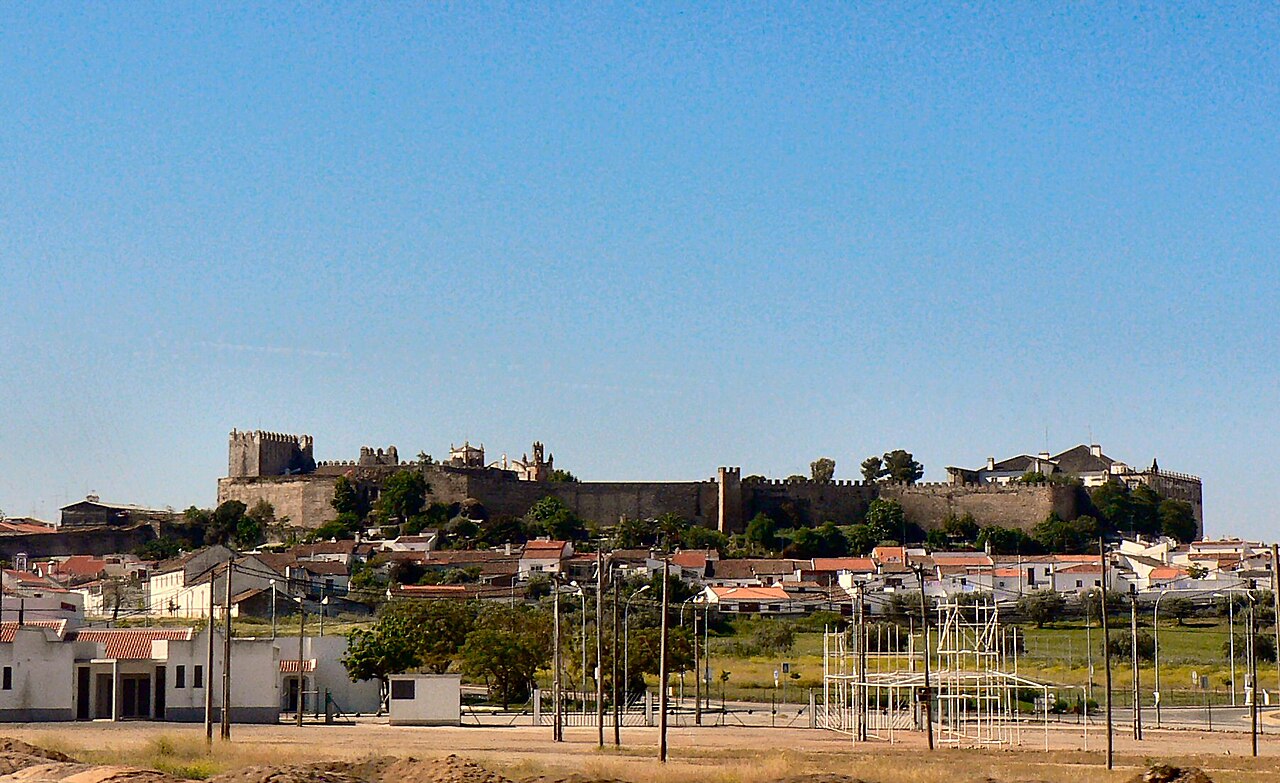
The Castle of Beja stands as a monumental hilltop fortress in the city of Beja, Portugal, embodying centuries of military architecture and historical significance. Its strategic location atop a hill in the northwest corner of the medieval city provided commanding views and defense, integrating with the extensive city walls that encircle Beja. The castle is surrounded by beautifully landscaped gardens and is closely neighbored by important landmarks such as the Se Cathedral, the Chapel of Santo Amaro, and the Hospital da Misericordia, along with historic residences and the municipal palace, making it a central feature of Beja's cultural heritage.
The castle's origins trace back to the Roman era, when the settlement known as Pax Julia was fortified as a key administrative center in the Roman province of Lusitania. The surviving Roman walls, dating from the 3rd to 4th centuries AD, mark the site as a long-standing military hub. Subsequent occupations by the Suebi, Visigoths, and Muslim rulers ensured continuous fortification and habitation through the early medieval period. The castle as it stands today primarily reflects medieval and Renaissance military architecture, with significant enhancements made during the 13th to 17th centuries.
Historical evolution and significance
Roman foundations and early medieval period
The Roman fortifications laid the groundwork for Beja's defensive system, establishing it as Pax Julia, one of Lusitania's principal centers. These early walls, constructed from durable stone masonry, formed the core around which later medieval defenses were built. After the Roman Empire's decline, the site remained strategically vital under the Suebi and Visigothic kingdoms, evidenced by reused carved stones bearing Portuguese shields from the Visigothic period incorporated into the walls. The Muslim conquest introduced new defensive adaptations, maintaining the site's importance through the early Middle Ages.
The reconquista and medieval fortification
During the Christian Reconquista, Beja changed hands multiple times, first seized by King Afonso Henriques in 1159, briefly lost, and finally secured permanently between 1232 and 1234. King Afonso III initiated restoration and strengthening of the fortifications from 1253, funded partly by church tithes. The granting of a town charter in 1254 and confirmation by King Dinis in 1291 marked Beja's growing political and military importance.
King Dinis further enhanced the castle's defenses by constructing the imposing keep tower in 1310, a hallmark of medieval military architecture. This period saw the castle's walls expanded into an irregular pentagonal plan, reinforced with towers and a barbican, providing layered defense. The castle became the principal stronghold of Beja's fortification system, featuring multiple gates including the Évora Gate with its Roman arch and the Portas de Avis.
Renaissance improvements and later military adaptations
The 15th and 16th centuries brought Renaissance influences under King Manuel I, who improved the castle's defenses with vaulted ceilings in the keep and constructed a larger gate, reflecting advancements in military architecture. The castle also gained prominence as the seat of the Duchy of Beja, associated with royal family members.
In the 17th century, during the Portuguese Restoration War, the castle underwent modernization with the design of bastions by French engineer Nicolau de Langres. Although the bastions were not fully completed, these works illustrate the adaptation of the medieval fortress to the evolving needs of gunpowder warfare.
Architectural features and layout
Fortifications and walls
The castle's fortifications follow an irregular pentagonal plan, with two lines of defensive walls partially encircling the site. The walls are constructed of medieval ashlar masonry, some blocks carved with Visigothic shields, topped with parallel prismatic merlons that provided cover for defenders. The walls are supported by numerous towers and corbels, while the barbican protects the northern and southern approaches.
Historically, the walls featured around forty towers and multiple gates, including seven main entrances and two posterns. Today, several Romanesque gates remain, notably the Évora Gate with its Roman arch and the Porta de Moura flanked by large towers, emphasizing its strategic importance.
The keep tower
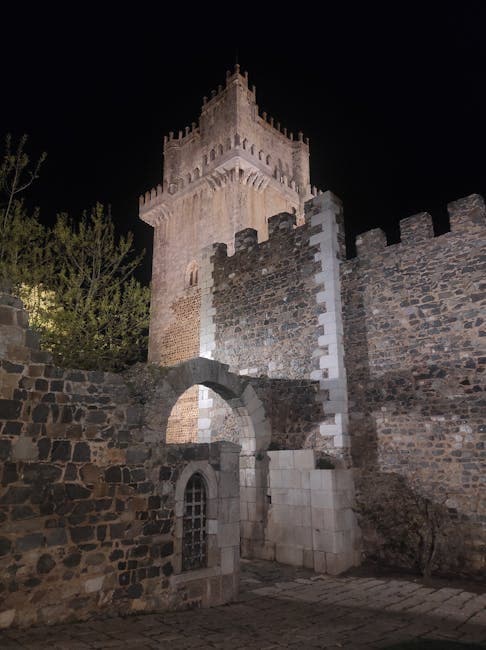
The castle's most striking feature is the keep tower, completed in 1310 under King Dinis. Rising nearly 40 meters, it is the tallest medieval military tower still standing in Portugal. The tower's design is a blend of functional military architecture and artistic detail, with ribbed vault ceilings decorated with vegetal and human motifs inside.
The keep comprises three floors connected by a spiral staircase, with the middle floor featuring an octagonal vault with an eight-pointed star pattern. The exterior is adorned with pyramidal merlons, machicolations, and balconies supported by corbels. Windows include distinctive twin horseshoe shapes and pointed ogival arches, exemplifying Gothic style.
Interior and ancillary buildings
Inside the castle, the main gate opens onto the Praça de Armas, a courtyard historically used for military assemblies. Attached to the inner walls is the two-story Casa do Governador, or Governor's Residence. Its ground floor now houses the Jorge Vieira museum, featuring arched entrances and a chimney, while the upper floor overlooks the barbican area.
Modern history and conservation efforts
Damage and restoration
The castle suffered damage during the Napoleonic invasions in 1808 and the Liberal Wars in the 19th century. Various gates and structures were demolished or rebuilt, including the Moorish Gate and the New Gate of Évora. The 20th century saw recognition of the castle's cultural importance, leading to its designation as a National Monument in 1910.
Subsequent restoration projects from 1938 onward cleared obstructive buildings, repaired walls, and reconstructed key gates such as the Roman arch of the Évora Gate. Archaeological excavations beginning in 2008 uncovered earlier fortifications dating back to the late Bronze Age, deepening understanding of the site's long defensive history.
Recent developments
The keep tower underwent repairs after a balcony collapse in 2014 and was reopened in 2016. The Governor's Residence was converted into a museum honoring sculptor Jorge Vieira, reopening in 2019 and again in 2025 with updated exhibits. These efforts reflect ongoing commitment to preserving and interpreting the castle's rich heritage for visitors and scholars alike.
Visiting the castle of beja
Today, the Castle of Beja is a well-preserved historic site offering visitors a glimpse into Portugal's medieval and Renaissance military architecture. Its elevated position provides panoramic views over the city and surrounding Alentejo landscape. The castle's gardens, museum, and architectural features make it a must-visit destination for history enthusiasts and cultural tourists.
Visitors can explore the castle's walls, towers, and the impressive keep, while also enjoying nearby historic sites such as the cathedral and chapels. The site is accessible and provides educational exhibits that highlight its layered history from Roman times through the modern era.
Frequently asked questions (FAQ)
- How do I get to the Castle of Beja?
- The Castle of Beja is conveniently located in the heart of Beja, Portugal. You can reach it by car, bus, or on foot, as it is well-signposted and accessible from various points in the city.
- What is the historical significance of the Castle of Beja?
- The Castle of Beja is a prominent medieval fortress that dates back to the 13th century. It played a crucial role in the defense of the region during the Reconquista and is a symbol of Portuguese heritage.
- When was the Castle of Beja built?
- The construction of the Castle of Beja began in the late 13th century, specifically around 1258, under the reign of King Afonso III. Over the centuries, it has undergone several renovations, preserving its historical integrity.
- Can I visit the Castle of Beja all year round?
- Yes, the Castle of Beja is open to visitors throughout the year, although hours may vary seasonally. It’s advisable to check the official website for specific opening times during holidays and special events.
- Why is the architecture of the Castle of Beja unique?
- The Castle of Beja features a blend of Gothic and Moorish architectural styles, showcasing its rich history and cultural influences. Its impressive towers and thick walls tell the story of its strategic importance over the centuries.
- Is it possible to access the Castle of Beja for individuals with mobility challenges?
- The Castle of Beja has made efforts to improve accessibility, with ramps and designated pathways for visitors with mobility issues. However, some areas may still pose challenges due to the historical structure.
- What is the best time to visit the Castle of Beja?
- The best time to visit the Castle of Beja is during the spring and autumn months when the weather is mild and pleasant for exploring. Additionally, visiting during weekdays can help you avoid larger crowds.
- Are there any nearby attractions to explore after visiting the Castle of Beja?
- Yes, nearby attractions include the Beja Regional Museum and the historic city center, which are both within walking distance. Exploring these sites will enrich your understanding of the region's history and culture.
- What are the ticket prices for the Castle of Beja?
- Ticket prices for the Castle of Beja are generally affordable, with discounts available for students and seniors. It's best to check the official website for the latest pricing information and any special promotions.
- What are the opening hours of the Castle of Beja?
- The Castle of Beja is typically open from 9 AM to 7 PM during the main tourist season, with reduced hours in the off-season. Always verify current opening hours before your visit to ensure a smooth experience.
Photo gallery

Photo by Linas Liudavicius
Information
Website
Visit websiteSources & official resources
Verify the information above using these authoritative references.
Loading map...
Visitor reviews
No reviews yet. Been here? Write the first review and help other travelers!
Write the first reviewVisited this castle? Share your experience
Your review helps other travelers and adds first-hand knowledge to our encyclopedia.