Castle of Almourol
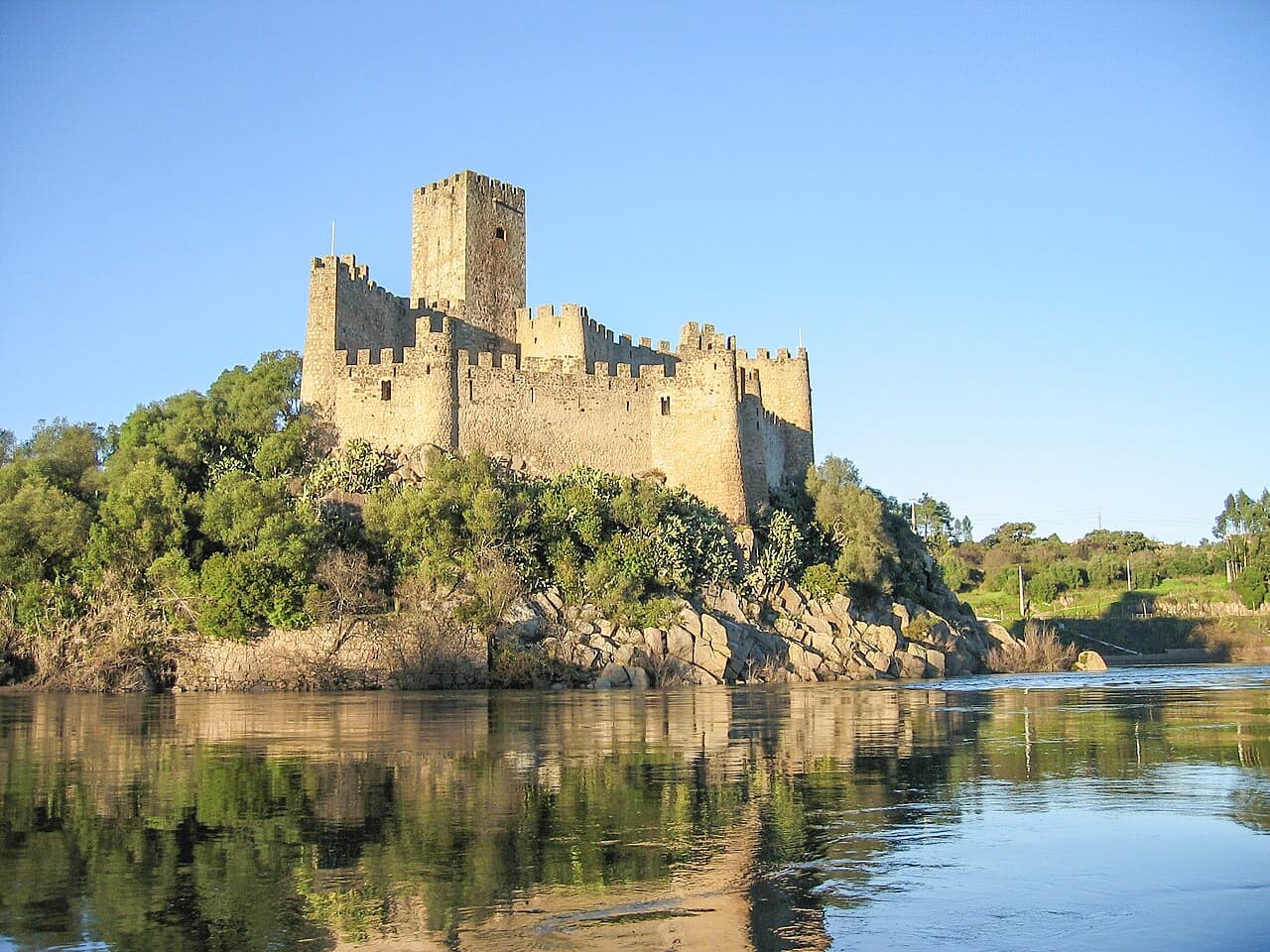
The Castle of Almourol is a striking medieval fortress situated on a small granite islet in the middle of the Tagus River near Vila Nova da Barquinha, Portugal. This hill castle is one of the most emblematic military monuments of the Portuguese Reconquista and represents the enduring influence of the Knights Templar in Portugal. Originally known as Almorolan when conquered in 1129 by forces loyal to the Portuguese crown, it was entrusted to Gualdim Pais, the master of the Knights Templar in Portugal, who undertook the castle’s significant reconstruction starting in 1171.
Historical context and early occupation
The site of the Castle of Almourol has a rich history of human occupation dating back to prehistoric times, as archaeological evidence reveals. The island was successively inhabited by various peoples, including the Alans, Visigoths, and from the 8th century, Muslim groups. Roman coins from the 1st century BCE and medieval artifacts attest to the continuous strategic importance of this location.
During the Christian Reconquista, the castle was captured by King Afonso Henriques in 1129. Recognizing its strategic importance controlling trade and military access along the Tagus River, he assigned the fortress to the Knights Templar, a military religious order tasked with defending the newly formed Portuguese territories.
Templar reconstruction and architectural features
Gualdim Pais, a prominent Templar leader, began rebuilding the fortress in 1171. An inscription above the main gate credits him with the construction of Almourol and other castles, underscoring his pivotal role. The castle's design reflects the 12th-century military architectural innovations introduced by the Templars in western Iberia.
The castle occupies an irregular rectangular area approximately 310 meters long and 75 meters wide, conforming to the uneven granite terrain rising 18 meters above the river. It is primarily constructed from granite blocks bound with mortar.
The fortress is divided into two main levels. The lower exterior courtyard features nine tall circular towers, with four on the west and five on the east side, creating a formidable defensive perimeter. This level also includes the main gate and a smaller postern known as the "porta da traição" or "gate of betrayal." Remnants of a well are also found here, highlighting the castle’s self-sufficiency during sieges.
The upper level contains the keep tower, a square, three-story structure dating from the 12th century. Inside, original stone corbels support wooden beams, and a carved Templar cross pattée is visible above an east-facing window, symbolizing the castle's Templar heritage. The surrounding curtain walls are crowned with battlements and narrow arrow slits for archers, while stone stairways provide access to the chemin de ronde, the walkway along the walls.
Multiple stone doorways connect the various internal sections, facilitating movement and defense within the castle. The irregular shapes of the towers and the robust keep illustrate the practical and symbolic architectural style favored by the Templars.
Later history and conservation efforts
After the suppression of the Knights Templar in 1311, the castle was transferred to the Order of Christ, which inherited many Templar properties in Portugal. Over the centuries, Almourol's military importance waned, and it suffered damage during the devastating 1755 Lisbon earthquake.
In the 19th century, the castle experienced a revival inspired by Romanticism, a cultural movement that idealized medieval architecture. This led to restoration works that included the addition of decorative battlements, reflecting the era's aesthetic preferences rather than purely defensive needs.
During the mid-20th century, under the Estado Novo regime, Almourol was adapted as an official residence of the Portuguese Republic. The Portuguese Army assumed responsibility for the site in the late 1800s and has overseen ongoing conservation efforts to preserve the castle's structural integrity and historical authenticity.
In 2013, a project was launched to create a museum space within the keep tower, enhancing the castle’s role as a cultural and educational site. Since 1910, the castle has been classified as a National Monument of Portugal, highlighting its significance in Portuguese heritage.
Visitor experience and architectural significance
Today, visitors to the Castle of Almourol can explore its well-preserved walls and towers, walk along the battlements, and enjoy panoramic views of the Tagus River and surrounding landscape. The castle’s pathways encircle the fortress, allowing for comprehensive exploration of its architectural features.
The castle’s unique location on a river islet, combined with its robust medieval fortifications, make it an outstanding example of hill castle architecture adapted to a water-surrounded environment. Its blend of military functionality and symbolic Templar elements offers insights into the medieval military strategies and the religious-military orders that shaped Portugal’s formation.
The Castle of Almourol remains a powerful symbol of the Knights Templar’s legacy in Portugal and a testament to the enduring medieval architectural heritage along the Tagus River.
Frequently asked questions (FAQ)
- How do I get to the Castle of Almourol?
- The Castle of Almourol is located on a small island in the Tagus River near Vila Nova da Barquinha, Portugal. Visitors typically reach it by boat tours departing from nearby towns such as Vila Nova da Barquinha or Tancos. Access to the castle is only possible by water, making boat transport the primary means of arrival.
- What is the historical significance of the Castle of Almourol?
- The Castle of Almourol is a key monument of the Portuguese Reconquista and the Knights Templar presence in Portugal. Built and rebuilt in the 12th century by Gualdim Pais, it served as a military stronghold controlling the Tagus River and is a symbol of medieval military architecture.
- When was the Castle of Almourol built?
- The castle was originally captured in 1129 and extensively rebuilt starting in 1171 under the direction of Gualdim Pais, the master of the Knights Templar in Portugal. Its current form largely dates from the 12th century.
- Is the Castle of Almourol open to visitors year-round?
- Yes, the Castle of Almourol is open to visitors throughout the year. However, access depends on boat availability and weather conditions, as the castle is situated on an island in the Tagus River.
- What architectural features are notable at the Castle of Almourol?
- The castle features nine tall circular towers, a square three-story keep tower with a carved Templar cross, curtain walls with battlements, arrow slits, and a chemin de ronde. These elements reflect 12th-century Templar military architecture adapted to a river island setting.
Photo gallery

Information
Sources & official resources
Verify the information above using these authoritative references.
Loading map...
Visitor reviews
No reviews yet. Been here? Write the first review and help other travelers!
Write the first reviewVisited this castle? Share your experience
Your review helps other travelers and adds first-hand knowledge to our encyclopedia.