Castle of Alegrete
The Castle of Alegrete stands prominently in the municipality of Alegrete, Portugal, as a significant medieval fortress whose origins and evolution reflect the turbulent history of the Portuguese borderlands. This hill castle crowns a mountain approximately 503 meters above sea level, offering commanding views that were vital for its defensive role. Its strategic location and robust fortifications made it a key military stronghold throughout the Middle Ages and into the early modern period.
Although traditional accounts attribute the initial reconquest of Alegrete from Muslim control to King Afonso Henriques around 1160, historical evidence firmly places the castle's construction or major rebuilding in the 13th century under King Afonso III. This period marked a critical phase in consolidating Portuguese sovereignty along the border with Castile. The castle's fortifications were part of a broader effort to secure frontier territories following the Treaty of Badajoz (1267), which formalized Alegrete’s integration into the Portuguese realm after negotiations between Afonso III and Alfonso X of Castile.
Medieval origins and early development
Following the treaty, the settlement of Alegrete was granted a foral or charter in 1319 by King Dinis, initiating significant reconstruction and fortification work. The castle's design reflects Gothic military architectural principles prevalent in the late medieval period, featuring an irregular rectangular plan adapted to the mountainous terrain. The fortress occupies the southern portion of a larger walled enclosure that included the original settlement, itself protected by urban fortifications.
Architectural features
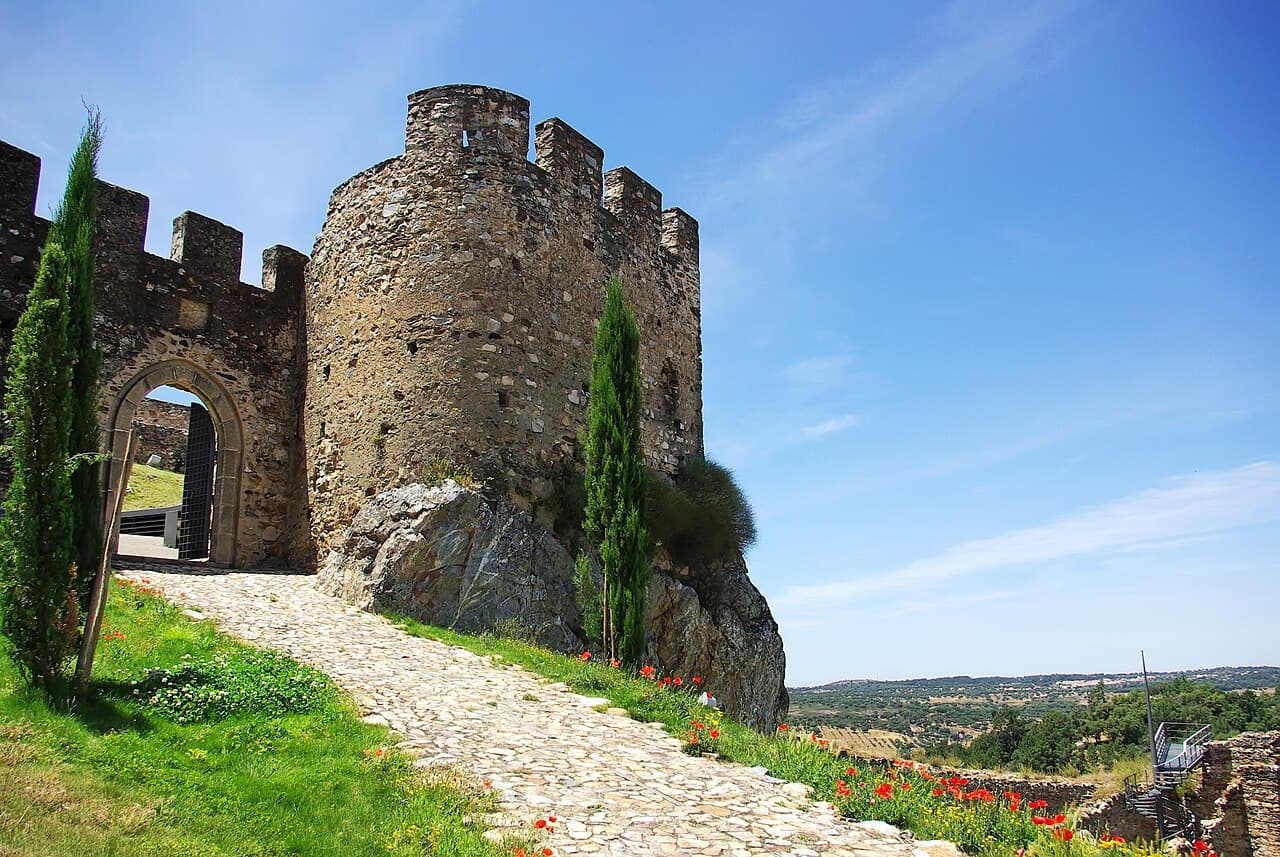
The castle’s main gate is located on the southern side, shielded by a small tower equipped with machicolations—openings that allowed defenders to drop projectiles on attackers below. This gate faces the town interior, emphasizing the castle’s role as the final defensive bastion. On the northern edge, the well-preserved "Vila" Gate exemplifies a Gothic urban entrance, flanked by two small defensive towers or corbels designed for enhanced protection and observation.
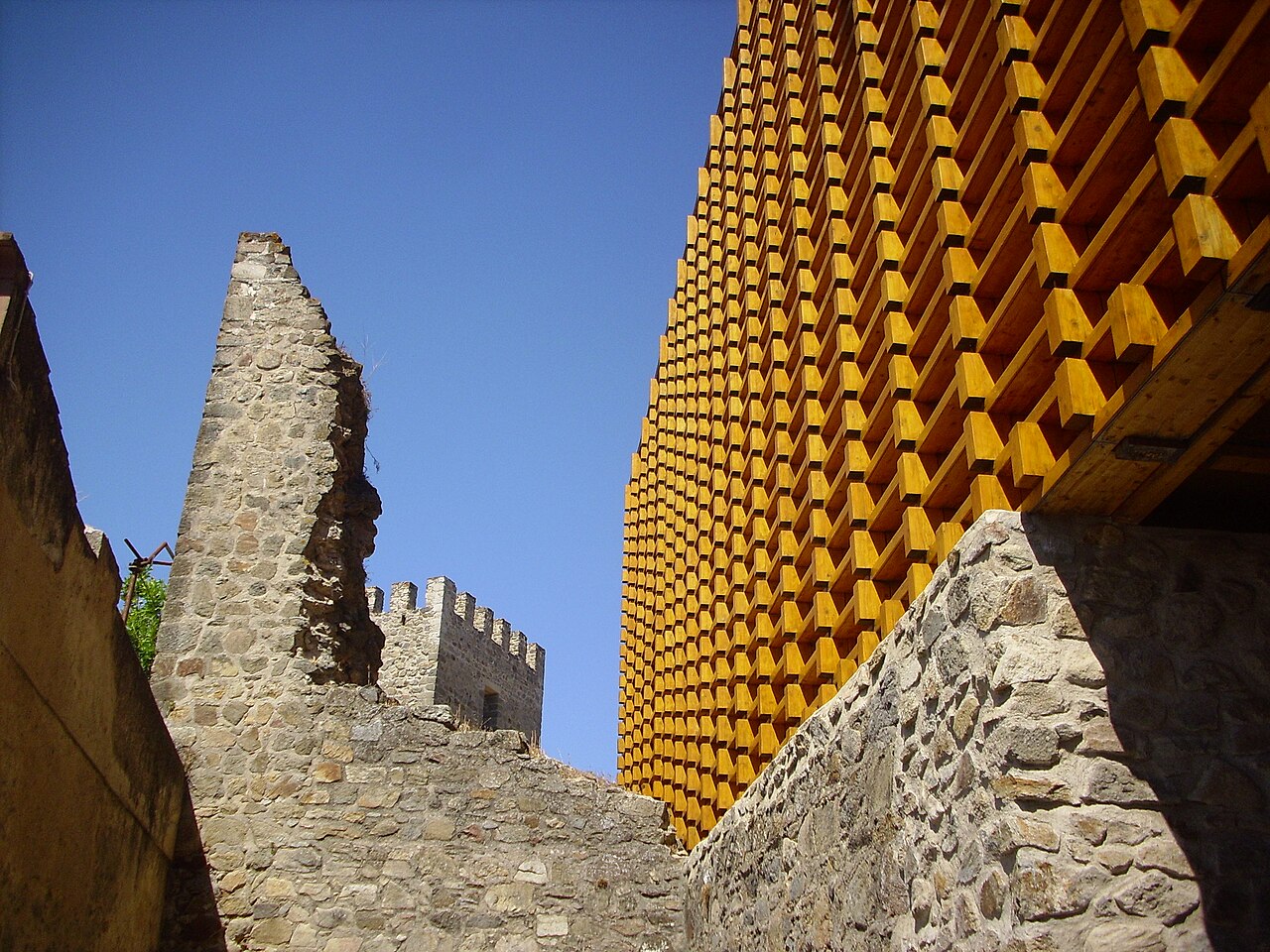
To the east stands a prominent rectangular keep tower rising two floors, adjacent to an integrated cistern used for water storage. The cistern divides the tower internally, with a lower paved floor and a second level accessible from the courtyard, demonstrating the castle’s practical integration of military and logistical needs.
West of the keep lies a smaller tower and an open terrace connecting to an inner patio, while in the south-southwest sector, ruins of a rectangular watchtower or cubel survive. This watchtower is accessible via a staircase attached to the southern curtain wall, illustrating the layered defensive strategy employed.
Strategic importance and military history
The castle’s location made it a crucial stronghold during the frequent conflicts between Portugal and Castile. During the 1383-1385 crisis over the Portuguese succession, the renowned general Nuno Álvares Pereira was based at Alegrete, underscoring its military significance. Although captured by Castilian forces in 1475 during the reign of King Afonso V, the castle was eventually restored to Portuguese control and reaffirmed in importance by a renewed foral granted by King Manuel I in 1516.
Throughout the 16th to 18th centuries, the castle remained relevant in border defense, especially during the 1580 succession crisis and the Portuguese Restoration War. King John IV honored General Matias de Albuquerque with the title Count of Alegrete, and the fortress was maintained as a frontline defense. A notable episode occurred in 1662 when a garrison commanded by La Costé successfully resisted a Spanish siege led by John of Austria. Local tradition recounts that the defenders’ use of regional wine to boost morale played a role in deterring the attackers.
17th-century modernization
From 1664, under the direction of the Marquess of Marialva, the castle underwent repairs and modernization, including the construction of a now-lost bastioned outwork. This enhancement reflected evolving military architecture responding to artillery advancements. The marquisate of Alegrete was established in 1687, with Manuel Teles da Silva as its first holder, further cementing the castle’s noble and strategic status.
Later history and preservation
The castle endured a siege in 1704 led by Philip V of Spain and suffered bombardment during the War of the Oranges (1801). Although the Liberal Wars in the early 19th century brought conflict near the area, the castle itself saw no significant action. The abolition of the municipality and courts in 1855 marked the beginning of the castle’s gradual abandonment.
Recognizing its historical and cultural importance, the Castle of Alegrete was designated a National Monument in 1946. Restoration and consolidation efforts commenced in 1965 and have continued intermittently, aiming to preserve the fortress’s remaining structures and highlight its integral role in Portugal’s border defense history.
Architectural remains and site features
The castle’s surviving structures reveal a complex and layered defensive system. The curtain walls, though largely in ruins, retain traces of trenches and defensive towers, attesting to their former strength. The walls connect to the town defenses, which include the "Santana" Gate, the Rua do Forno Gate, and other towers, forming an integrated protective circuit.
A continuous wall walk or adarve runs along the castle walls, built into the natural terrain, with access provided by a stone staircase. This walkway allowed defenders to patrol the perimeter efficiently.
The castle’s interior is characterized by uneven, rocky flooring that follows the natural mountain contours, integrating the fortress seamlessly into its environment. The combination of military architecture with practical elements like the cistern highlights the castle’s dual function as a stronghold and a sustainable settlement.
Though the 17th-century bastioned outwork no longer survives, historical records confirm its past presence, reflecting the castle’s adaptation to changing military technologies. Together, the castle and its surrounding enceinte formed a connected defensive system protecting both the fortress and the adjacent town.
Cultural and heritage significance
Today, the Castle of Alegrete stands as a testament to centuries of border conflict and architectural evolution in Portugal. Its preservation as a National Monument ensures that visitors can explore a site that encapsulates medieval military ingenuity, Renaissance and early modern adaptations, and the enduring legacy of Portugal’s frontier defenses.
Visitors to the castle can appreciate the blend of Gothic military architecture, the strategic use of natural topography, and the layers of history embedded in its walls and towers. The site offers insight into the military, political, and social history of the region, making it a valuable destination for those interested in medieval fortifications and Portuguese heritage.
Frequently asked questions (FAQ)
- How do I get to the Castle of Alegrete?
- The Castle of Alegrete is located on a hilltop in the municipality of Alegrete, Alentejo region, Portugal. It is accessible by car via local roads leading to the town, followed by a short hike uphill to the castle ruins.
- What is the best time to visit the castle?
- The best time to visit the Castle of Alegrete is during spring and autumn when the weather is mild and pleasant for hiking and exploring the outdoor ruins.
- Are there guided tours available at the castle?
- Guided tours may be available through local tourism offices or heritage organizations. Visitors are encouraged to check in advance for availability to enrich their experience with historical context.
- Is the castle suitable for children and families?
- While the castle ruins offer an engaging historical experience, visitors should be aware that the terrain is uneven and rocky. Families with children should exercise caution and supervise young visitors closely.
- Can I explore the castle walls and towers?
- Visitors can explore much of the castle grounds, including the curtain walls and some towers. However, some areas may be restricted for safety reasons due to the ruinous condition.
Photo gallery

Information
Current owner
Portuguese government
Loading map...
Visitor reviews
No reviews yet. Been here? Write the first review and help other travelers!
Write the first reviewVisited this castle? Share your experience
Your review helps other travelers and adds first-hand knowledge to our encyclopedia.