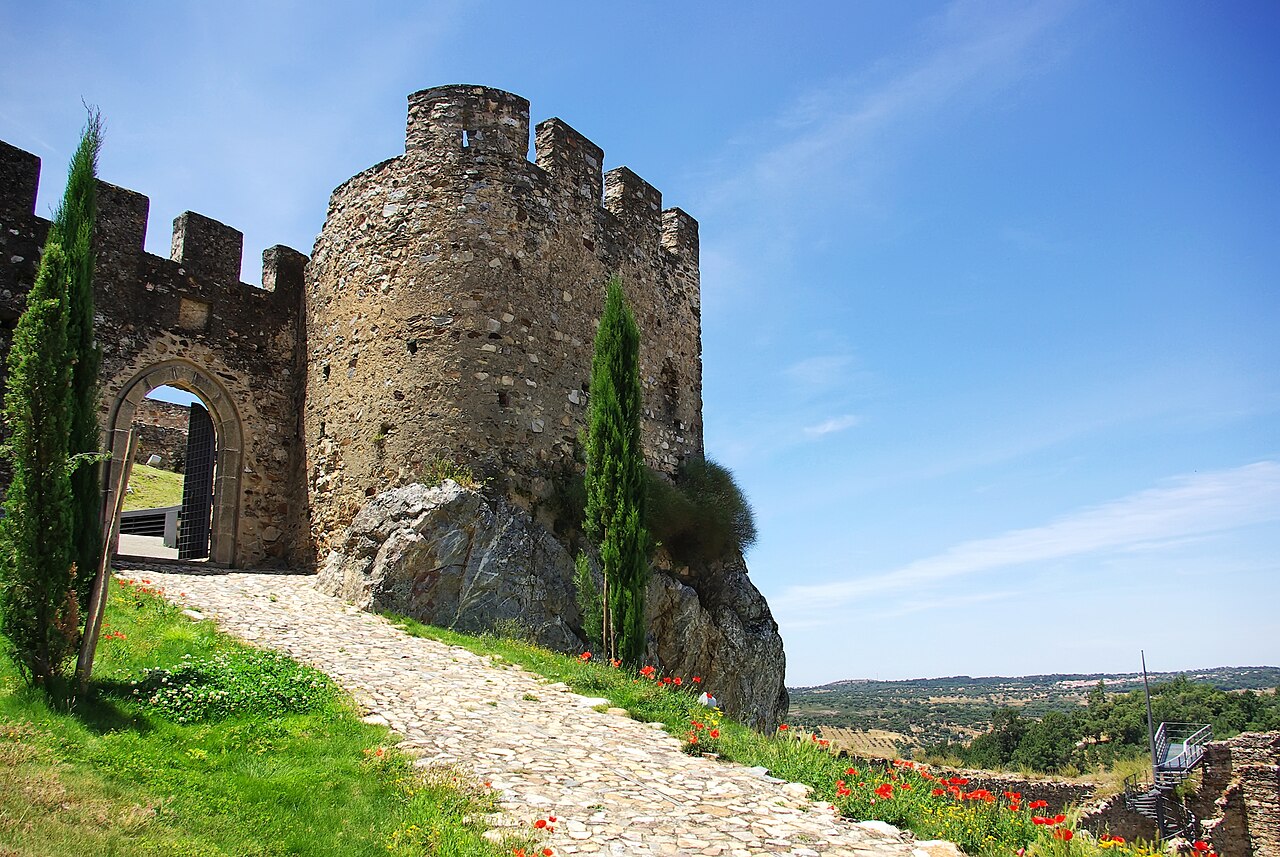
Castelo de Assumar
Castelo de Assumar is a medieval hill castle located in the village of Assumar, within the Monforte municipality in Portugal. This site holds a deep historical significance, with archaeological evidence indicating human settlement since the Neolithic era, well before the castle's construction. The castle's location reflects its strategic importance in the border region of eastern Portugal, an area marked by centuries of conflict and cultural exchange.
Medieval origins and historical context
The region encompassing Assumar was a contested frontier during the early medieval period, experiencing alternating control between Christian and Muslim powers. Initially, the territory was captured by King Afonso Henriques, the first king of Portugal, who laid the foundations of the Portuguese kingdom. However, control was lost to Muslim forces before being definitively reconquered during the reign of King Sancho I. These shifts were part of the broader Reconquista campaigns across the Iberian Peninsula.
In the late 13th and early 14th centuries, under the reign of King Dinis I, Assumar gained prominence. The village was granted special privileges in 1298 and achieved administrative independence from Monforte by 1314. Recognizing the need for defense in a volatile border region, King Afonso IV commissioned the construction of a small defensive castle in 1332. This fortification was intended to protect the local population and assert royal authority, as evidenced by an inscription originally placed on the castle.
Architectural features and fortification
The castle of Assumar was a modest military structure typical of smaller Portuguese fortifications of the early 14th century. While detailed architectural plans have not survived, the castle likely featured a curtain wall enclosing the settlement, providing a basic defensive perimeter. Today, only a small fragment of this original curtain wall remains visible within the village, offering a rare physical link to the medieval fortress.
The castle's design would have included essential defensive elements such as battlements and possibly a gatehouse, though no substantial remains of these survive. The fortification's scale and construction reflect its role as a protective refuge rather than a large-scale military stronghold.
Religious and military significance
The castle's history intertwines with both military and religious developments. During the 1383–1385 crisis, a civil war triggered by the death of King Ferdinand I without a male heir, Assumar played a supportive role. Following the Battle of Atoleiros, the renowned Constable Nuno Álvares Pereira is said to have taken refuge in the village's Church of Nossa Senhora dos Milagres. This highlights Assumar's strategic and symbolic importance during a period of national upheaval.
In the 15th century, the castle was entrusted to local nobility, with King João II appointing Gonçalo Álvarez as alcaide-mor, or chief governor, of the castle and village. This position granted him ownership of the castle and control over royal lands and tolls, reflecting the feudal practices of frontier governance prevalent at the time.
By the early 16th century, the castle and village were documented by the scribe Duarte de Armas around 1509, providing one of the earliest visual records of Assumar. At this time, Gonçalo Álvares de Abreu served as alcaide, continuing the lineage of local governance.
Conflicts and decline
The castle's strategic location made it a target during later military conflicts. In 1662, during the Portuguese Restoration War aimed at ending Spanish rule, the castle was captured by Spanish forces led by Don Juan of Austria. This occupation caused significant damage to the fortifications. A subsequent occupation in 1701 further undermined the castle's defensive capabilities.
By the 19th century, the castle had fallen into disrepair, with much of the structure demolished or deteriorated. Today, only scant remains survive, including a small section of the original curtain wall and an important epigraphic inscription.
Preservation and archaeological remains
The most notable surviving artifact is an epigraphic inscription commemorating the castle's founding under King Afonso IV. Originally affixed to the castle itself, this inscription was later moved to the south façade of the Church of Nossa Senhora dos Milagres and subsequently relocated to the church tower in the 19th century. It remains preserved there as a tangible link to the castle's medieval past.
Physically, the only visible structural remnant of the castle is a small segment of the original curtain wall, which still stands within the village landscape. These remains, although limited, provide valuable insight into the castle's defensive role and the historical layering of the site.
Despite its historical significance, the castle has not been officially designated as a protected heritage site by Portuguese authorities. Nevertheless, the combination of the inscription and surviving wall fragment constitutes an important archaeological and cultural record, reflecting Assumar's military, administrative, and religious history.
Cultural heritage and visitor information
While the castle itself offers limited physical remains, the village of Assumar and its church continue to embody the historical legacy of this medieval fortification. Visitors interested in Portuguese medieval history and border fortifications can explore the site to appreciate the layers of history embedded in the landscape.
The preserved inscription in the church tower provides a focal point for understanding the castle's origins and significance. The surrounding region, rich in historical sites, offers additional opportunities to explore Portugal's medieval heritage.
Frequently asked questions (FAQ)
- What is the historical significance of Castelo de Assumar?
- Castelo de Assumar played a strategic role during the medieval period, especially in the border conflicts between Christian and Muslim forces and later during the Portuguese Restoration War.
- Can I visit the remains of Castelo de Assumar?
- Yes, visitors can see the small remaining section of the castle's curtain wall and the epigraphic inscription preserved in the Church of Nossa Senhora dos Milagres in the village of Assumar.
- When was Castelo de Assumar built?
- The castle was constructed in 1332 under the commission of King Afonso IV to protect the village of Assumar in a turbulent border region.
- What remains of Castelo de Assumar today?
- Today, only a small fragment of the original curtain wall and an important epigraphic inscription relocated to the church tower remain from the castle.
- Why was the castle important during the 1383–1385 crisis?
- During the 1383–1385 crisis, Castelo de Assumar served as a refuge and rallying point, with Constable Nuno Álvares Pereira reportedly staying in the village church after the Battle of Atoleiros.
Information
Loading map...
Visitor reviews
No reviews yet. Been here? Write the first review and help other travelers!
Write the first reviewVisited this castle? Share your experience
Your review helps other travelers and adds first-hand knowledge to our encyclopedia.