Castle of Alcalá la Vieja
The Castle of Alcalá la Vieja stands as a significant medieval fortress located in the municipality of Alcalá de Henares, Spain. Its origins trace back to the end of the 10th century during the period of the Caliphate of Al-Hakam II, when Muslim forces constructed the fortress as a strategic watchtower to oversee and defend the access routes along the Henares river. This castle was pivotal in controlling the frontier between the Islamic territory of Al-Andalus and the advancing Christian kingdoms to the north.
Situated atop the Cerro del Castillo hill at an elevation of 630 meters, the castle commands a dominant position over the southern bank of the river. The site was carefully chosen to control the vital communication and trade route connecting Toledo and Zaragoza. Initially known as Qal’at ‘Abd al-Salam, the fortress was surrounded by a fortified settlement that gradually grew to overshadow the older Roman city of Complutum, which lay across the river but was more vulnerable to northern incursions.
Historical significance and reconquest
The earliest documented mention of the castle dates to 1009, marking its importance in the early medieval period. In 1118, the castle fell to Christian forces after a siege launched from the nearby hills of Malvecino and La Veracruz. This conquest was a crucial moment in the Reconquista, as the fortress and its surrounding settlement came under the jurisdiction of the Archdiocese of Toledo. The Christian rulers initiated a repopulation program focused on the Campo Laudable area, blending secular and ecclesiastical efforts to consolidate control over the reclaimed territory.
Throughout the 14th and 15th centuries, the castle underwent significant renovations and fortifications, notably under the direction of Archbishop Pedro Tenorio of Toledo. These enhancements reflected the castle’s ongoing strategic importance during the late medieval period, adapting its defenses to the evolving military technologies and political landscape.
Architectural features and defensive structures
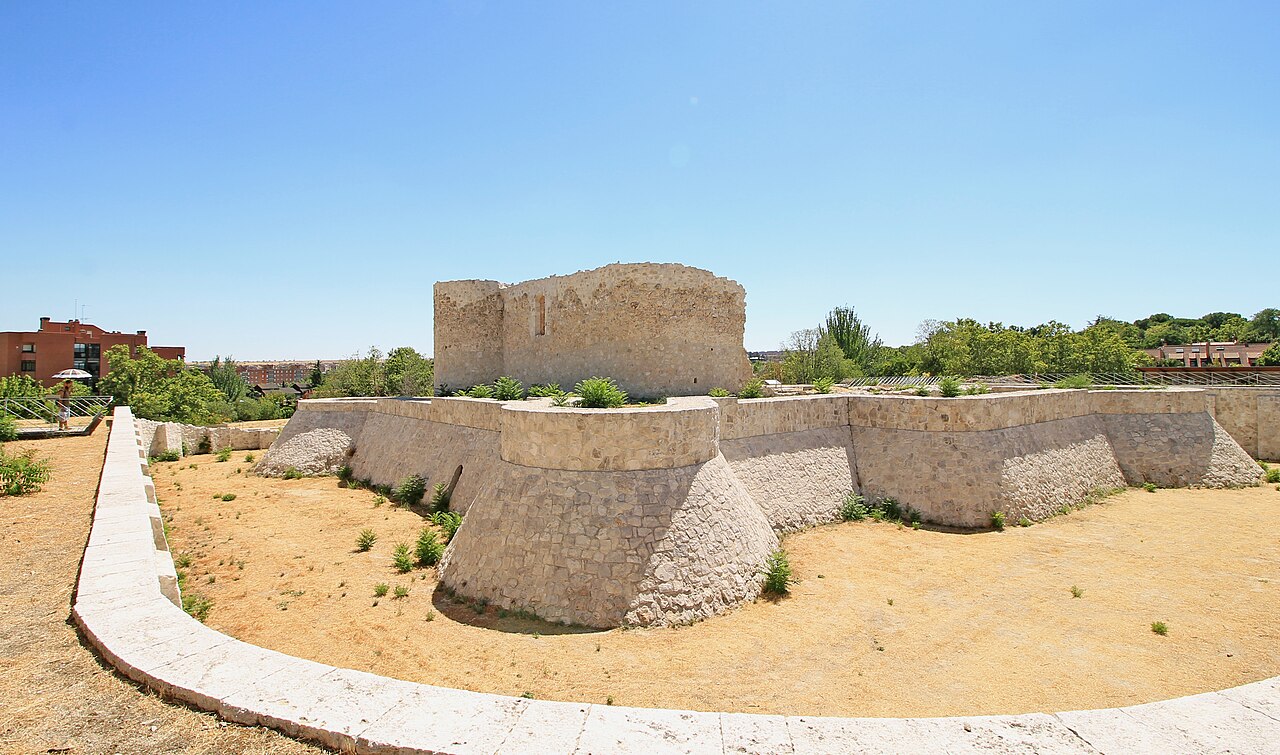
The Castle of Alcalá la Vieja occupies approximately two hectares on an irregularly shaped plateau adapted to the natural contours of the hill. Its defensive perimeter was defined by a robust medieval wall interspersed with rectangular towers spaced between 10 and 35 meters apart. Today, visitors can observe remnants of this wall and the foundations or fragments of nine towers, with two towers still standing prominently.
Albarrana tower and main entrance
One of the most notable surviving structures is a 14th-century albarrana tower, a type of detached defensive tower designed to provide flanking fire along the curtain walls. Positioned near the main entrance, this tower was constructed using large ashlar stones combined with brick and lime mortar, showcasing advanced masonry techniques of the period. Restoration efforts in 1984 stabilized and partially rebuilt this tower, preserving its original defensive function and medieval character.
The main entrance itself originally featured a ramp passing beneath two Andalusian horseshoe arches, a hallmark of Islamic architectural influence characterized by their rounded, narrow shape extending beyond a semicircle. Although only the impost line and the first granite voussoir remain visible today, these elements provide important insights into the castle’s Islamic origins and architectural heritage.
Highest point tower and construction techniques
The second standing tower is located at the highest point of the hill and has a rectangular floor plan. Its construction utilized reused ashlar stones set within a core of lime and rubble. A landslide damaged the tower’s outer face, which was later reconstructed using tapia, a traditional technique involving compacted rammed earth. This restoration choice reflects both the original local building methods and a commitment to maintaining historical authenticity.
Internal features and infrastructure
Within the castle’s enclosure, archaeological excavations have revealed three silos used for storing grain and other provisions, highlighting the fortress’s role in sustaining a resident population during times of siege. Additionally, a rectangular underground cistern covered by a barrel vault supported by transverse semicircular arches was uncovered, demonstrating the settlement’s capacity for water storage vital for survival during prolonged conflicts or droughts.
Surrounding settlement and urban development
The fortress was not an isolated military installation but the center of a small yet stable urban nucleus that extended over approximately 28 hectares across adjacent hills separated by ravines. This area included two suburbs that remained inhabited until the 16th century: one located on the hilltop above the castle and a larger suburb situated across the ravine near the fortress. These suburbs illustrate the enduring community life connected to the castle’s defensive and administrative roles.
Decline and modern preservation efforts
With the gradual decline of its strategic importance, the Castle of Alcalá la Vieja entered a period of abandonment and decay from the later medieval centuries onward. Despite this, the site has been the focus of modern archaeological research and restoration initiatives, notably those undertaken by Spain’s Ministry of Culture in 1984. These efforts aimed to document, stabilize, and preserve the castle’s remains, ensuring that this key monument of medieval military architecture and Islamic-Christian frontier history continues to be accessible and informative for future generations.
Today, the castle stands as a testament to the complex historical layers of Alcalá de Henares, reflecting its transformation from a Muslim frontier fortress to a Christian stronghold and its role in shaping the region’s cultural landscape.
Frequently asked questions (FAQ)
- What is the historical significance of the Castle of Alcalá la Vieja?
- The castle was a strategic frontier fortress during the Islamic period and played a key role in the Christian Reconquista, marking the transition of control in the region.
- How can I visit the Castle of Alcalá la Vieja?
- The castle is open daily from 10:00 to 18:00 with free admission, allowing visitors to explore its ruins and learn about its history.
- What architectural features are notable at the castle?
- Notable features include the 14th-century albarrana tower, remnants of Andalusian horseshoe arches at the main entrance, and a rectangular tower at the hilltop restored using traditional tapia techniques.
- Is the castle accessible for visitors with mobility issues?
- Due to the hilltop location and uneven terrain, accessibility may be limited for visitors with mobility challenges. It is advisable to check with local tourist information for assistance options.
- When was the castle originally built?
- The castle was initially constructed in the late 10th century by Muslim forces under the Caliphate of Al-Hakam II as a watchtower and defensive stronghold.
Information
Opening hours
10:00-18:00, daily
Ticket prices
Free
Current owner
Spanish Ministry of Culture
Loading map...
Visitor reviews
No reviews yet. Been here? Write the first review and help other travelers!
Write the first reviewVisited this castle? Share your experience
Your review helps other travelers and adds first-hand knowledge to our encyclopedia.