Castle Donovan
Castle Donovan, also known as Castledonovan, is a striking example of a 16th-century Irish tower house located in the townland of the same name on the east bank of the River Ilen in County Cork, Ireland. Perched on a prominent rocky outcrop, the castle commands a strategic vantage point overlooking the surrounding valley, embodying the defensive architecture typical of its era. This imposing structure was initially constructed by the Gaelic O'Donovan family, specifically the Clann Cathail sept, around the mid-16th century, with the primary purpose of guarding the northern border of their lands.
Early history and construction
The castle is believed to have been built circa 1560 by Donal 'of the Hides' O'Donovan, the Lord of Clancahill, possibly on the site of an earlier fortification. Originally known as Sowagh Castle, it served as a fortified residence and defensive stronghold for the O'Donovan clan. Donal 'of the Hides' was a prominent Gaelic lord who died in 1584, after which his son, Donal II O'Donovan, inherited the castle.
Donal II undertook significant repairs and alterations to the castle during the 1620s, although he did not reside there permanently, having moved the family's principal residence to Rahine Manor on the coast to better protect their maritime interests. The castle's name transitioned to Castle Donovan following a land regrant issued by King James II of England in 1615, cementing its association with the O'Donovan family identity.
Architectural features and layout
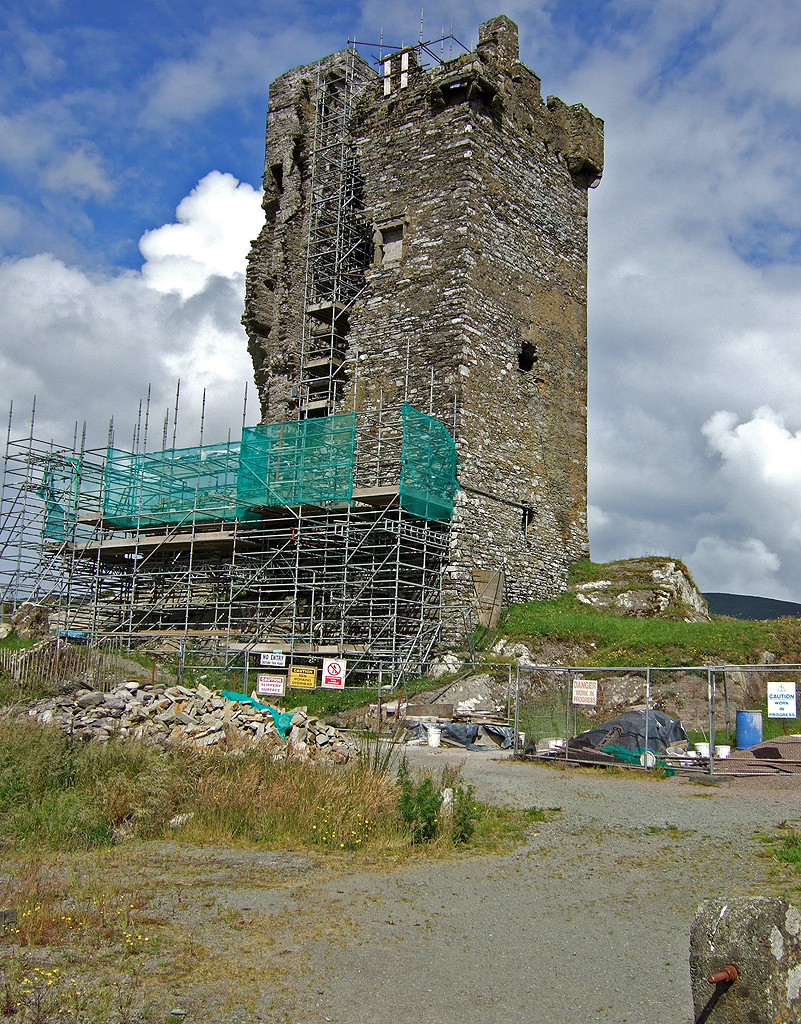
Castle Donovan is a classic example of a Renaissance-period Irish tower house, rising approximately 18 meters (60 feet) tall. It is built of robust masonry on a substantial rock foundation, which provided natural defense and stability. The tower house features thick stone walls designed to withstand sieges and artillery attacks, a testament to the turbulent times during which it was constructed.
The castle originally included a bawn, a walled courtyard typical of Irish castles, and several outbuildings that supported the household and defensive functions. Although these ancillary structures were still visible in the early 19th century, they have since disappeared. The castle's interior includes a spiral staircase (or winding staircase) within the surviving sections of the tower, which was a defensive architectural feature allowing controlled access between floors.
Siege and destruction in the 17th century
During the 1640s, Castle Donovan became embroiled in the conflicts of the Irish Confederate Wars and the English Civil War. Donal III O'Donovan, a staunch supporter of the Stuart monarchy, sided with the Royalists and participated in the 1641 Rebellion. In retaliation, Oliver Cromwell's forces attacked the castle in 1649, bombarding it with cannon fire. This assault caused severe damage, including a significant explosion that left large cracks and structural weaknesses, particularly in the southwest corner.
The damage was so extensive that the castle was rendered uninhabitable and subsequently abandoned. By the mid-17th century, the castle and its lands were confiscated and granted to Nathaniel Evanson, a lieutenant in Cromwell's army, but the castle was never rebuilt or reoccupied as a residence.
Later history and conservation
Over the centuries, the castle's ruins deteriorated further. In 1936, the southwest corner collapsed due to the previous damage and natural decay. Despite this, more than two-thirds of the tower still stands, providing a remarkable glimpse into Irish Renaissance military architecture.
In the 19th century, the castle attracted antiquarian interest. Philip Dixon Hardy documented a visit in 1828, recording the presence of outbuildings that have since vanished. More recently, between 2001 and 2014, the Office of Public Works undertook conservation efforts to stabilize and preserve the remains of Castle Donovan, recognizing its status as a National Monument of Ireland.
Visiting castle donovan today
Castle Donovan is freely accessible to the public and remains a popular site for visitors interested in Irish history and architecture. While the tower itself is not fully accessible—only a small hallway can be entered—the ruins offer an evocative experience of a once-formidable stronghold. The castle's scenic location on the rocky promontory overlooking the River Ilen enhances its appeal, combining natural beauty with historical significance.
The visible artillery damage, the surviving spiral staircase, and the imposing stone walls all contribute to the castle's atmosphere, making it a compelling destination for those fascinated by Ireland's medieval and early modern heritage.
Frequently asked questions (FAQ)
- How do I get to Castle Donovan and what should I expect when visiting?
- Castle Donovan is located in County Cork, Ireland, accessible by local roads leading to the townland of Castledonovan. Visitors should prepare for a walk to the rocky outcrop where the castle stands. The site is free to enter, but access inside the tower is limited to a small hallway due to safety concerns.
- What is the historical significance of Castle Donovan?
- Castle Donovan was built in the 16th century by the O'Donovan family as a defensive tower house. It played a role in the Irish Confederate Wars and was heavily damaged by Oliver Cromwell's forces in 1649, marking it as a symbol of Gaelic resistance and the tumultuous history of Ireland in that era.
- When was Castle Donovan built and who was responsible for its construction?
- The castle was constructed around 1560 by Donal 'of the Hides' O'Donovan, Lord of Clancahill, possibly on the site of an earlier fortification. His son later made repairs in the 1620s.
- Can I explore the interior of Castle Donovan?
- Access to the interior of Castle Donovan is limited. Visitors can enter a small hallway in the tower, but the main tower and upper floors are not open due to structural instability and preservation efforts.
- Why was Castle Donovan attacked by Cromwell's forces?
- Castle Donovan was attacked in 1649 because Donal III O'Donovan supported the Stuart monarchy and participated in the 1641 Rebellion against English rule. Cromwell's forces targeted the castle as part of their campaign to suppress Royalist and Irish resistance.
Information
Website
Visit websiteSources & official resources
Verify the information above using these authoritative references.
Loading map...
Visitor reviews
No reviews yet. Been here? Write the first review and help other travelers!
Write the first reviewVisited this castle? Share your experience
Your review helps other travelers and adds first-hand knowledge to our encyclopedia.