Castle Campbell
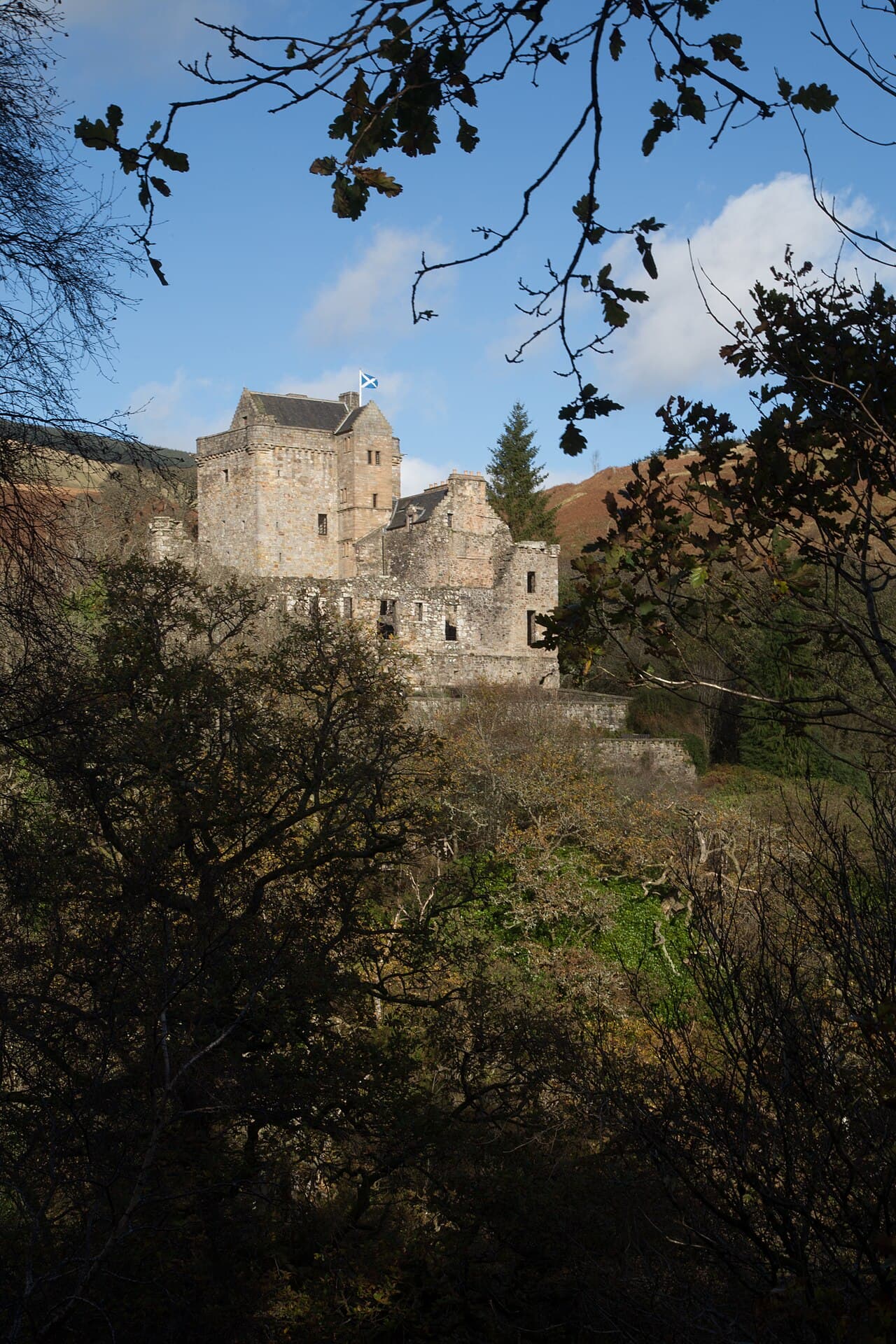
Castle Campbell stands prominently above the town of Dollar in central Scotland, commanding views over the Devon Valley and embodying centuries of Scottish history. This late medieval hill castle was the principal lowland seat of the earls and dukes of Argyll, chiefs of Clan Campbell, from the 15th to the 19th century. Its strategic location on a naturally defended promontory bordered by steep gorges enhanced its defensive capabilities, while its architectural evolution reflects the changing needs and fortunes of its noble owners.
The site of Castle Campbell may have origins dating back to the 12th century, possibly featuring an earlier motte or fortified mound. The present tower house was constructed around 1430, likely commissioned by John Stewart, Lord Lorne, or his close kin. This early phase is documented by a 1466 papal bull condemning an attack on the "Place of Glom," the castle's original name before it was renamed in the late 15th century after the Campbells.
Early history and acquisition by the campbells
By the mid-15th century, ownership of the castle transitioned to the Campbells. Around 1460, Colin Campbell, 1st Earl of Argyll, acquired the property through marriage to Isabel Stewart, daughter of Lord Lorne. This marriage marked a significant expansion of Campbell influence from their traditional western stronghold in Argyll into central Scotland. In 1490, the castle's name was officially changed from Castle Gloom to Castle Campbell, symbolizing the clan's rising prominence and royal recognition by King James IV and the Scottish Parliament.
Architectural development and expansions
The castle's core structure centers on a four-story tower house built in the mid-1400s, featuring defensive design elements such as limited windows on the vulnerable north side. Surrounding the tower is a high curtain wall enclosing a courtyard, with a late 16th-century gatehouse equipped with gun loops to accommodate emerging firearm technology.
The initial castle layout included the tower and ancillary buildings arranged around the courtyard and gardens. The east range was likely the first addition, followed by the construction of the substantial south range after 1493 under the 2nd Earl of Argyll. This south wing housed important residential spaces, including a state apartment with a large hall, outer chamber, and bedchamber, all featuring large south-facing windows overlooking terraced gardens and the valley.
In the late 16th century, the castle underwent significant enhancements under Archibald Campbell, 7th Earl of Argyll. The east range was rebuilt to connect the south range with refurbished guest chambers in the tower. This included a distinctive two-arched loggia facing the courtyard and a polished ashlar masonry façade. Behind the façade were galleries and new staircases providing access to various parts of the castle, reflecting Renaissance architectural influences and the desire for greater comfort and style.
Interior features and furnishings
Inside the tower, a new spiral staircase was added around 1600, replacing the older stairwell which was converted into storage. The third floor features a stone ceiling adorned with two Green Man masks, symbolic carvings representing nature and rebirth, from which chandeliers were suspended. A detailed 1595 inventory lists 47 beds and numerous furnishings including tapestries and carpets, indicating the castle's capacity to accommodate a large retinue of residents and guests.
Castle campbell and the protestant reformation
During the 16th century, Castle Campbell played a pivotal role in Scotland's religious upheavals. The 4th Earl of Argyll embraced the Protestant Reformation and became a leading Protestant lord. The castle hosted John Knox, the prominent Calvinist preacher, who delivered sermons there around 1556. This association with the Reformation highlighted the castle as a center of religious and political power for the Campbells.
In 1563, Mary, Queen of Scots stayed at Castle Campbell to attend the marriage of Margaret Campbell, sister of the 5th Earl, to James Stewart, Lord Doune. However, the castle was soon embroiled in the Chaseabout Raid of 1565, a rebellion by Protestant lords against Queen Mary and her consort Lord Darnley. The castle was surrendered to the queen during this conflict, illustrating its strategic and symbolic importance.
17th century conflicts and decline
In the 17th century, the castle remained central to the turbulent religious and political conflicts of Scotland. Archibald Campbell, 8th Earl of Argyll, emerged as a leader of the Presbyterian Covenanters opposing Royalist forces led by James Graham, 1st Marquess of Montrose. In 1645, Montrose's troops devastated the lands around Castle Campbell but did not besiege the castle itself.
Following the execution of King Charles I, the Campbells initially supported Charles II, with Argyll famously crowning him at Scone in 1651. However, Argyll later submitted to Oliver Cromwell's Commonwealth, and in 1653, Cromwell's forces garrisoned Castle Campbell. The following year, Royalist rebels attacked and burned parts of the castle during two nights of destruction, leaving charred timbers that were uncovered in 1980s excavations.
After the Restoration in 1660 and the execution of Archibald Campbell, 1st Marquis of Argyll, the family shifted their primary residence to Argyll's Lodging in Stirling, leading to the castle's gradual abandonment. It saw brief military use during the Jacobite rising of 1715 but was largely left to decay thereafter.
Modern history and preservation efforts
In 1805, the castle passed out of Campbell ownership when sold to Crawford Tait of Harviestoun. Later, in 1859, it was acquired by Sir Andrew Orr, a former Lord Provost of Glasgow. His son, James Orr, conducted archaeological excavations in the 1870s, uncovering stained glass fragments from the south range windows.
Since 1948, Castle Campbell and the surrounding Dollar Glen have been under the care of the National Trust for Scotland and managed by Historic Scotland as a scheduled ancient monument. Restoration works have included re-roofing the main tower and archaeological investigations revealing the castle's layered history.
Architectural features and layout
The castle's layout reflects its dual roles as a defensive stronghold and noble residence. The tower house rises four stories and is surrounded by a high curtain wall enclosing a courtyard. The gatehouse with gun loops illustrates adaptations to early firearm warfare. The south range contains the grand living quarters with large windows and symmetrical staircases emphasizing comfort and status.
The east range connects the south wing to the tower's guest chambers and includes the elegant loggia and galleries, demonstrating Renaissance influences and the growing importance of aesthetic appeal alongside defense.
Within the courtyard are terraced gardens descending towards the south, featuring a rocky outcrop known as John Knox's Pulpit, a natural platform traditionally associated with the preacher's sermons. The castle also housed functional spaces such as storerooms, a kitchen, and a prison cell.
Cultural significance and visitor experience
Castle Campbell remains a powerful symbol of the Campbell clan's heritage and Scotland's religious and political history. Its well-preserved structures and scenic setting attract visitors interested in medieval architecture, Scottish history, and the Reformation era.
Visitors can explore the castle's tower house, courtyard, and terraced gardens, gaining insight into the lifestyle of Scottish nobility from the 15th to 17th centuries. The castle's connection to figures such as John Knox and Mary, Queen of Scots enriches the historical narrative presented on-site.
Today, Castle Campbell is managed by Historic Scotland, which ensures its preservation and accessibility. The castle offers a tangible link to Scotland's complex past, making it a significant heritage attraction in the Central Scotland region.
Frequently asked questions (FAQ)
- How do I get to Castle Campbell?
- Castle Campbell is located in Dollar, Scotland, and can be accessed by car or public transportation. The nearest train station is in Alloa, from where you can take a bus or taxi to reach the castle. Be sure to check local transport schedules for the most convenient routes.
- What is the historical significance of Castle Campbell?
- Castle Campbell, originally known as Castle Gloom, is steeped in history dating back to the 15th century. It served as a stronghold for the Campbell family and played a key role in the turbulent Scottish history, particularly during the Wars of the Scottish Independence. The castle is a testament to Scotland's feudal past and showcases the evolution of medieval architecture.
- When was Castle Campbell built?
- Construction of Castle Campbell began in the 15th century, with significant modifications made in the 16th century. Originally a fortress, it was transformed into a residence that reflected the power and influence of the Campbell family. Today, visitors can explore its remains and imagine life during its heyday.
- Can I take a guided tour of Castle Campbell?
- Yes, guided tours are available at Castle Campbell, providing visitors with in-depth knowledge about its history and architecture. Guides share fascinating stories and insights, enhancing the experience of exploring this historic site. It’s advisable to check the castle's official website for tour availability and times.
- Why is Castle Campbell a popular tourist destination?
- Castle Campbell is popular due to its stunning location and breathtaking views of the surrounding countryside. The castle's rich history and well-preserved architecture attract history enthusiasts and photographers alike. Additionally, the picturesque gardens and walking trails make it an ideal spot for a relaxing day out.
- Is it possible to visit Castle Campbell year-round?
- Castle Campbell typically opens to visitors from April to October, with varying hours depending on the season. It’s recommended to check the official website for the most current opening hours and any seasonal events. During winter months, the castle may be closed for maintenance.
- What are the ticket prices for Castle Campbell?
- Ticket prices for Castle Campbell are generally affordable, with discounts available for students, seniors, and children. Entry fees help support the preservation of the site and its maintenance. For the most accurate pricing, please refer to the official site or visitor center upon arrival.
- What is the best time to visit Castle Campbell?
- The best time to visit Castle Campbell is during the late spring and summer months when the weather is generally warmer and the gardens are in full bloom. This season offers the most pleasant conditions for exploring the castle and its grounds. However, visiting in autumn can also provide beautiful foliage views.
- Are there any nearby attractions to Castle Campbell?
- Yes, there are several nearby attractions, including the charming village of Dollar and the beautiful Dollar Glen, which offers scenic walks and nature trails. Visitors can also explore the historical sites in the surrounding areas, making it easy to plan a full day of exploration. Be sure to enjoy the stunning landscapes and local culture while visiting.
Photo gallery

Information
Website
Visit websiteSources & official resources
Verify the information above using these authoritative references.
Loading map...
Visitor reviews
No reviews yet. Been here? Write the first review and help other travelers!
Write the first reviewVisited this castle? Share your experience
Your review helps other travelers and adds first-hand knowledge to our encyclopedia.