Castle Budyně nad Ohří
Castle Budyně nad Ohří stands as a remarkable example of medieval fortification and noble residence in the Czech Republic. Located in the town of Budyně nad Ohří, this hill castle was originally constructed during the 13th century under the reign of King Přemysl Otakar II of the Bohemian kingdom. It was part of a strategic royal initiative to consolidate and strengthen holdings in the region, reflecting the political and military ambitions of the time.
The earliest records mention the surrounding settlement in 1173, which by the late 13th century had achieved the status of a royal town. The castle itself likely predates this elevation, serving as a focal point for administration and defense. Its location atop a hill overlooking the Ohře River provided a commanding view of the surrounding landscape, vital for surveillance and control.
Medieval origins and early development
The initial construction of Castle Budyně nad Ohří followed a typical kastel-type fortress layout prevalent in medieval Central Europe. The fortress was designed with four wings arranged in a near-square around a central courtyard, although the southwest corner remained open, a distinctive feature of its plan. This quadrangular design combined stone and timber elements, surrounded from the outset by a water-filled moat that enhanced its defensive capabilities.
During the 14th century, ownership transitioned from the crown to the noble family of Zbyněk Zajíc of Valdek in 1336, following an exchange by King John of Luxembourg. The Zajícové of Hazmburk made Budyně their primary residence, initiating a period of significant architectural and cultural development. They infused the castle with late Gothic stylistic elements, drawing inspiration from Saxon architectural trends, which was evident in their extensive rebuilding efforts during the 15th century.
Fortifications and military adaptations
Responding to the evolving nature of warfare, particularly the rise of artillery, the castle's defenses were substantially reinforced in the 15th century. Thick stone walls were augmented with gun loops, narrow openings designed for cannon fire, and two round towers were constructed to defend the perimeter. The main entrance on the west was protected by a simplified barbican, a fortified outpost that served as the first line of defense against attackers.
A secondary gate linked the castle to the town, accessible via a bridge over the moat, emphasizing the castle's role as a fortified gateway. Additionally, the rear gate was shielded by a half-round bastion-like foregate, designed to delay and disrupt enemy advances. These layered defenses illustrate the castle's strategic importance and the owners' commitment to maintaining its military viability.
Renaissance transformation and architectural refinement
In the latter half of the 16th century, the Zajíc family undertook a significant transformation of the fortress into a more comfortable and aesthetically refined Renaissance-style chateau. This shift reflected broader European trends where fortresses were adapted to noble residences with greater emphasis on style and livability.
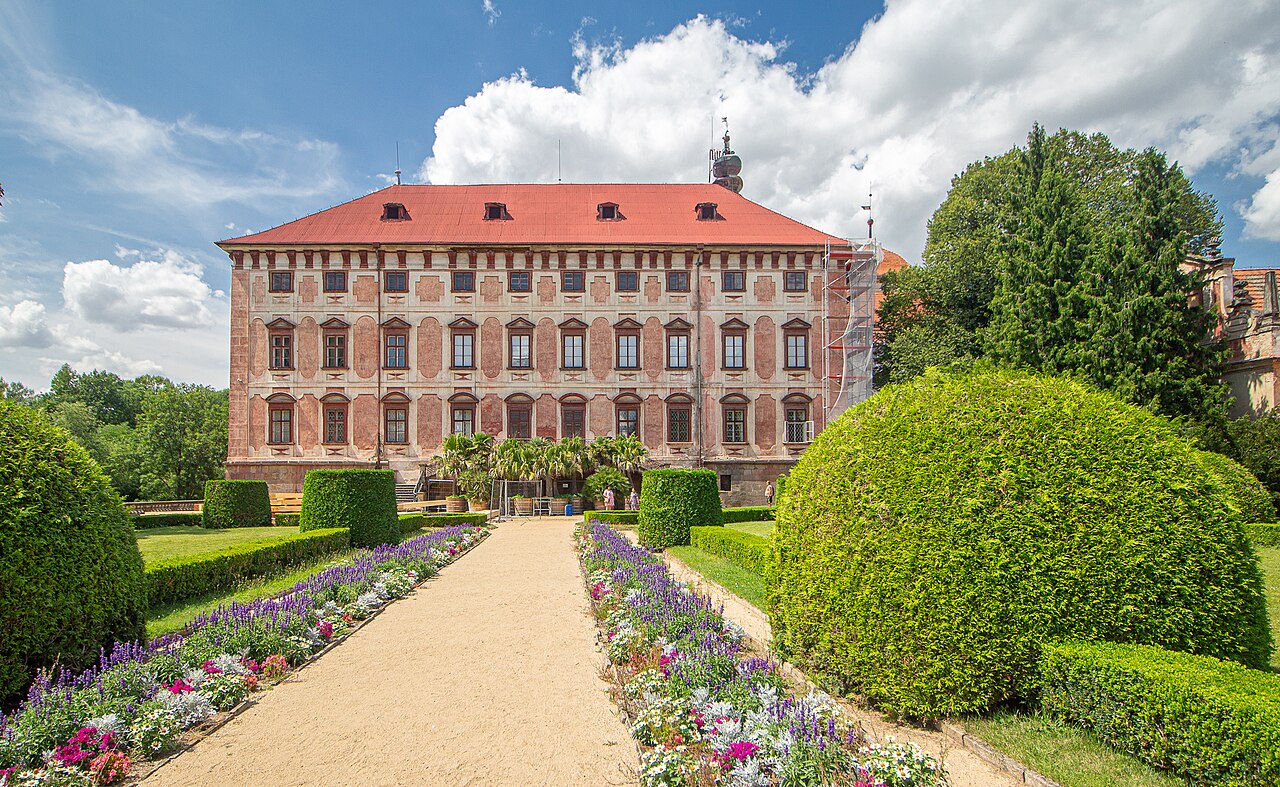
Architectural modifications included the introduction of sgraffito decoration on facades, a plaster technique that created contrasting layers of color through intricate scratching, enhancing the castle's visual appeal. Above the main gate, a shield adorned with sgraffito stands as a testament to this artistic renewal. Painted wall decorations further enriched the interiors and exteriors.
The palace wings, renovated in the late Gothic style, feature covered galleries on the first floor that connect individual rooms, while spiral staircases provide access to expansive second-floor halls. These halls are notable for their ribbed groin vaulting, an advanced Renaissance technique involving intersecting barrel vaults forming a web-like ceiling. Some rooms in the northwest corner retain earlier Gothic cross vaults, characterized by pointed arches formed by intersecting ribs.
The northern palace wing, slightly lower than the western wing, includes distinctive oriels—projecting windows that increase interior light and space. Adjacent stands a square tower, partially lowered after a gunpowder explosion in 1551, its facade decorated with sgraffito rustication that mimics large-cut stone blocks. The tower's uppermost floor was reconstructed in timber framing during 20th-century restorations.
Later history and decline
In 1614, the castle passed to Adam of Šternberk and became part of the larger Libochovice estate. The Šternberk family preferred Libochovice as their main seat, leading to Budyně's gradual decline in prominence. The subsequent ownership by the Ditrichštejn family after the Thirty Years' War did not reverse this trend; plans to remodel Budyně in the Baroque style were abandoned.
The castle suffered significant damage during the Seven Years' War in 1759 when Prussian troops looted the town and set fire to the fortress. This event marked the beginning of long-term neglect. In the 19th century, parts of the castle were demolished, with stones repurposed for local construction and to fill defensive moats, reflecting practical adaptations to changing times.
20th century restoration and cultural significance
The early 20th century saw renewed interest in preserving Castle Budyně nad Ohří. The Herberstein family initiated restoration efforts, stabilizing and refurbishing surviving structures. After World War II, the castle became municipal property, prompting further reconstruction in the 1970s and 1990s driven by local initiatives.
Since the 1920s, the castle has housed the Jand Museum, which was closed prior to 1975 but reopened in 1997, revitalizing cultural activities on site. The museum features an exhibition dedicated to Jan Zbyněk Zajíc of Hazmburk, a notable nobleman and alchemist associated with the castle. Among the curiosities displayed is a "dragon," actually a crocodile brought to the castle in 1518, highlighting the unique historical anecdotes linked to the site.
Castle Budyně nad Ohří also gained contemporary cultural recognition as a filming location for the 2017 television series "Knightfall", further boosting its profile as a heritage site.
Architectural features and layout
The castle's original kastel-type fortress plan with four wings around a courtyard remains a defining characteristic. The southwest corner's openness adds a unique aspect to the design. The combination of stone and timber construction, along with the water-filled moat, underscores the defensive priorities of its builders.
The late Gothic renovations introduced covered galleries and ribbed vaulting, enhancing both function and aesthetics. The Renaissance modifications brought decorative sgraffito and oriel windows, reflecting evolving tastes and the transition from fortress to residence.
Defensive structures such as the round towers, barbican, and bastion-like foregate illustrate the castle's military significance. The presence of an outer bailey for stables and workshops reflects typical medieval castle organization.
Despite damage and partial demolition in the 18th and 19th centuries, the castle's surviving elements offer valuable insights into medieval and Renaissance architecture and noble life in Bohemia.
Frequently asked questions (FAQ)
- How do I get to Castle Budyně nad Ohří?
- Castle Budyně nad Ohří is easily accessible by car and public transport. If traveling by train, the nearest station is in the town of Budyně, from where you can take a short taxi ride to the castle. For those driving, ample parking is available nearby.
- What is the historical significance of Castle Budyně nad Ohří?
- Castle Budyně nad Ohří dates back to the 13th century and played a crucial role in the defense of the region. It served as a noble residence and has witnessed many historical events, reflecting the architectural evolution and cultural heritage of Czechia. Today, it stands as a testament to the medieval military architecture of the time.
- When was Castle Budyně nad Ohří built?
- Construction of Castle Budyně nad Ohří began in the early 13th century, with significant modifications made in the following centuries. Throughout its history, it has undergone several renovations that have preserved its original charm while accommodating modern visitors. The castle's rich history is showcased in its architectural features and design.
- Can I take guided tours of Castle Budyně nad Ohří?
- Yes, guided tours of Castle Budyně nad Ohří are available and highly recommended for a more in-depth understanding of its history and architecture. The tours typically include access to the main rooms and towers, allowing visitors to appreciate the castle's impressive features. It's advisable to check the schedule in advance and book your tour to ensure availability.
- Why is Castle Budyně nad Ohří a popular tourist destination?
- Castle Budyně nad Ohří attracts visitors due to its fascinating history, stunning architecture, and picturesque location overlooking the Ohře River. The castle also hosts various cultural events and exhibitions throughout the year, appealing to both history enthusiasts and families. Its scenic surroundings and well-preserved structures make it a perfect destination for a day trip.
- Is it possible to visit Castle Budyně nad Ohří with children?
- Absolutely! Castle Budyně nad Ohří is family-friendly and provides a captivating experience for visitors of all ages. There are often special events and activities designed for children, making it an educational and fun outing for the whole family. Be sure to check the castle's website for any upcoming family-oriented events.
- What are the opening hours for Castle Budyně nad Ohří?
- Castle Budyně nad Ohří typically opens to visitors from April to October, with varying hours throughout the week. During the peak season, the castle may remain open longer, allowing for more flexible visiting times. It's best to check the official website for the most current opening hours and any seasonal changes.
- What are the ticket prices for visiting Castle Budyně nad Ohří?
- Ticket prices for Castle Budyně nad Ohří are generally quite affordable, with discounts available for students, seniors, and children. Family tickets are also offered, providing great value for those visiting with kids. For the most accurate and up-to-date pricing, it's recommended to check the official website before your visit.
- What are some nearby attractions to Castle Budyně nad Ohří?
- Visitors to Castle Budyně nad Ohří can explore nearby attractions such as the charming town of Budyně nad Ohří itself, which features quaint shops and local cuisine. Additionally, the picturesque Ohře River offers opportunities for hiking and picnicking, while other castles in the region can make for an exciting day trip. The area is rich in natural beauty and cultural sites, perfect for a full day of exploration.
Information
Website
Visit websiteSources & official resources
Verify the information above using these authoritative references.
Loading map...
Visitor reviews
No reviews yet. Been here? Write the first review and help other travelers!
Write the first reviewVisited this castle? Share your experience
Your review helps other travelers and adds first-hand knowledge to our encyclopedia.