Hazmburk Castle
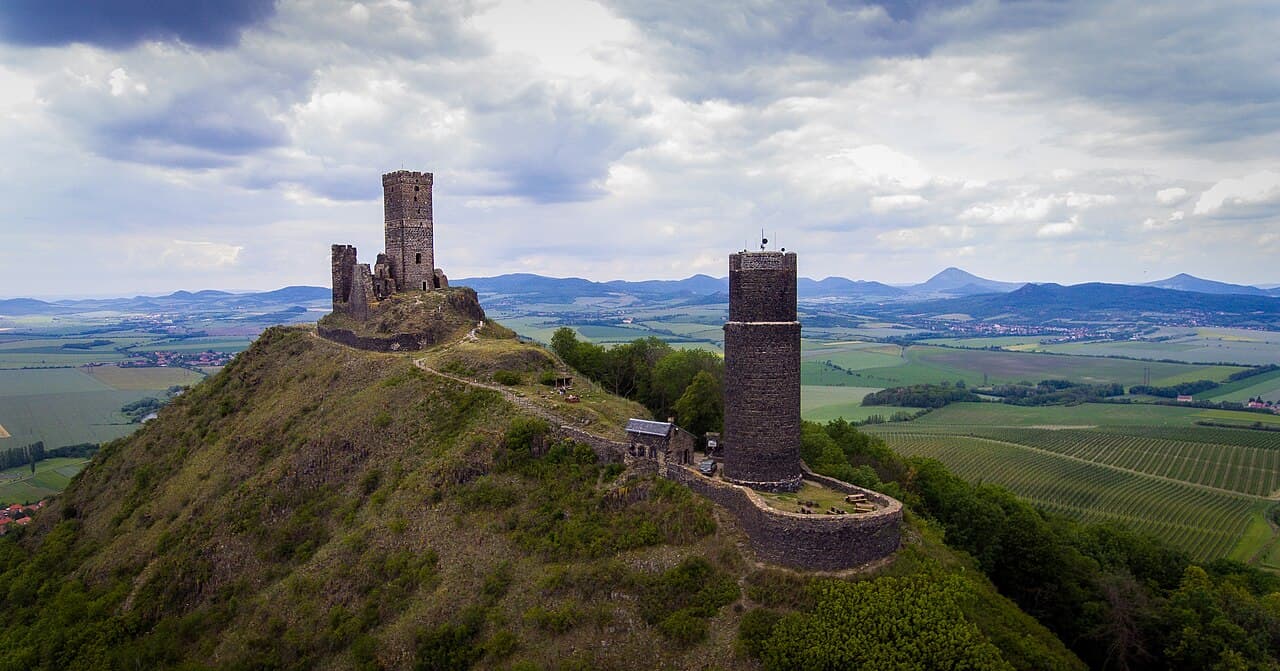
Hazmburk Castle, also historically known as Hasenburg, is a prominent Gothic castle ruin perched atop a commanding basalt hill near the town of Libochovice in the Czech Republic. This hill castle is a significant medieval monument, renowned for its imposing fortifications and its rich history spanning from the early 14th century through the late medieval period. The castle's dramatic silhouette, dominated by its two main towers—the Black Tower and the White Tower—has long been a landmark in the region and a source of inspiration for Czech romantic artists and writers.
The origins of Hazmburk trace back to around 1335, when it was first recorded under the ownership of Zbyněk Zajíc of Valdek, a member of the noble Zajíc family. The castle's name derives from the family’s heraldic symbol, a hare ("zajíc" in Czech), reflecting the close connection between the noble lineage and the fortress. Some historical accounts suggest the site may have earlier royal origins, possibly linked to King Václav II in the late 13th century, though the definitive construction phase aligns with the early 14th century Gothic period.
Historical significance and ownership
Throughout the 14th and 15th centuries, Hazmburk served as the principal seat of the Zajíc family, playing a strategic role during the turbulent Hussite Wars in Bohemia. The castle's robust defenses allowed it to withstand multiple sieges by Hussite forces in 1424, 1429, and 1431, underscoring its military importance in protecting Catholic strongholds during this era of religious and political upheaval.
In the 16th century, the castle's prominence declined as the nobility shifted residence to more comfortable Renaissance estates, notably the nearby Budyně Castle. Ownership passed to the influential Lobkowicz family in 1558, and subsequently to other noble owners. By 1586, Hazmburk was officially recorded as deserted, marking the beginning of its gradual decay into ruin.
Prior to the castle's construction, the hill had been a site of human activity since prehistoric times. Archaeological discoveries include Neolithic stone tools, Bronze Age artifacts, Iron Age Hallstatt culture pottery, and Roman bronze pins. Early medieval Slavic fortifications and settlements also existed on the slopes, indicating a long continuum of occupation well before the Gothic fortress was erected.
Architectural features and layout
Hazmburk Castle is uniquely situated on a basalt volcanic hill rising sharply above the surrounding landscape. The fortress extends approximately 170 meters from west to east and narrows to about 30 meters across at its widest. The complex is divided into two main parts: the Upper Castle at the summit and the Lower Castle on the hillside below, utilizing the natural topography to enhance defense.
The lower castle and the black tower
The Lower Castle is dominated by the Black Tower, an imposing round tower approximately 25 meters tall, constructed from dark bazanite basalt. The tower's walls are nearly 2 meters thick, with a diameter of about 9 meters. A distinctive recessed masonry belt encircles the tower two-thirds up, originally supporting a wooden defensive gallery. Access to the tower was limited to a first-floor doorway, connected by a wooden bridge to an adjacent residential palace, now lost. Surrounding ramparts and curtain walls remain partially preserved, though archaeological exploration of this area is incomplete.
The upper castle and the white tower
The Upper Castle crowns the hilltop with a roughly rectangular courtyard enclosed by a curtain wall featuring battlements and a defensive walkway. A moat separated the Upper Castle from the Lower Castle, crossed by a wooden bridge with a lifting section for added security. Within the courtyard, three palace buildings line the curtain wall, with the oldest and largest on the southern side.
A notable feature is the stone cistern built against the palace wall, designed to collect and store water. This cistern is crafted from squared masonry with a funnel-shaped inlet leading to a bulbous, bottle-shaped reservoir below, an advanced water management solution for the period. By the 15th century, the courtyard was densely built-up, leaving the cistern area as the only open space.
Dominating the Upper Castle is the White Tower, a rectangular keep standing about 26 meters high. The tower's lower two-thirds are constructed of dark basalt, while the upper third is built from lighter chalk sandstone, creating a striking visual contrast. The tower is crowned with battlements and served both defensive and residential purposes. It has been restored and today functions as a popular lookout point offering panoramic views of the surrounding countryside.
Access within the Upper Castle was carefully controlled for defense. All main buildings, including the White Tower, were reachable only from the first floor via a network of wooden galleries and bridges, minimizing vulnerable ground-level entrances.
The fortified settlement of podhradí
On the southeastern slope of the hill lies the site of Podhradí, a fortified settlement first mentioned in 1452. Established likely after the destruction of the nearby town of Libochovice in 1424, Podhradí supported the castle's defenders with craftsmen, merchants, and a church dedicated to Saint Nicholas. The settlement was enclosed by a defensive wall up to 4 meters high, pierced by two gates, a tower, and a bastion. Podhradí was abandoned by the mid-16th century, and its remains were cleared for agricultural use.
Romanticism and modern preservation
In the 19th century, the evocative ruins of Hazmburk inspired Czech romantic writers and artists, notably Karel Hynek Mácha and Svatopluk Čech. Their works celebrated the castle's dramatic presence and historical depth, reflecting the era's fascination with medieval heritage and national identity.
Despite natural challenges such as significant landslides in the late 19th and early 20th centuries that affected nearby villages, many of Hazmburk's walls and towers remain standing. The castle is now protected as a cultural monument under the care of the National Heritage Institute since 2002. It is open to the public during the summer months, accessible from the village of Klapý or the train stop Slatina pod Hazmburkem.
Visitors today can explore the impressive ruins, climb the restored White Tower for sweeping views, and appreciate the castle's historical significance as a symbol of medieval Bohemian fortification and noble power. Ongoing archaeological research continues to shed light on Hazmburk's complex construction phases and its role in the region's history.
Frequently asked questions (FAQ)
- How do I get to Hazmburk Castle from Libochovice?
- Hazmburk Castle is accessible by hiking from the nearby village of Klapý or by train to Slatina pod Hazmburkem, followed by a short walk. The castle is well signposted and open to visitors during the summer months.
- What is the historical significance of Hazmburk Castle?
- Hazmburk Castle was a key Gothic fortress in medieval Bohemia, notable for its resistance during the Hussite Wars and its association with the noble Zajíc family. It played an important role in regional defense and noble residence from the 14th to 16th centuries.
- Can I climb the towers at Hazmburk Castle?
- Yes, visitors can climb the restored White Tower, which offers panoramic views of the surrounding landscape. The Black Tower remains a ruin and is not accessible for climbing.
- When is the best time to visit Hazmburk Castle?
- The best time to visit Hazmburk Castle is during the summer months when the site is open to the public and the weather is favorable for hiking and exploring the ruins.
- Is there an entrance fee to visit Hazmburk Castle?
- Entrance to Hazmburk Castle is typically free, but visitors should check local information sources for any seasonal changes or special events that might require tickets.
Photo gallery

Information
Website
Visit websiteSources & official resources
Verify the information above using these authoritative references.
Loading map...
Visitor reviews
No reviews yet. Been here? Write the first review and help other travelers!
Write the first reviewVisited this castle? Share your experience
Your review helps other travelers and adds first-hand knowledge to our encyclopedia.