Castillo de Ubierna
The Castillo de Ubierna stands as a significant medieval fortress located in the municipality of Merindad de Río Ubierna in the region of Castilla, Spain. This hill castle played a pivotal role during the formative years of the early Kingdom of Castilla, serving both military and administrative functions. Its strategic position on elevated terrain allowed it to dominate the surrounding landscape, providing a defensive advantage against rival forces and overseeing important routes within the territory.
Historical significance and early ownership
The castle's history is closely intertwined with the turbulent political landscape of 11th-century Spain. Following the Battle of Atapuerca in 1054, a decisive conflict between the kingdoms of Castilla and Navarre, control of the castle shifted in favor of Castilla. Diego Flaínez, a nobleman of considerable influence and the father of the legendary Rodrigo Díaz de Vivar, also known as El Cid, seized the fortress from Navarrese forces. This conquest was part of a broader campaign that included several nearby strongholds, consolidating Castilian power in the region.
The medieval chronicle Historia Roderici documents Diego Flaínez's efforts to reclaim and secure these fortifications, highlighting the strategic importance of the castle within the broader context of territorial disputes. Upon Diego Flaínez's death, stewardship of the castle passed to his son, Rodrigo Díaz de Vivar, who maintained control over Castillo de Ubierna and other key fortresses, reinforcing the family's military and political influence.
Administrative role and royal connections
Beyond its military function, Castillo de Ubierna also served as the residence of the royal tenant, the appointed administrator acting on behalf of King García. This role underscored the castle's significance as a center of governance within the local district, or merindad, of Ubierna. The royal tenant was responsible for managing the king's interests, overseeing justice, and ensuring the security of the territory. This dual function as both fortress and administrative seat reflects the castle's integral place in the medieval Castilian power structure.
Architectural features and surviving remains
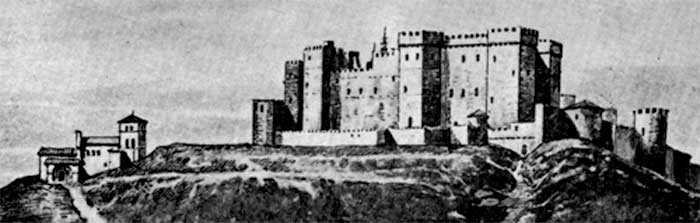
Today, Castillo de Ubierna remains as a ruined fortress, with surviving walls and foundational elements that offer valuable insights into its medieval construction. While detailed architectural plans are scarce, photographic evidence from circa 1925 reveals the scale and defensive design typical of hill castles from the period. The fortress likely featured stone walls adapted to the natural contours of the hill, with battlements and towers designed to provide comprehensive surveillance and defense.
The castle's construction materials, though not explicitly documented, would have consisted primarily of locally sourced stone, a common practice in medieval fortifications to ensure durability and resistance to siege warfare. The layout probably integrated both military and residential spaces, accommodating the needs of the royal tenant and garrison alike.
Defensive structures
The remnants suggest the presence of strong defensive walls, possibly including a keep or donjon, which served as the last line of defense. The elevated position of the castle enhanced its natural defenses, making direct assault difficult for enemy forces. The site’s topography and remaining masonry indicate a well-planned fortification designed to withstand the regional conflicts of the High to Late Medieval period.
Cultural heritage and preservation status
In recognition of its historical and cultural value, Castillo de Ubierna was granted legal protection in the 20th century. The 1949 decree declared the site a Bien de Interés Cultural (Asset of Cultural Interest), a status that ensures its conservation under Spanish heritage laws. This designation was formalized under the regime of Francisco Franco and the Minister of Education José Ibáñez Martín, reflecting the castle's importance within Spain's national patrimony.
Despite its ruined condition and lack of restoration, the castle remains an authentic witness to the medieval history of Castilla. Its preservation as a protected archaeological site allows scholars and visitors to appreciate the architectural and historical legacy embedded in its stones. The castle's enduring presence continues to evoke the era of Reconquista and the legendary figures who shaped Spanish history.
Visiting Castillo de Ubierna
While the castle is primarily a ruin, it offers a compelling destination for enthusiasts of medieval architecture and Spanish history. Visitors can explore the remains and imagine the strategic importance the fortress held during its prime. The site’s location within the scenic landscape of Merindad de Río Ubierna provides opportunities for hiking and cultural tourism, connecting the castle to the broader historical narrative of the Castilla region.
Access to the site may be limited due to its condition, and visitors are advised to check local information regarding opening hours and any guided tours. The castle's status as a protected cultural asset ensures ongoing efforts to maintain its historical integrity for future generations.
Frequently asked questions (FAQ)
- When was Castillo de Ubierna built?
- Castillo de Ubierna was established during the medieval period, with significant historical events linked to the 11th century after the Battle of Atapuerca in 1054.
- What is the historical significance of Castillo de Ubierna?
- The castle was a key military and administrative site in the early Kingdom of Castilla, associated with Diego Flaínez and his son Rodrigo Díaz de Vivar (El Cid).
- Can visitors access Castillo de Ubierna today?
- The castle remains in ruins and is protected as a cultural heritage site. Access may be limited, so visitors should check local information before planning a visit.
- Why is Castillo de Ubierna protected as a cultural heritage site?
- It was declared a Bien de Interés Cultural in 1949 due to its historical importance and connection to prominent medieval figures and events.
- What architectural features are visible at Castillo de Ubierna?
- Surviving elements include stone walls and foundational remains typical of medieval hill castles, reflecting defensive design adapted to the terrain.
Information
Website
Visit websiteSources & official resources
Verify the information above using these authoritative references.
Loading map...
Visitor reviews
No reviews yet. Been here? Write the first review and help other travelers!
Write the first reviewVisited this castle? Share your experience
Your review helps other travelers and adds first-hand knowledge to our encyclopedia.