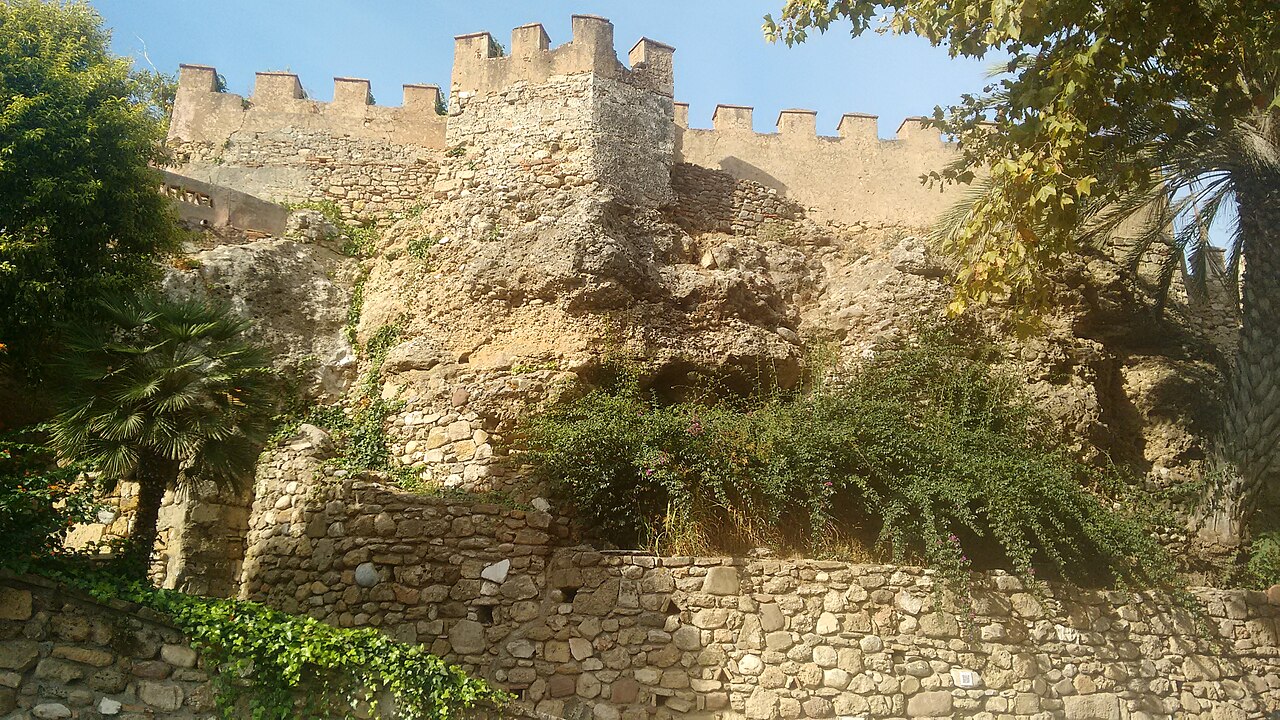
Castillo de Montemayor
The Castillo de Montemayor stands as a remarkable hill castle in the municipality of Benahavís, located in southern Spain. This fortress encapsulates a rich tapestry of history, spanning from its earliest known occupation in the Roman period to its prominent role throughout the Islamic period of the Iberian Peninsula and subsequent phases of Christian rule. Strategically perched atop a pyramidal mountain at an elevation of 579 meters near the Sierra Palmitera, the castle commands sweeping views over the surrounding landscape, underscoring its military and surveillance significance across centuries.
Archaeological evidence, including Roman coins, attests to the site's early use, suggesting that the location was valued for its vantage and defensibility even before the medieval period. The castle’s documented history begins in earnest during the early Middle Ages, when it was referenced by notable 10th-century Arab historians such as Ibn Hayyan and al-Razi. These chroniclers highlight the fortress's strategic importance, particularly in connection with the rebel leader Umar Ibn Hafsun, a key figure who resisted central authority in Al-Andalus. Initially, the castle was linked to the nearby fortress of Bobastro, serving as part of a defensive network before transitioning under the control of the Marbella domain following Bobastro's fall.
Medieval significance and territorial conflicts
Throughout the 11th century, the Castillo de Montemayor played an active role in the turbulent political landscape of the Iberian Peninsula. It became a contested site amid the fragmentation of the Caliphate of Córdoba, witnessing clashes between rival Muslim taifas, notably the Idrisid taifa of Málaga and the Hamudí taifa of Algeciras. These conflicts illustrate the castle's strategic value in controlling territory and trade routes in the region.
References to the castle persist into the 14th century, appearing in Maghrebi administrative records that situate Montemayor within the district of Málaga. This continued mention underscores the fortress's sustained regional importance well beyond the initial Islamic period, highlighting its role as a defensive stronghold and a center for local governance.
Transition to christian rule and later uses
The castle's military role evolved significantly with the Reconquista. In 1485, following the fall of Ronda, the Castillo de Montemayor surrendered to Castilian forces, marking a pivotal shift from Muslim to Christian control. Although the fortress was subsequently abandoned as a permanent military installation, it was not rendered obsolete. During the Morisco revolt of 1568, the castle served as a refuge for rebellious Muslim populations resisting Christian authority, demonstrating its enduring strategic and symbolic significance.
The fortress regained military relevance in the 19th century during the Peninsular War, when Spanish forces utilized its commanding position against Napoleon's invading troops. This resurgence highlights the castle's lasting value as a defensive lookout point in times of conflict.
Architectural features and defensive design
The Castillo de Montemayor is characterized by its robust defensive architecture, adapted to the rugged topography of its hilltop location. The fortress features up to three concentric rings of defensive walls, with the two inner enclosures remaining the most intact. These walls are constructed entirely from masonry and reinforced by a series of small prismatic towers. Notably, two of these towers have been modified into semicylindrical forms, while another retains a trapezoidal shape, reflecting a diversity of medieval defensive architectural styles.
The castle's double enclosure includes thick masonry walls and square defensive towers known as "cubos". These towers provided vantage points for surveillance and defense against attackers. Within the walls, several cisterns (locally called aljibes) were essential for water storage, enabling the fortress to endure prolonged sieges. One particularly notable cistern, located inside a tower, is divided into two parts—a rectangular compartment and a trapezoidal one—linked by a small window. The interior walls of this cistern are coated with hydraulic plaster bearing traces of red ochre pigment, and remnants of vaulted ceilings remain visible, indicating the care and sophistication invested in its construction.
Gates and internal layout
Access to the castle was controlled through two main gates situated on the outer walls: a larger entrance facing east and a smaller gate opening to the south. These gates would have been critical for regulating movement and defending the fortress from assault.
Inside the fortress, archaeological remains include fragments of rooms and collapsed structures that once connected the primary enclosure to secondary defensive areas. These remnants provide valuable insight into the castle's internal organization and functional spaces, suggesting areas designated for habitation, storage, and military operations.
Archaeological findings and preservation
Excavations at the site have uncovered ceramic fragments dating from the 10th to the 14th centuries, which have been instrumental in reconstructing the castle's plan and understanding its development during the medieval Islamic period. While some sections of the outer walls and their accompanying towers have succumbed to ruin or vanished over time, the remaining structures continue to testify to the castle's long-standing role as a military and surveillance site in southern Spain.
Today, the Castillo de Montemayor is protected under Spanish heritage laws established in 1949 and reinforced in 1985. These protections recognize the fortress's cultural and historical significance, ensuring its preservation for future generations to study and appreciate.
Visitors to the site can explore the well-preserved inner walls, towers, and cisterns, gaining a tangible sense of the castle's strategic importance and architectural ingenuity. The castle's elevated position offers breathtaking views of the surrounding landscape, connecting visitors with centuries of history embedded in the rugged Andalusian terrain.
Frequently asked questions (FAQ)
- How do I get to Castillo de Montemayor?
- The Castillo de Montemayor is located near Benahavís in Andalusia, Spain. Visitors can reach it by car or hiking from nearby towns; the castle is accessible via local roads and marked trails.
- What is the historical significance of Castillo de Montemayor?
- The castle has a rich history from Roman times through the Islamic period and the Reconquista, serving as a strategic military and surveillance site for centuries.
- Are there guided tours available at Castillo de Montemayor?
- Guided tours may be available through local tourism offices or heritage organizations, providing detailed historical and architectural insights about the castle.
- What architectural features can I see at Castillo de Montemayor?
- Visitors can observe the castle's concentric defensive walls, prismatic and trapezoidal towers, cisterns with hydraulic plaster, vaulted ceilings, and the main gates.
- Is the castle suitable for visitors with limited mobility?
- Due to its hilltop location and rugged terrain, access to Castillo de Montemayor may be challenging for visitors with limited mobility. Appropriate footwear and physical readiness are recommended.
Information
Sources & official resources
Verify the information above using these authoritative references.
Loading map...
Visitor reviews
No reviews yet. Been here? Write the first review and help other travelers!
Write the first reviewVisited this castle? Share your experience
Your review helps other travelers and adds first-hand knowledge to our encyclopedia.