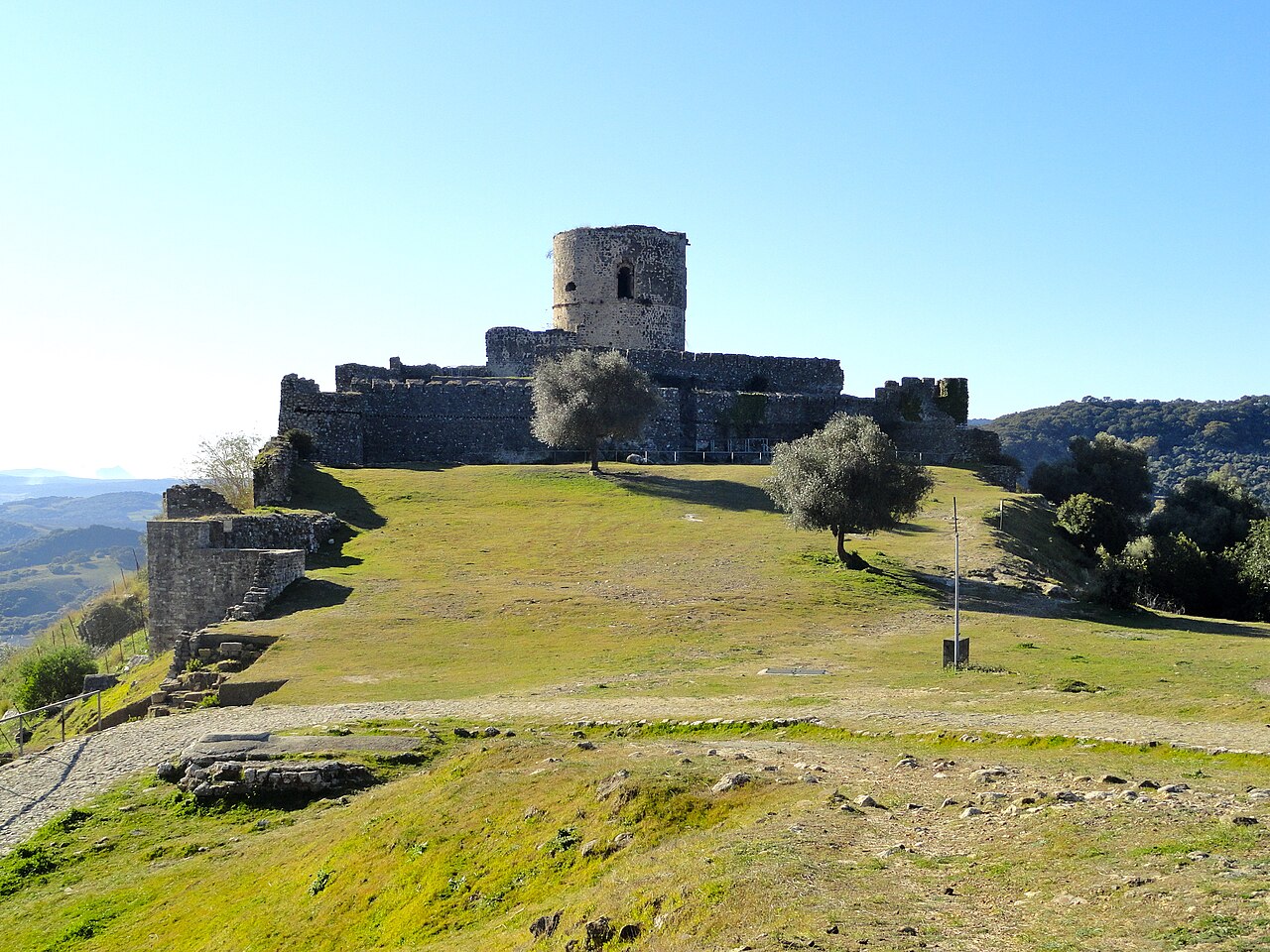
Castillo de Casares
The Castillo de Casares stands as a remarkable example of medieval military architecture nestled in the town of Casares, southern Spain. This hill castle was originally constructed during the Nasrid Kingdom of Granada era, a period marked by Muslim rule on the Iberian Peninsula before the Christian Reconquista reshaped the region's political landscape. Its strategic location atop a rugged rocky outcrop at 435 meters above sea level provided a commanding vantage point over the surrounding territory, underscoring its importance as a defensive bastion.
Historical significance and strategic role
During the Nasrid period, the Castillo de Casares served as a critical fortification on the southwestern frontier of the kingdom. Historical records, including those referenced by the scholar Simonet and the writer Ibn al-Jatib, confirm the castle’s role in securing the borderlands against encroaching Christian forces. The fortress was part of a network of strongholds that maintained Nasrid control over this contested area.
The castle’s military importance is highlighted by the events of May 1485, when it surrendered peacefully following the Christian conquest of nearby Ronda. This marked a turning point, as control passed to Sancho de Saravia, a Christian nobleman, initiating the castle's integration into the expanding Christian territories. Subsequently, in 1491, the fortress was granted to Rodrigo Ponce de León, Duke of Cádiz, in exchange for financial support to the Crown, reflecting the political and economic shifts during the final phases of the Reconquista.
The demographic landscape around the castle also transformed during this period. Christian settlers repopulated the coastal areas, while the Morisco population—Muslims converted to Christianity—was confined to the mountainous interior. The latter half of the 16th century witnessed the Morisco rebellion, which deeply affected Casares and led to the eventual expulsion of the Moriscos, significantly altering the social fabric and reducing the population under the castle’s influence.
Architectural features and fortifications
The Castillo de Casares is strategically positioned on a rocky promontory that naturally defends its southern and southwestern flanks with steep cliffs, minimizing the need for artificial fortifications on those sides. The fortress covers an area of approximately 10,000 square meters, adapting its design to the rugged terrain.
The most substantial remnants of the castle’s defenses are concentrated on the northern and northeastern sides, where the terrain was less naturally secure. Here, visitors can observe a semicircular arched gateway notable for its robust stone construction. This gateway is integrated with a defensive tower carved directly into the rock, a testament to the ingenuity of medieval military engineering aimed at protecting the main approach from the town.
Additional surviving structures include two more towers and extensive stretches of curtain walls that once enclosed the castle. These walls have been subject to numerous repairs and modifications over the centuries, reflecting the fortress's continuous use and adaptation through different historical periods and rulers.
Entrances and town connection
The fortress is connected to the town of Casares through two principal entrances located at the Plaza de Blas Infante. The Puerta de la Villa, accessed via Calle de la Villa, and the Puerta del Arrabal, reached by Calle del Arrabal, functioned as controlled gateways regulating movement between the castle and the surrounding settlement. These entrances emphasize the castle’s role not only as a military installation but also as a focal point of community life.
Religious and communal spaces within the castle
Within the castle enclosure lies the Iglesia Mayor de la Encarnación (Main Church of the Incarnation), a significant religious structure that symbolizes the Christianization of the site following the Reconquista. The presence of the church highlights the dual military and spiritual functions the castle complex served over time.
Adjacent to the church is the town cemetery, enclosed by its own wall, marking a dedicated area for burial practices. This aspect of the castle grounds illustrates the integration of civic life within the fortified space, underscoring the castle’s role beyond mere defense.
Preservation and cultural importance
Today, the Castillo de Casares remains a protected heritage site under Spanish law, recognized for its historical, architectural, and cultural significance. The castle’s partially preserved condition offers valuable insights into medieval fortification techniques adapted to challenging terrain and the complex history of the Iberian Peninsula during the transition from Muslim to Christian rule.
Visitors to the site can explore the surviving walls, towers, and gateways, gaining an appreciation of the castle’s strategic design and its role in regional history. The castle’s commanding position also provides panoramic views of the surrounding landscape, enhancing its appeal as a cultural and tourist destination.
Architectural legacy
The castle exemplifies the military architecture of the late medieval period in southern Spain, with features characteristic of Nasrid defensive construction. Its adaptation to the natural topography, use of rock-cut towers, and robust gateways reflect a sophisticated approach to fortress design. These elements contribute to our understanding of the military and social dynamics of the era.
Visitor experience
Exploring the Castillo de Casares offers a journey through centuries of history, from its origins under Muslim rule to its transformation under Christian governance. The site’s layout, fortifications, and religious buildings provide a tangible connection to the past, making it a compelling destination for those interested in medieval history, architecture, and cultural heritage.
Frequently asked questions (FAQ)
- When was the Castillo de Casares built?
- The Castillo de Casares was constructed during the Nasrid Kingdom of Granada period, which corresponds to the late medieval era in southern Spain.
- What is the architectural style of Castillo de Casares?
- The castle reflects late medieval military architecture typical of Nasrid fortifications, adapted to the rugged terrain of its hilltop location.
- Can I visit Castillo de Casares year-round?
- Visiting hours may vary, so it is recommended to check with local tourist information centers for the most current access times and any seasonal restrictions.
- What are the main features to see at Castillo de Casares?
- Visitors can explore the semicircular arched gateway, defensive towers carved into the rock, curtain walls, and the Iglesia Mayor de la Encarnación within the castle enclosure.
- Why is Castillo de Casares historically significant?
- The castle played a key role during the Nasrid Kingdom's rule and the Christian Reconquista, marking the transition of power and cultural shifts in southern Spain.
Information
Sources & official resources
Verify the information above using these authoritative references.
Loading map...
Visitor reviews
No reviews yet. Been here? Write the first review and help other travelers!
Write the first reviewVisited this castle? Share your experience
Your review helps other travelers and adds first-hand knowledge to our encyclopedia.