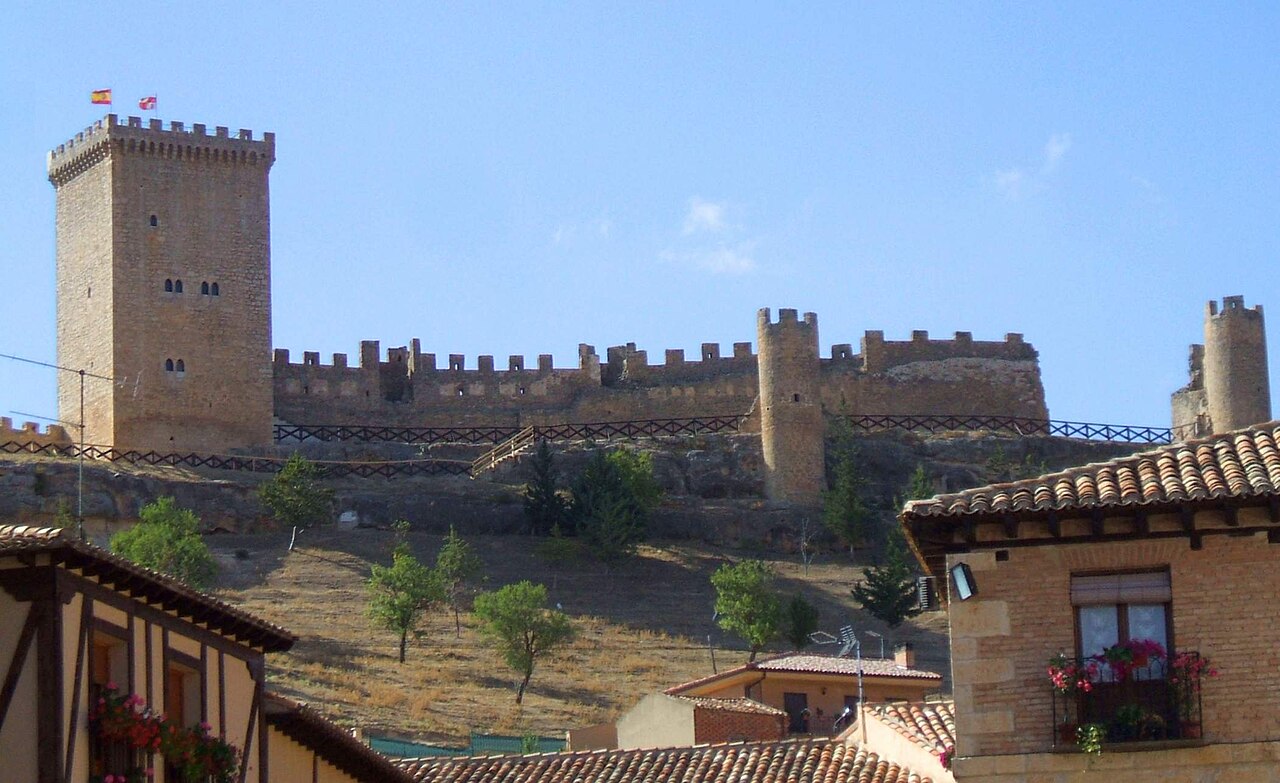
Castillo de Langa de Duero
The Castillo de Langa de Duero is a striking example of a medieval hill castle located in the town of Langa de Duero, Spain. Perched strategically on a hill overlooking the Duero river valley, this fortress exemplifies the military architecture of the 15th century in the Castilian region. Though the site itself reveals traces of earlier Celtic, Visigothic, and Christian settlements dating back to the 10th century, the castle as it stands was primarily constructed during the late medieval period to serve as a defensive stronghold controlling key access points in the area.
The castle's most prominent surviving feature is the imposing square tower, locally known as El Cubo. This robust tower measures approximately twelve meters on each side and rises to about twenty meters in height, with walls nearly two meters thick. These dimensions reflect the fortress's defensive purpose, designed to withstand sieges and provide a commanding vantage point over the surrounding landscape. The tower's entrance is elevated above ground level, a typical medieval defensive design to prevent easy access by attackers.
Historical significance and ownership
During the 15th century, the Castillo de Langa de Duero played a notable role in the regional power dynamics of Castile. In 1441, ownership passed to Don Álvaro de Luna, a prominent nobleman who served as the constable of Castile and wielded significant political influence. Historical records from around 1445 indicate that the castle's tower was used as a prison, including the detention of the brother of the Admiral of Castile under Don Álvaro's orders. This highlights the castle's function not only as a military fortress but also as a center of authority and control.
The surrounding area during this period was home to a diverse population, including a Jewish community (aljama hebrea). This multicultural presence reflects the complex social fabric of late medieval Castile, where different religious and ethnic groups coexisted, often under the protection or control of local lords.
Architectural features and defensive elements
The castle's architecture is characteristic of late medieval military construction in Castile. The surviving tower features multiple defensive elements that illustrate the strategic thinking of the period. The tower's interior is divided into four levels: a ground floor and three upper floors, ending with a rooftop terrace. The terrace retains remnants of battlements and elongated arrow slits, allowing defenders to observe and repel attackers while remaining protected.
One of the tower's notable features is the vestiges of a machicolation—an opening in the parapet enabling defenders to drop objects or pour boiling substances onto enemies at the base of the walls. This architectural element was common in fortifications designed to repel close assaults.
Adjacent to the tower lies a trapezoidal cistern, or aljibe, carved directly into the rock. This cistern was essential for storing water, particularly during sieges when external supplies were cut off. The presence of this cistern underscores the castle's preparedness for prolonged defense.
Remnants of additional fortifications surround the tower, suggesting that the castle once included a more extensive defensive enclosure protecting vital access points such as a nearby bridge. Archaeological evidence also points to now-blocked underground passages, which likely served as quarters for soldiers, stables for horses, or storage rooms such as granaries, highlighting the castle's multifunctional military role.
Later history and economic context
By the 18th century, the military importance of the Castillo de Langa de Duero had diminished, reflecting broader changes in warfare and political structures. However, the surrounding territory remained economically significant. The Count of Miranda, who owned a nearby flour mill on the Valdanzo river, imposed a toll known as a Portazgo on residents of Langa for crossing goods over the Duero river. This toll system indicates the continued strategic and economic importance of this border region, serving as a hub for trade and local administration.
Conservation and modern use
In recent decades, efforts have been made to conserve and repurpose the Castillo de Langa de Duero. The castle has been transformed into a center dedicated to educating the public about the network of watchtowers and fortifications that historically guarded the Duero frontier. This educational role honors the castle's enduring legacy as part of the region's defensive infrastructure.
Conservation programs have restored the tower's façade and improved visitor access by constructing a secure walkway from the town. Inside the tower, modern stairs and floors have been sensitively added to facilitate visitor mobility while respecting the historic fabric. Ornamental lighting highlights the fortress's silhouette after dark, enhancing its visual prominence in the landscape.
Protective glass barriers near the battlements allow visitors to safely enjoy panoramic views across the Duero valley. From the rooftop terrace, clear sightlines extend to the distant fortress of Gormaz, another significant medieval stronghold in the region, emphasizing the strategic positioning of Castillo de Langa de Duero within the broader defensive network.
Architectural style and classification
The castle is classified as a hill castle, typical of medieval fortifications built on elevated terrain to maximize defensive advantage and surveillance capabilities. Its architectural style is predominantly late medieval military, with features designed for defense and control rather than residential comfort. The surviving tower exemplifies the utilitarian approach of Castilian military architecture in the 15th century, focusing on robust construction and practical defensive elements like machicolations, arrow slits, and elevated entrances.
While the castle itself remains partially preserved, it stands as a significant cultural and historical monument, providing insight into the military, social, and economic history of the Duero valley region. Its preservation and adaptive reuse as an educational site ensure that this heritage continues to be appreciated by visitors and scholars alike.
Frequently asked questions (FAQ)
- How do I get to Castillo de Langa de Duero?
- You can reach Castillo de Langa de Duero by car, as it is located in a rural area of Spain. The nearest major city is Soria, which is approximately 40 kilometers away. Public transportation options may be limited, so plan ahead for your visit.
- What is the historical significance of Castillo de Langa de Duero?
- Castillo de Langa de Duero dates back to the 11th century and played a crucial role in the defense against invasions during the Reconquista. Its strategic location allowed it to oversee the surrounding lands, making it an important military stronghold. Today, it stands as a testament to the rich history of the region.
- When was Castillo de Langa de Duero built?
- The construction of Castillo de Langa de Duero began in the early 11th century, with various modifications made over the centuries. It was originally built by the Moors and later taken over by Christian forces. The castle's architecture reflects the styles and influences of the different periods in which it was inhabited.
- Can I visit Castillo de Langa de Duero year-round?
- Yes, Castillo de Langa de Duero is open to visitors throughout the year. However, it is advisable to check local conditions or any specific closure dates, particularly during the winter months. Guided tours may be available to enhance your experience.
- Why is the architecture of Castillo de Langa de Duero noteworthy?
- The architecture of Castillo de Langa de Duero is noteworthy for its blend of Moorish and Christian styles, typical of many castles from the Reconquista period. The castle features impressive stone walls, towers, and a unique layout that demonstrates its defensive purpose. This architectural diversity makes it an interesting subject for visitors and historians alike.
- Is it possible to take guided tours of the castle?
- Yes, guided tours of Castillo de Langa de Duero are available and highly recommended for a more enriching experience. Knowledgeable guides provide insights into the castle's history, architecture, and its role in local culture. Check the official website or local tourist information for tour schedules.
- What are the opening hours for Castillo de Langa de Duero?
- Castillo de Langa de Duero typically opens from 10 AM to 6 PM, but hours may vary depending on the season and special events. It is best to verify the current hours before your visit to ensure you have ample time to explore. Local tourism websites often provide updated information.
- What are the ticket prices for visiting the castle?
- Ticket prices for Castillo de Langa de Duero are generally affordable, with discounts available for children, students, and seniors. Special rates may apply for group visits or guided tours. Check the official website for the most current pricing and any available promotions.
- What nearby attractions should I visit while in Langa de Duero?
- While visiting Castillo de Langa de Duero, you can explore the picturesque village of Langa de Duero itself, known for its charming architecture and local culture. Additionally, the surrounding natural landscape offers opportunities for hiking and enjoying the scenic views of the region. Other nearby historical sites may also enhance your visit.
Information
Website
Visit websiteSources & official resources
Verify the information above using these authoritative references.
Loading map...
Visitor reviews
No reviews yet. Been here? Write the first review and help other travelers!
Write the first reviewVisited this castle? Share your experience
Your review helps other travelers and adds first-hand knowledge to our encyclopedia.