Castillo de Giribaile
Castillo de Giribaile is a significant 12th-century hill castle located near the village of Guadalén in the municipality of Vilches, in the province of Jaén, Andalusia, Spain. This fortress stands on the northern edge of a plateau approximately 500 meters above sea level, overlooking the valley of the río Guadalimar. Its strategic position allowed it to control important land routes and protect the surrounding agricultural lands during the medieval period.
Historical background and early settlement
The site of Castillo de Giribaile has a history that extends far beyond its medieval fortress. Archaeological evidence reveals human activity dating back to the early second millennium BCE. The area was a significant settlement for the Iberian Oretani people, possibly corresponding to the ancient city of Orissia, their capital. By the 4th and 3rd centuries BCE, this settlement had developed into a fortified oppidum spanning over 18 hectares. Defensive walls, including a southern wall approximately 200 meters long and over 10 meters high, protected the settlement, while natural terrain features secured other sides.
This Iberian oppidum was destroyed during the late Roman Republic era, specifically in the context of the Sertorian Wars (80–72 BCE). Archaeological layers of ash confirm that Roman forces razed the site, which was subsequently abandoned in the early 1st century BCE.
During the Visigothic period, small agricultural communities re-emerged nearby, with evidence of cereal cultivation, livestock grazing, and Christian worship spaces in rock shelters. It is believed that a Hispano-Visigothic fortification once existed on this site, forming the foundation for later medieval constructions.
Islamic construction and medieval military role
With the arrival of Muslim rule in the Iberian Peninsula, the current castle was built over the earlier Iberian and Roman ruins as a hisn, a type of fortified refuge. The castle served to protect local farmland and monitor movement along key trade and mountain routes. During the 12th century, particularly under Almohad control, the fortress was reinforced with mortar-based fortifications to strengthen its defenses against advancing Christian forces from La Mancha.
In 1227, the castle was surrendered by Abu Muhammad to King Ferdinand III of Castile. Later, in 1274, it was transferred to the military Order of Calatrava by King Alfonso X. By 1292, King Sancho IV granted the castle and its lands to Don Gil Bayle de Cabrera, the judge of Baeza, whose name is the origin of "Giribaile."
Architectural features and construction details
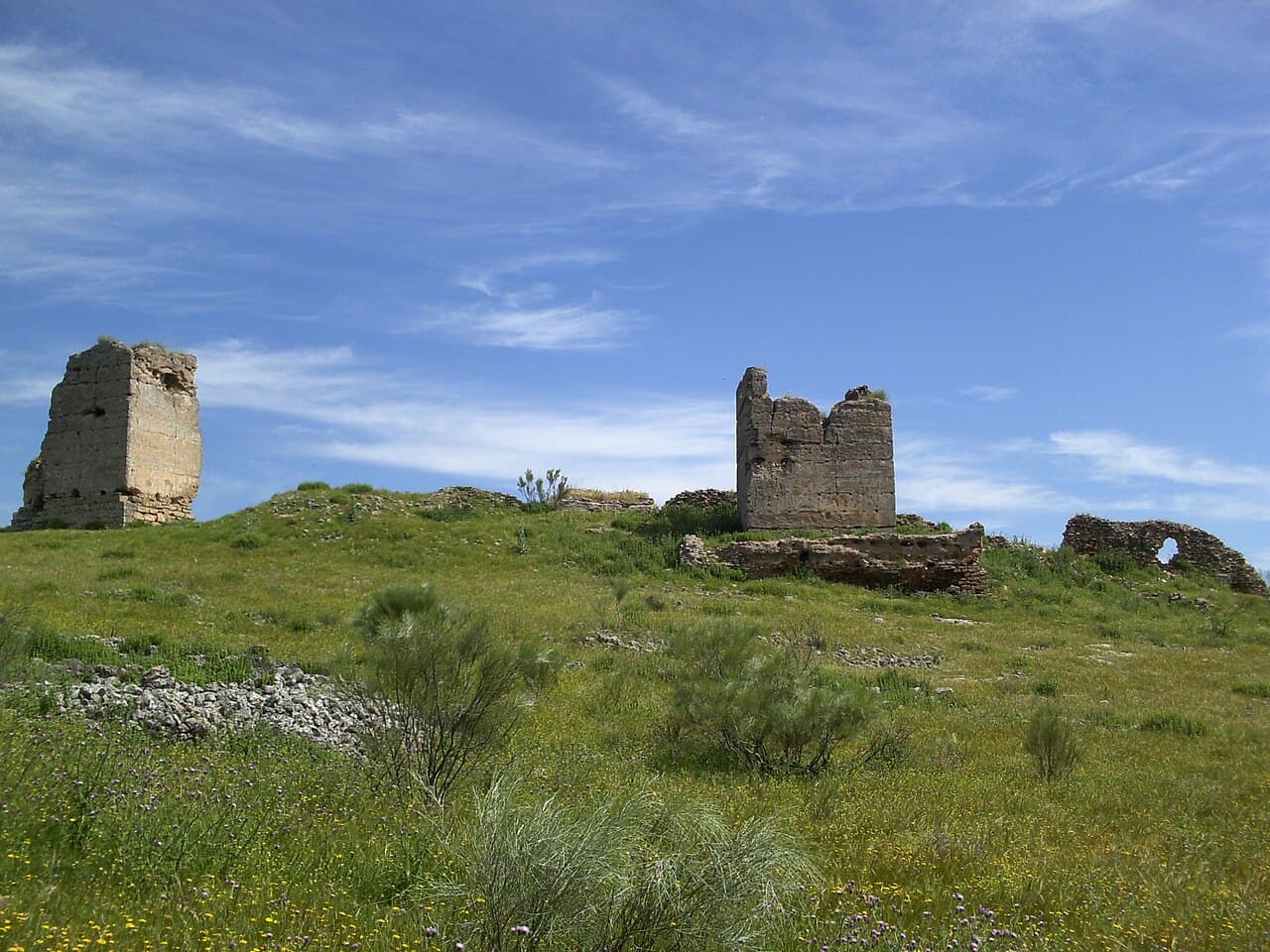
The ruins of Castillo de Giribaile display an irregular layout dominated by two main square towers connected by surviving stretches of defensive walls. The construction materials include rammed earth (tapial) and stone bonded with mortar, characteristic of Islamic military architecture in medieval Spain.
One tower measures approximately 7.45 meters by 6.20 meters and is divided internally into three rooms. Its base incorporates parts of an older Islamic minaret, evidencing the reuse of earlier architectural elements. Between the towers lies a narrow passage about two meters wide, likely serving as a small barbican, a fortified gateway area for controlling access.
The second tower shows multiple construction phases. Its foundation consists of carefully arranged masonry blocks supporting the upper square tower. Later reinforcements include thick rammed earth walls, reflecting adaptations over time to evolving military needs.
Inside the castle, remnants of a vaulted cistern (aljibe) remain. This water storage chamber with a barrel-vaulted ceiling was essential for collecting rainwater and sustaining the castle's occupants during sieges or dry spells.
Decline, protection, and current condition
Despite its historical importance and strategic location, Castillo de Giribaile eventually fell into disuse and decline. The castle is currently in a state of ruins, with significant weathering and structural deterioration affecting the surviving walls and towers.
Recognized for its cultural and historical value, the site has been protected under Spanish heritage laws since a decree in 1949 and was officially designated as a Bien de Interés Cultural in 1993. However, it remains largely neglected, with ongoing deterioration inviting further archaeological research and conservation efforts.
Geographical and cultural significance
Located in the province of Jaén, Andalusia, Castillo de Giribaile is part of a network of medieval fortifications that illustrate the complex history of Muslim and Christian interactions during the High Middle Ages in Spain. Its position overlooking the Guadalimar valley provided control over important routes and agricultural resources.
The castle's layered history, from ancient Iberian settlement to Islamic fortress and later Christian possession, reflects the dynamic cultural and political changes in the region over more than two millennia.
Frequently asked questions (FAQ)
- What is the historical significance of Castillo de Giribaile?
- Castillo de Giribaile is historically significant as a site with continuous human occupation from the early second millennium BCE, evolving from an Iberian oppidum to a medieval Islamic fortress, reflecting the cultural layers of Andalusia.
- Can I visit the ruins of Castillo de Giribaile?
- Yes, the ruins of Castillo de Giribaile are accessible to visitors. However, as the site is in a state of ruin and largely unmaintained, visitors should exercise caution and check local information for access details.
- When was Castillo de Giribaile built and by whom?
- The current castle structure was built in the 12th century during the period of Muslim rule in the Iberian Peninsula, likely under Almohad influence as a fortified hisn to protect local lands.
- What architectural features are notable at Castillo de Giribaile?
- Notable features include two main square towers constructed with rammed earth and stone, a vaulted cistern for water storage, and the reuse of an Islamic minaret base integrated into one tower's foundation.
- Why is Castillo de Giribaile important in Andalusian history?
- It is important because it illustrates the transition from ancient Iberian and Roman settlements through Visigothic and Islamic periods to Christian medieval control, highlighting Andalusia's layered history.
Photo gallery

Information
Loading map...
Visitor reviews
No reviews yet. Been here? Write the first review and help other travelers!
Write the first reviewVisited this castle? Share your experience
Your review helps other travelers and adds first-hand knowledge to our encyclopedia.