Canena Castle
Canena Castle stands as a remarkable example of Renaissance architecture built upon medieval foundations in the town of Canena, Spain. This hill castle is renowned for its transformation from a medieval fortress into a grand Renaissance palace residence during the 16th century. The castle's evolution reflects the broader cultural and architectural shifts that occurred in Spain during the Renaissance period, particularly under the patronage of influential figures such as Francisco de los Cobos, secretary to Emperor Charles I.
The origins of Canena Castle trace back to a medieval fortress predating the 13th century, which initially served as a defensive stronghold in the region. Over the centuries, as military technology and political conditions evolved, the fortress gradually lost its purely defensive function. In 1538, Francisco de los Cobos acquired the town and its fortress, initiating a comprehensive transformation that would reimagine the castle as a Renaissance palace. This transformation was designed and overseen by the eminent Spanish Renaissance architect Andrés de Vandelvira (1509-c.1575), whose work is celebrated for introducing Renaissance principles to Andalusia.
Architectural transformation and design
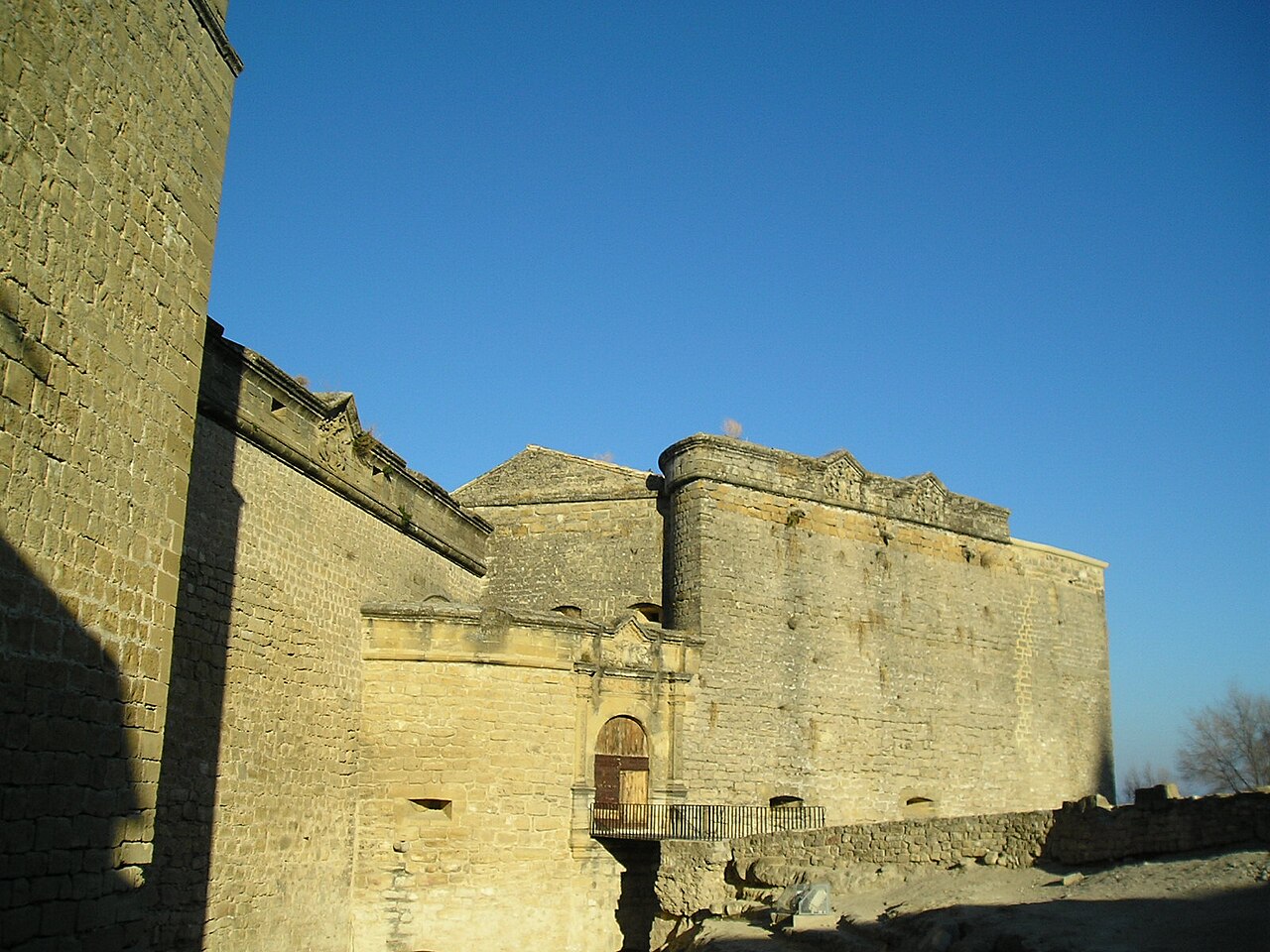
The castle's current form largely dates from the 17th century but rests on the solid medieval foundations of the earlier fortress. The building adopts an almost square ground plan, a typical Renaissance feature emphasizing symmetry and proportion. It is delimited by two large circular towers at the ends of the main façade and two smaller, somewhat incomplete circular towers on the rear façade. These towers contribute both to the castle's defensive capabilities and its imposing aesthetic presence.
One of the castle's most imposing features is the square keep (torre del homenaje), which rises within the interior courtyard. This keep was originally surrounded by a moat, now filled in, that provided defensive isolation. The entrance to the keep was accessed via a drawbridge, evidence of which remains in the form of grooves in the stone where the drawbridge mechanism was once anchored.
The main entrance portal
The castle's entrance is a masterpiece of Renaissance decoration. It features an elegant semicircular arch framed by Corinthian pilasters resting on stone plinths. Above these pilasters lies an entablature adorned with a frieze of grotesque motifs, fanciful and mythical figures typical of Renaissance ornamentation. Surmounting this is another semicircular arch whose tympanum displays the coats of arms of the castle's founders. Flanking the heraldic display are fantastic tenant figures, mythical beings symbolically supporting the structure. The portal is crowned by three flaming urns (flameros), which add a dramatic and ornamental flourish to the entrance.
The Renaissance courtyard galleries
Inside, the castle courtyard embodies Renaissance architectural ideals with its two-level gallery. The lower gallery features semicircular arches with prominent keystones. The intrados of these arches are decorated with rosettes and tondos—round decorative panels containing sculpted heads set within the spandrels, the triangular spaces between the arches and their rectangular frames.
The upper gallery is supported by large corbels, stone brackets that project from the wall to carry the weight of the gallery above. These corbels rest upon columns set on plinths decorated with military motifs, reflecting the castle's martial heritage. The gallery is enclosed by a balustrade, a railing composed of small columns called balusters, which provides both safety and ornamental elegance. This harmonious combination of structural and decorative elements creates a courtyard that is both functional and artistically rich, exemplifying Renaissance aesthetics.
Historical significance and ownership
Canena Castle's transformation from a medieval fortress to a Renaissance palace reflects the broader historical context of 16th-century Spain, where aristocratic patrons sought to express their power and prestige through architecture. Francisco de los Cobos was a key figure in this cultural movement, leveraging his position as secretary to Emperor Charles I to commission significant architectural projects in the region, including the castle's redesign.
After Francisco de los Cobos' death, the castle remained in the hands of his family, notably the Marquises of Camarasa, who preserved and maintained the estate through subsequent generations. Their stewardship ensured the castle's survival and upkeep, preserving its Renaissance character while respecting its medieval origins.
Preservation and cultural heritage
In recognition of its architectural and historical importance, the Castillo de Canena was declared a National Monument in 1931 and is registered as a Bien de Interés Cultural, underscoring its status as one of Andalusia's most significant heritage sites. The castle is well preserved, allowing visitors to appreciate the blend of medieval defensive features and Renaissance residential elegance.
Though the original moat has been filled, the castle's defensive layout remains evident in the structure and design details. The quality of the masonry work and the ornamental richness of the entrance and courtyard galleries highlight the craftsmanship of the Renaissance period in Spain.
Visitor experience and architectural highlights
Visitors to Canena Castle can explore its imposing façade with its circular towers, the grand entrance portal, and the beautifully decorated courtyard galleries. The interplay of defensive and decorative elements offers insight into the castle's dual role as a fortress and a noble residence. The castle's elevated position on a hill provides commanding views of the surrounding landscape, emphasizing its strategic importance historically.
Overall, Canena Castle exemplifies the fusion of medieval fortification and Renaissance artistry, making it a significant monument in Spain's architectural and cultural history.
Frequently asked questions (FAQ)
- What is the historical significance of Canena Castle?
- Canena Castle dates back to the 12th century and is a prominent example of medieval military architecture in Spain. It played a crucial role during the Reconquista, serving as a defensive stronghold against invading forces.
- When was Canena Castle built?
- Canena Castle was constructed in the late 11th century, with significant modifications made in the 12th century. Its strategic location allowed it to oversee the surrounding areas and protect the region from invasions.
- Can I visit Canena Castle year-round?
- Yes, Canena Castle is open to visitors throughout the year. However, it is advisable to check for any specific opening times or closures during holidays and special events.
- What are the opening hours for Canena Castle?
- Typically, Canena Castle opens at 10 AM and closes at 6 PM, but hours may vary seasonally. It is recommended to confirm the current hours before planning your visit.
- Is it possible to access Canena Castle with limited mobility?
- The castle's historic structure presents challenges for those with limited mobility, as the terrain can be uneven and steep in places. However, some areas may be accessible, so it's best to contact the management for specific accommodations.
- What is the best time to visit Canena Castle?
- The best time to visit Canena Castle is during the spring and fall when the weather is mild and pleasant for exploring. Summer can be quite hot, while winter may bring cooler temperatures.
- Are there any nearby attractions to visit along with Canena Castle?
- Yes, visitors can explore the charming village of Canena and its surrounding natural landscapes. Additionally, the nearby city of Jaén offers historical sites, museums, and beautiful olive groves to discover.
- What are the ticket prices for Canena Castle?
- Tickets for Canena Castle are generally affordable, with discounts available for students and seniors. Prices may vary based on special events, so it's a good idea to check the official website for the latest information.
Information
Website
Visit websiteSources & official resources
Verify the information above using these authoritative references.
Loading map...
Visitor reviews
No reviews yet. Been here? Write the first review and help other travelers!
Write the first reviewVisited this castle? Share your experience
Your review helps other travelers and adds first-hand knowledge to our encyclopedia.