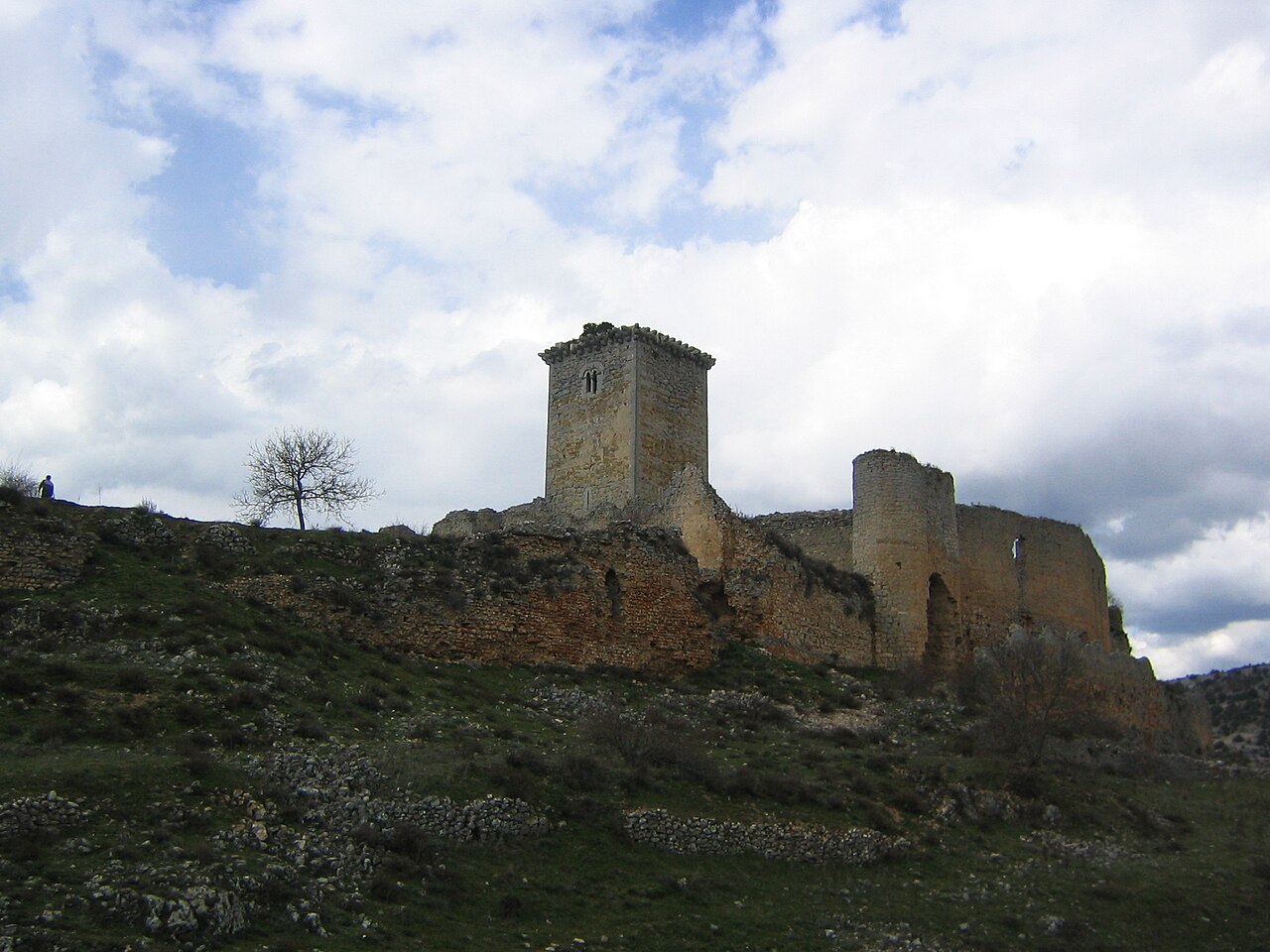
Castillo de Castrovido
The Castillo de Castrovido stands as a remarkable example of a medieval hill castle in Spain, embodying centuries of military architecture and regional history. Constructed in the late 9th century by Christian settlers, it was strategically positioned on a rocky hilltop near the Arlanza River to guard newly colonized lands against Muslim incursions. This fortress not only reflects the turbulent Early Medieval period of the Iberian Peninsula but also showcases the evolution of defensive architecture through subsequent centuries.
Historical significance and early origins
The first documentary mention of Castrovido appears in the Fuero de Salas dated 974, where Count García Fernández granted lands in the region to Gonzalo Gustios and his companions. Among these was a figure named Víctor, credited with founding the castle near an ancient Roman road, highlighting the site's long-standing strategic importance. The castle's location atop a hill overlooking key routes allowed control over movement and served as a critical defensive outpost during the Christian Reconquista efforts.
In 1002, the fortress gained historical prominence when it resisted a raid led by the Muslim military leader Almanzor. While surrounding territories suffered devastation, the castle's defenders successfully repelled the assault, marking Almanzor's first recorded defeat in the area. This event underscored the castle's military resilience and its role in safeguarding Christian territories.
Ownership and medieval transformations
From the 11th century onward, the castle became a tenencia—a fiefdom—under the influential noble Lara family. During the 14th and 15th centuries, amidst the civil conflicts that shook the Kingdom of Castile, control of the castle passed to the Velasco family, lords of Salas. In 1380, Pedro Fernández de Velasco y Castañeda established a mayorazgo to secure the castle's ownership, initiating reconstruction efforts that likely included the addition of defensive walls encircling the hilltop. Another mayorazgo was founded in 1458 by Pedro Fernández de Velasco y Solier for his son, who later became the constable of Castile, further cementing the castle's noble lineage and strategic value.
These medieval transformations reflected the castle's adaptation to evolving military needs, with fortifications expanded to withstand sieges and internal conflicts. The castle remained in active use at least until the 14th century, after which it gradually fell into disuse and ruin.
Architectural features and defensive design
The core of the Castillo de Castrovido is a robust rectangular defensive tower, measuring approximately 10.95 meters in length and 8.45 meters in width. Its walls, nearly two meters thick at the base, are constructed using rubble masonry composed of roughly shaped stones bonded with a mortar mixture of stone fragments, earth, and lime. This technique provided substantial strength and durability suitable for late 9th-century military architecture.
The tower's corners and window frames are crafted from finely cut ashlar blocks, demonstrating skilled stonecutting to reinforce structurally vulnerable points. Windows are scarce and small, likely limited to one per side, designed to minimize vulnerabilities while allowing light and observation.
Internally, the tower comprises a basement, three main floors, and a roof area. The roof features an adarve, a protected walkway behind battlements known as almenas, enabling defenders to patrol and defend the tower's perimeter effectively. Access was controlled through a single entrance on the eastern façade, elevated about three meters above ground level. Originally, this entrance was reached by a wooden ramp that could be withdrawn during attacks, enhancing the tower's defensive capability.
Fortifications and later additions
During the 14th century reconstruction under the Velasco family, fortifications were extended beyond the tower itself. Defensive walls likely encircled the hilltop, creating a fortified enclosure that strengthened the castle's defensive position. These walls would have included battlements and possibly towers to improve surveillance and defense against sieges.
Today, the remains of these fortifications, alongside the tower, provide valuable insight into the castle's military architecture and strategic importance during the medieval period.
Decline, ruin, and restoration efforts
Following its active use through the medieval period, the Castillo de Castrovido gradually fell into ruin over the centuries. Natural decay, combined with changing military technologies and political circumstances, rendered the fortress obsolete. By the early 21st century, restoration initiatives were undertaken to preserve the castle's historical legacy and promote cultural understanding of its significance.
These restoration efforts have stabilized the remaining structures, particularly the tower, allowing visitors to appreciate the castle's imposing presence and architectural features. The site serves as a testament to the region's complex history and the enduring legacy of medieval fortifications in Spain.
Geographical context and strategic importance
Located in the municipality of Castrovido within Spain, the castle's position on a rocky hill overlooking the Arlanza River valley was crucial for controlling regional movement. Its proximity to a Roman road highlights the continuity of strategic routes from antiquity through the medieval period.
The elevated position provided natural defense advantages, enabling surveillance of the surrounding landscape and early warning against approaching forces. This geographical context underpinned the castle's military role throughout its history.
Visiting information and cultural significance
Today, the Castillo de Castrovido stands as a cultural landmark reflecting Spain's medieval heritage. While the castle is primarily a ruin, its well-preserved tower and fortifications attract visitors interested in military architecture and history.
Visitors can explore the remains of the tower, observe the construction techniques, and appreciate the castle's strategic location. The site offers insights into the Early Medieval period and the complex history of Christian-Muslim conflicts in the Iberian Peninsula.
The castle's restoration and preservation underscore its importance as a heritage site, contributing to regional identity and historical education.
Frequently asked questions (FAQ)
- When was Castillo de Castrovido built?
- Castillo de Castrovido was constructed in the late 9th century by Christian settlers to protect newly colonized lands.
- What is the architectural style of Castillo de Castrovido?
- The castle features typical early medieval military architecture, characterized by a robust rectangular tower with thick rubble masonry walls and ashlar stone reinforcements.
- Can visitors access the interior of Castillo de Castrovido?
- Visitors can explore the remains of the tower and fortifications, although the castle is partially preserved and may have limited access to some areas for safety reasons.
- Why was Castillo de Castrovido strategically important?
- Its location on a rocky hill overlooking the Arlanza River valley allowed control over key routes, including a Roman road, making it a vital defensive stronghold during the medieval period.
- What historical events is Castillo de Castrovido known for?
- The castle is notable for resisting a raid by Muslim leader Almanzor in 1002, marking his first recorded defeat in the region and highlighting its military significance.
Information
Loading map...
Visitor reviews
No reviews yet. Been here? Write the first review and help other travelers!
Write the first reviewVisited this castle? Share your experience
Your review helps other travelers and adds first-hand knowledge to our encyclopedia.