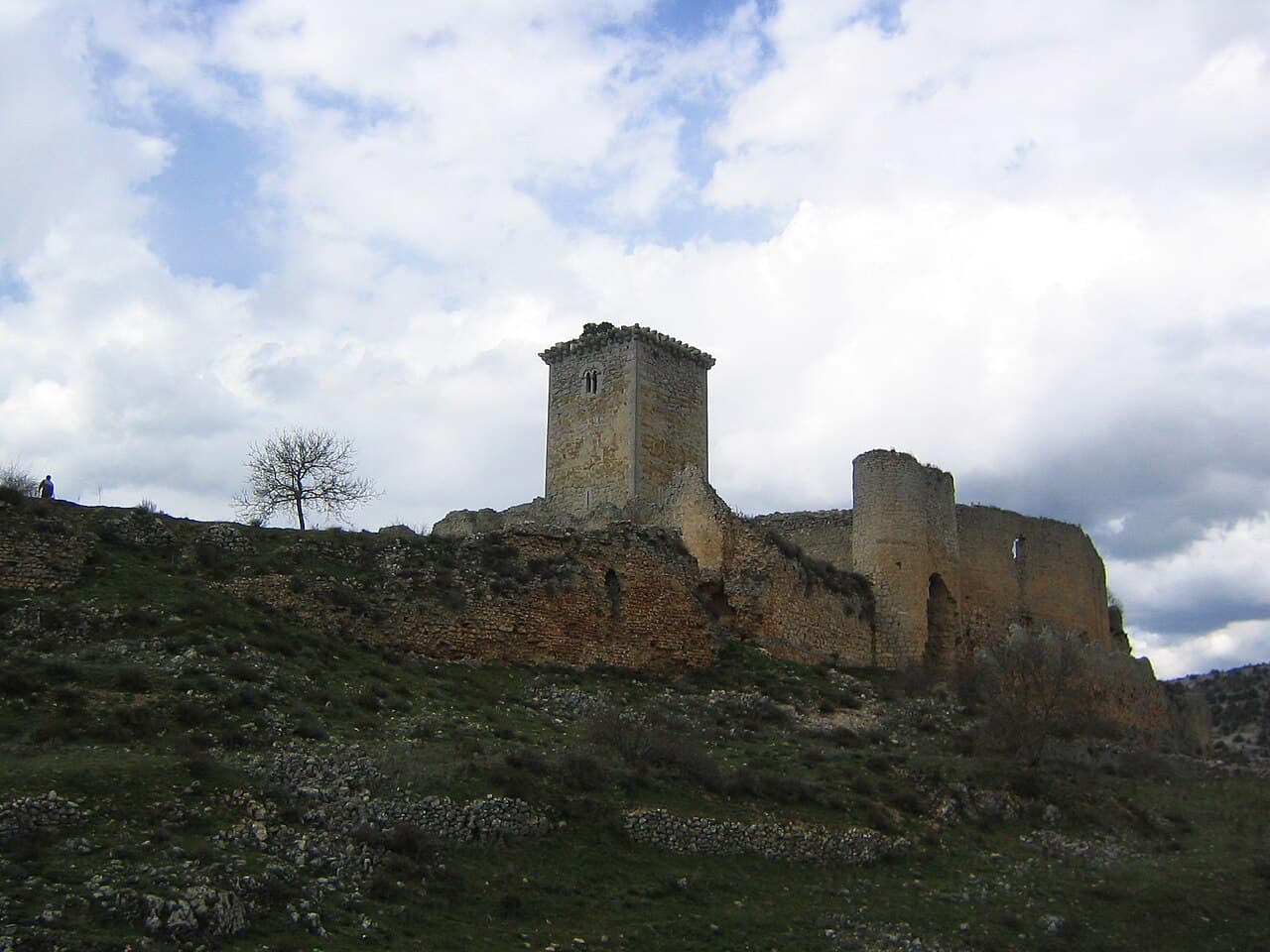
Ucero Castle
Ucero Castle stands as a remarkable example of a late medieval hill castle located in the province of Soria, Spain. Perched on a rocky ridge overlooking the village of Ucero and the surrounding fertile valley of the Ucero River, the castle commands breathtaking views of the nearby Canyon of the Lobos River, a protected natural reserve. Its strategic position atop this elevation provided both defensive advantages and control over the vital river valley routes.
The castle's origins trace back to the 14th century, although the site itself has a history of human occupation dating to prehistoric times. Built upon an ancient Celtiberian castro, the location was first documented in the 12th century, with the fortress mentioned in records from the 13th century. The castle's historical significance is further enriched by its association with the Knights Templar and prominent medieval figures, such as Juan González de Ucero, a Templar knight who fought at the pivotal Battle of Las Navas de Tolosa (1212).
Historical context and ownership
The lordship of Ucero Castle passed through notable hands during the Middle Ages. Initially controlled by the Templar family of Juan González de Ucero, it later came under the ownership of María de Meneses and subsequently Violante Sánchez de Castilla, an illegitimate daughter of King Sancho IV of Castile. The castle became embroiled in legal disputes over ownership in the early 14th century, involving the Order of Santiago and the Bishopric of Osma. Ultimately, the Diocese of Osma secured long-term control, maintaining the castle and its lands from the early 1300s onward.
Throughout the 15th and 16th centuries, the castle underwent significant repairs and fortifications under the direction of bishops such as Don Pedro Montoya, who also rebuilt the city walls of nearby El Burgo de Osma, and Honorato Juan, who left his coat of arms above the entrance gate. The castle served multiple roles during this period, functioning as a bishop's residence, a prison for clerics, and a symbol of ecclesiastical power in the region.
Architectural features and defensive design
Ucero Castle is distinguished by its robust defensive structures characteristic of late medieval military architecture. The fortress features a triple ring of walls enclosing the main enclosure, enhanced by a surrounding moat that added an extra layer of protection. Access to the castle was historically controlled by a combination of ramps and a drawbridge, designed to impede attackers and secure the entrance.
The castle's keep, or tower of homage, remains one of its most impressive elements. Constructed with finely cut ashlar stone blocks at the corners, the keep is adorned with beautifully carved corbels supporting battlements and features ogival windows framed by decorative moldings. Notably, the keep displays several gargoyles, including a rare triple-figure gargoyle and another depicting a figure beneath an eagle clutching a serpent, adding to the castle's unique iconography.
Inside the keep, the ceiling is formed by an ogival vault, typical of Gothic architecture, supported by intricately carved modillions shaped as heads and figures. At the vault's center is a keystone bearing the Agnus Dei (Lamb of God), a symbol that some scholars associate with the castle's Templar heritage.
Subterranean passage and water supply
A remarkable feature of Ucero Castle is the underground passage carved into the rock, which descends in a zigzag fashion from the castle to the banks of the Ucero River. This tunnel was a vital lifeline during sieges, allowing secure access to water. Although partially collapsed, visitors can still enter and explore approximately 25 meters of the passage. The corridor measures around 1.16 meters wide and between 1.5 and 2.13 meters high, constructed with rubble masonry slabs bonded by mortar.
Religious and cultural significance
The castle's location and history are intertwined with religious institutions and orders. Nearby stood the hermitage of San Juan de Otero, a now-ruined site associated with the Knights Templar, and the chapel of San Bartolomé, which also had Templar connections. The castle itself was under the ownership of the Bishops of Osma for centuries, serving not only as a military fortress but also as a residence and administrative center for ecclesiastical authorities.
Throughout its history, Ucero Castle also functioned as a prison for clerics, reflecting its role within the church's judicial system. The presence of the bishops and their influence is evident in the castle's architecture and heraldic symbols, such as the coat of arms placed by Honorato Juan in the 16th century.
Current condition and visitor experience
Today, Ucero Castle remains in a ruinous condition but retains much of its original outer and inner enclosures. The keep is particularly well-preserved, showcasing the skilled masonry and detailed carvings that highlight its historical importance. The castle is freely accessible to visitors and is noted for its scenic beauty, combining architectural interest with the natural splendor of the surrounding landscape.
The approach to the castle involves crossing the river and ascending a path flanked by steep cliffs, emphasizing the fortress's natural defenses. Visitors can also enjoy observing the local wildlife, including a colony of griffon vultures that inhabit the nearby canyon, often seen circling above the castle ruins.
Despite its relatively remote location and limited visitor numbers, Ucero Castle offers a compelling glimpse into Spain's medieval past, blending military, religious, and cultural histories with outstanding natural scenery. It is a must-see site for enthusiasts of Spanish castles, medieval architecture, and historical landscapes.
Frequently asked questions (FAQ)
- How do I get to Ucero Castle?
- Ucero Castle is located near the village of Ucero in the province of Soria, Spain. Visitors can reach the castle by following local roads to Calle Castillo and then walking the path that ascends to the castle ruins.
- What is the historical significance of Ucero Castle?
- Ucero Castle has a rich history dating back to the 14th century, built on a site with earlier Celtiberian and medieval occupation. It was linked to the Knights Templar and later served as a residence and prison under the Bishops of Osma.
- Is Ucero Castle accessible to visitors?
- Yes, Ucero Castle is freely accessible to the public. Although in ruinous condition, visitors can explore the outer walls, the keep, and parts of the underground passage.
- What architectural style is Ucero Castle built in?
- Ucero Castle exhibits features of late medieval Gothic military architecture, including ogival windows, corbels, and an ogival vaulted keep ceiling.
- When is the best time to visit Ucero Castle?
- The best time to visit Ucero Castle is during the spring and autumn months when the weather is mild, and the surrounding natural scenery, including the Canyon of the Lobos River, is especially beautiful.
- Are there any notable wildlife species near Ucero Castle?
- Yes, the nearby Canyon of the Lobos River hosts a colony of griffon vultures, which can often be seen circling above the castle ruins, adding to the visitor experience.
Photo gallery

Photo by No machine-readable author provided. Txo assumed (based on copyright claims).•Public domain
Information
Address
Calle Castillo, Spain
Loading map...
Visitor reviews
No reviews yet. Been here? Write the first review and help other travelers!
Write the first reviewVisited this castle? Share your experience
Your review helps other travelers and adds first-hand knowledge to our encyclopedia.



