Castillo de Belmonte
Castillo de Belmonte is a remarkable late-medieval hill castle located on the hill of San Cristobal near the village of Belmonte, in the province of Cuenca, Spain. This fortress stands out for its unique triangular layout, a rare architectural feature in Spanish and European castle design. Constructed primarily in the 15th century, it reflects the turbulent historical context of the Kingdom of Castile during the mid-to-late 1400s, a time marked by internal conflicts and the evolution of military technology, particularly artillery.
The castle was commissioned in 1456 by Don Juan Pacheco, the first Marquis of Villena, a powerful nobleman and political figure. His ambition was to build a fortress that combined defensive innovation with residential grandeur, symbolizing his influence and status. Although the initial construction was led by the architect Hanequín de Bruselas, with possible later contributions from Juan Guas, the castle remained incomplete at Pacheco's death. His son, Diego Lopez de Pacheco, continued some work but largely neglected the fortress, leading to its gradual decline.
Historical context and significance
The castle's strategic role was underscored during the late 15th century, particularly in the conquest of Granada in 1492, which ended Muslim rule in Spain. The fortress also served as a refuge for Juana la Beltraneja, a contested claimant to the Castilian throne, highlighting its importance in the dynastic struggles of the era.
Over the centuries, Castillo de Belmonte experienced periods of abandonment and decay. By the early 19th century, it was largely ruinous, exacerbated by damage during the Peninsular War when French forces occupied the castle in 1811. The fortress' military relevance waned, and it fell into disuse.
Nineteenth-century restoration and neo-gothic influence
Restoration efforts began in 1857 under the patronage of Eugenia de Guzmán, better known as Empress Eugenia de Montijo, a descendant of the Marquis of Villena. She commissioned architect Alejandro Sureda to restore the castle, emphasizing a neo-Gothic architectural style that blended romantic aesthetics with the fortress's medieval origins. This restoration included enclosing galleries with brickwork, refurbishing interiors, and reinforcing the walls and towers.
Despite the ambitious restoration, work halted in 1870 following the fall of the Second French Empire. Subsequently, the castle was repurposed for various uses including a French Dominican monastery, a prison, and an academy for the Francoist youth movement. These changes contributed to further alterations and wear.
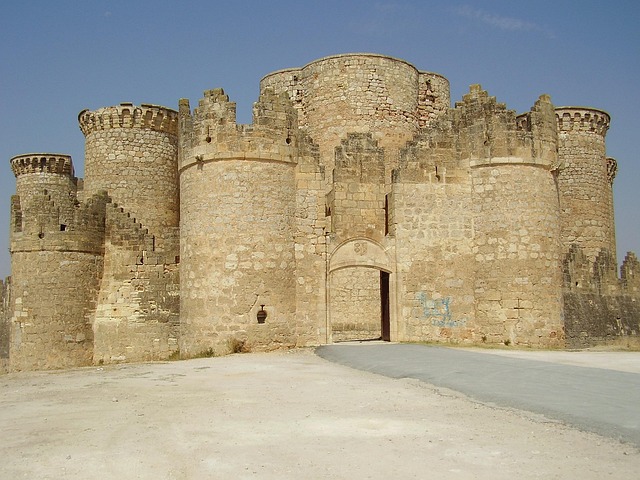
Photo by guzmadera0
Architectural features and layout
Unique triangular plan and defensive structures
The castle's most distinctive feature is its equilateral triangular plan, which forms a nine-sided polygon with six towers arranged in a six-pointed star shape. Each tower reaches approximately 22 meters in height, providing commanding views and strong defensive positions. This layout is exceptional in medieval military architecture, designed to optimize defense against artillery attacks.
Surrounding the main structure is a robust artillery barrier with about 100 firing points, including embrasures and loopholes distributed on upper and lower levels. These features allowed defenders to cover all approaches with cannon and firearm fire. The fortress is accessed through three main gates: Puerta del Campo, Puerta de la Villa, and Puerta de los Peregrinos. Additionally, three bastions reinforce the castle’s defenses.
Decorative elements and interior details
Inside, the castle showcases exquisite Mudéjar-style wooden ceilings with intricate artesonado (carved wooden panels) and mocárabe (stalactite-like) decorations. The ambassador’s hall, which also served as a chapel, contains a rare medieval stone bestiary carved into two windows, depicting 59 figures attributed to Juan Guas. This artistic work is comparable in quality to the decorative programs of the Alhambra and the Aljafería palaces.
The triangular courtyard is paved and surrounded by galleries enclosed during the 19th-century restoration. The castle walls and towers, constructed from stone masonry and brick, feature decorative plasterwork and carved stone elements that blend Mudéjar and Gothic architectural influences.
Current condition and visitor experience
Today, Castillo de Belmonte is well preserved following extensive restoration completed in the 21st century, notably culminating in its public reopening in 2010 and further work finished by 2017. It is classified as a Bien de Interés Cultural and a National Historic-Artistic Monument since 1931, ensuring its protection and maintenance.
Visitors can explore the battlement walkway (camino de ronda), the keep tower, the main courtyard (patio de armas), and the dungeon (calabozo). The northern tower offers panoramic views of the village of Belmonte and nearby landmarks such as the Collegiate Church of San Bartolomé and the old Alcázar of Don Juan Manuel.
The castle provides a comprehensive cultural visit that traces its history from the 15th century through various phases of restoration and reuse, illustrating the evolution of military architecture and noble residence design in Spain.
Frequently asked questions (FAQ)
- How do I get to Castillo de Belmonte?
- Castillo de Belmonte is located on San Cristobal hill near the village of Belmonte in Cuenca, Castilla-La Mancha. It is accessible by car and local roads, with parking available nearby.
- What is the historical significance of Castillo de Belmonte?
- The castle was built in the 15th century by Don Juan Pacheco during a turbulent period in Castile. It played roles in the conquest of Granada and dynastic disputes, reflecting military and noble history.
- Can I visit the interior of the castle?
- Yes, visitors can explore the interior including the battlement walk, keep tower, main courtyard, and the dungeon. Guided tours provide detailed historical and architectural insights.
- When is the best time to visit Castillo de Belmonte?
- The castle is open year-round, but spring and autumn offer mild weather and fewer crowds, enhancing the visitor experience.
- Are there any special events or exhibitions at the castle?
- Castillo de Belmonte hosts cultural events, medieval reenactments, and exhibitions that highlight its history and architecture. Check the official website for current schedules.
- Is the castle accessible for people with limited mobility?
- Due to the historic nature and terrain, some areas may be challenging for visitors with limited mobility. However, key accessible areas and assistance are provided where possible.
Photo gallery

Photo by Emilio Sánchez Hernández

Information
Opening hours
10:00-18:00, daily
Ticket prices
€6 adult, €3 child
Current owner
Dukes of Peñaranda
Website
Visit websiteSources & official resources
Verify the information above using these authoritative references.
Loading map...
Visitor reviews
No reviews yet. Been here? Write the first review and help other travelers!
Write the first reviewVisited this castle? Share your experience
Your review helps other travelers and adds first-hand knowledge to our encyclopedia.