Castillo de Almodovar del Rio
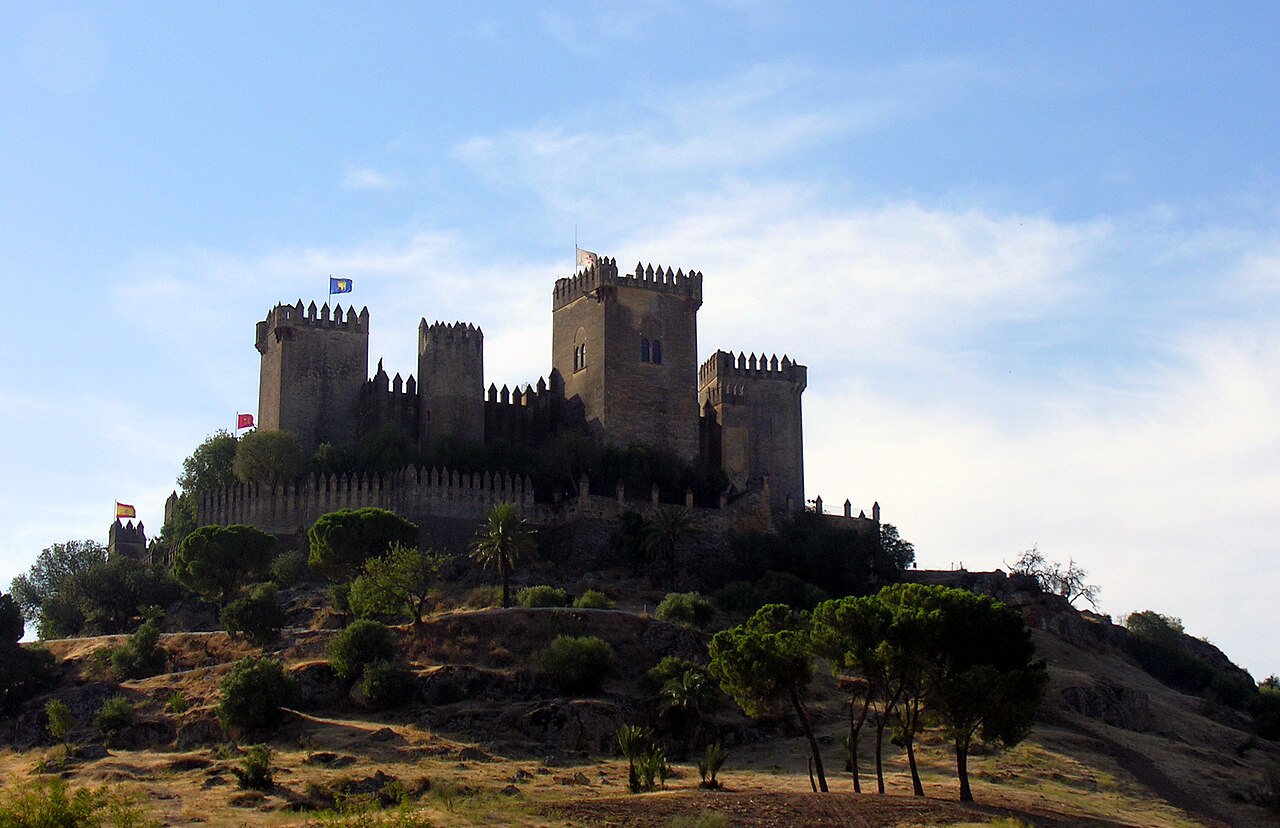
Castillo de Almodóvar del Río, located approximately 24 kilometers from Córdoba on the left bank of the Guadalquivir River, is a striking example of a hill castle with deep historical roots spanning from Roman times through the Middle Ages and into the modern era. Originally a Roman military castrum, the site was strategically chosen for its elevation atop El Redondo hill, which rises 218 meters above sea level and commands expansive views of the surrounding Andalusian plains and the town below.
The castle's name derives from the Arabic "al-Mudawar," meaning "the round castle" or "secure enclosure," reflecting its origins during the early Islamic period in the Iberian Peninsula. Constructed by the Berbers around 760 AD, the fortress was built on the foundations of a Roman fortification and likely an earlier Iberian-Turdetani oppidum known as Cárbula. This ancient settlement was notable in the 2nd century BC for its pottery production, local silver mining, and coin minting, as described by Pliny the Elder.
Architectural evolution and historical significance
Throughout the Early Medieval period, the castle served as a vital defensive stronghold within the Emirate and later the Caliphate of Córdoba. Its fortifications were adapted and expanded to meet the military needs of the time, with construction techniques reflecting Andalusian military architecture characterized by robust stone and masonry walls. The castle's defensive system prominently features three main towers: the Cuadrada (Square Tower), the Redonda (Round Tower), and the Torre del Homenaje (Keep). These towers formed the backbone of the fortress's medieval defenses and remain key architectural highlights today.
During the 11th century, control of the castle fluctuated between the Taifa kingdoms of Carmona and Seville, illustrating the region's political instability following the collapse of the Caliphate. Subsequently, the fortress was reintegrated under the Almoravid and later the Almohad dynasties, who ruled from Seville in the 12th and 13th centuries. These successive rulers maintained and enhanced the castle's fortifications to secure their territories.
In 1240, the castle was incorporated into the Castilian crown by King Ferdinand III. It was granted to Córdoba's municipal council three years later, signaling its transition from a Muslim fortress to a Christian stronghold. The castle continued to hold strategic and residential importance through the 14th century, serving as a royal residence for monarchs such as Pedro I and Enrique II. The 15th century linked the castle to prominent noble families, including Baena and Cabra, and in 1513 it was used as collateral in a land transaction involving the nearby town of Fuente Obejuna. By 1629, King Felipe IV sold the castle and town to Francisco del Corral y Guzmán, establishing a seigniory.
20th-century restoration and modern use
By the early 20th century, Castillo de Almodóvar del Río had fallen into ruin. Between 1901 and 1936, extensive restoration was undertaken by Rafael Desmaissieres y Farina, the 12th Count of Torralva, with architect Adolfo Fernández Casanova leading the technical work. This restoration aimed to revive the castle's medieval character, carefully respecting its original layout and defensive features. The project halted with the outbreak of the Spanish Civil War, after which ownership eventually passed to the Solís family, who maintain the castle today.
The restored castle now stands as a well-preserved example of a fortified hilltop settlement, showcasing medieval Andalusian military architecture with its intact walls, towers, and keep. Its commanding position atop El Redondo hill continues to offer panoramic views, making it a popular site for visitors interested in Spain's rich historical and architectural heritage.
Castle features and visitor experience
The fortress's construction primarily employs stone and masonry typical of the region's military architecture. Visitors can explore the three main towers, each with distinctive shapes and defensive purposes. The Cuadrada Tower offers insight into the castle's square defensive bastions, while the Redonda Tower exemplifies the rounded fortification style that provided enhanced resistance to siege weaponry. The Torre del Homenaje, or keep, served as the last line of defense and a royal residence, symbolizing the castle's status and power.
The castle's walls and battlements are largely intact due to the early 20th-century restoration efforts, allowing visitors to appreciate the fortress's formidable defensive design. The layout includes courtyards and chambers that reflect the castle's evolution through different historical periods, from Roman origins to Islamic and Christian modifications.
Popular culture and cultural significance
In recent years, Castillo de Almodóvar del Río has gained international recognition as a filming location for popular television series, including the seventh season of Game of Thrones and the 2020 series Warrior Nun. This exposure has increased its profile as a cultural landmark and tourist attraction.
The castle's layered history, architectural features, and commanding location make it a significant monument within Andalusia's heritage. It embodies the region's complex past, from ancient Iberian settlements through Roman, Islamic, and Christian influences, and stands today as a testament to centuries of military architecture and historical transformation.
Frequently asked questions (FAQ)
- How do I get to Castillo de Almodovar del Rio?
- You can reach Castillo de Almodovar del Rio by car, as it is conveniently located just a short drive from Córdoba. Public transport options, including buses, are also available from surrounding cities, making it accessible for day trips.
- What is the historical significance of Castillo de Almodovar del Rio?
- Castillo de Almodovar del Rio dates back to the 8th century, originally built by the Moors as a fortress. It played a crucial role in the defense against Christian reconquest and has witnessed numerous historical events throughout the centuries, reflecting the rich cultural heritage of the region.
- When was Castillo de Almodovar del Rio last restored?
- The castle underwent significant restoration in the late 20th century, particularly in the 1990s, to preserve its architectural integrity and historical value. These efforts have made it one of the best-preserved Moorish castles in Spain, attracting history enthusiasts and tourists alike.
- Can I take guided tours of the castle?
- Yes, guided tours are available at Castillo de Almodovar del Rio, providing insight into its fascinating history and architecture. These tours are conducted by knowledgeable guides who share intriguing stories and details that enhance the visitor experience.
- Why is Castillo de Almodovar del Rio a popular tourist destination?
- The castle's stunning architecture and panoramic views of the surrounding landscape make it a must-visit attraction. Its historical significance and beautifully preserved structure offer visitors a glimpse into Spain's rich past, attracting both history buffs and casual tourists.
- Is it possible to visit Castillo de Almodovar del Rio with children?
- Absolutely! Castillo de Almodovar del Rio is a family-friendly destination, and children will enjoy exploring the castle's towers and grounds. Educational tours and interactive exhibits make it an engaging experience for visitors of all ages.
- What are the opening hours for Castillo de Almodovar del Rio?
- The castle is typically open to visitors from 10 AM to 7 PM, but these hours may vary by season. It is advisable to check the official website or contact them directly for the most current information before your visit.
- What are the ticket prices for visiting the castle?
- Ticket prices for Castillo de Almodovar del Rio are generally very reasonable, with discounts available for seniors and children. Special family packages may also be offered, making it an affordable outing for families looking to explore history together.
- What nearby attractions should I consider visiting?
- In addition to the castle, the charming village of Almodóvar del Río offers picturesque streets and local cuisine to explore. Nearby, you can also visit the Guadalquivir River and the natural parks that provide opportunities for hiking and outdoor activities.
Information
Website
Visit websiteSources & official resources
Verify the information above using these authoritative references.
Loading map...
Visitor reviews
No reviews yet. Been here? Write the first review and help other travelers!
Write the first reviewVisited this castle? Share your experience
Your review helps other travelers and adds first-hand knowledge to our encyclopedia.