Alcazar de los Reyes Cristianos
The Alcázar de los Reyes Cristianos, or Castle of the Christian Monarchs, stands prominently in the historic heart of Córdoba, Spain, adjacent to the Guadalquivir River and near the iconic Grand Mosque. This medieval fortress is a remarkable testament to the layered history of the region, reflecting centuries of Roman, Islamic, and Christian influence in its architecture and function. Originally a Roman military camp, the site evolved through Islamic rule into a formidable alcázar before becoming a royal residence and a center of the Spanish Inquisition.
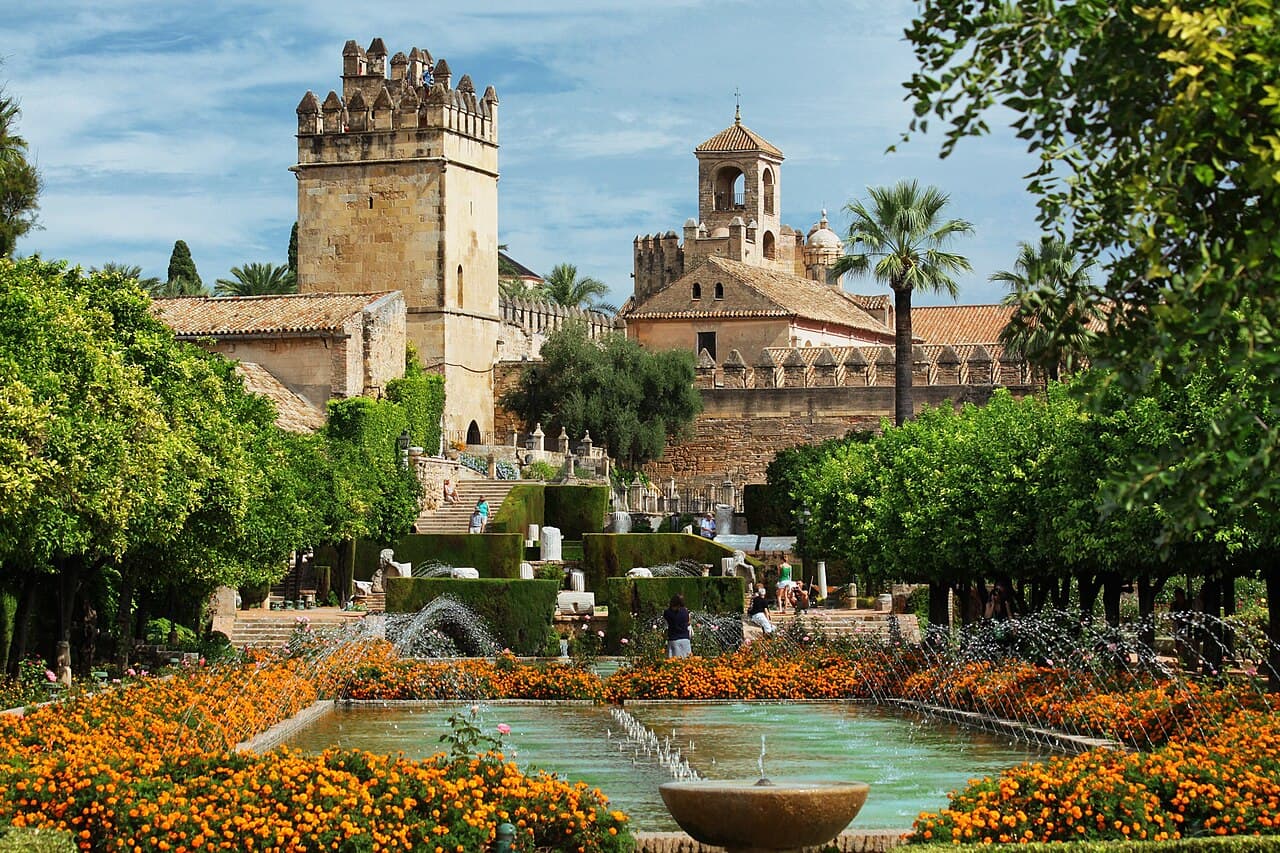
The Alcázar is a prime example of a hill castle strategically situated to control the city and river access. Its complex architectural fabric showcases Mudéjar elements alongside Gothic and Romanesque influences, illustrating the cultural fusion characteristic of Andalusia. The fortress’s four main towers, extensive gardens, and richly decorated interiors narrate stories of conquest, royal power, religious authority, and architectural innovation.
Historical evolution of the alcázar de los reyes cristianos
Roman origins and early fortifications
The site of the Alcázar was originally fortified in the 1st century AD as a Roman castellum, serving as a military outpost to secure the important Guadalquivir River crossing. Roman masonry and foundations remain visible in the lower walls of the fortress, underscoring the site's long-standing defensive significance. Archaeological discoveries include mosaics and a 3rd-century Carrara marble sarcophagus decorated with mythological scenes, highlighting the Roman presence.
Islamic period: umayyad and almohad fortifications
During the early medieval period, Córdoba became a major center of Islamic culture under the Umayyad Caliphate. The original Roman fortifications were replaced by an Umayyad alcázar, a palace-fortress that combined residential and military functions. Later, the Almohad dynasty in the 12th century constructed a robust alcazaba or fortress on the site, incorporating advanced defensive features such as thick walls and towers. This phase included the construction of the large arch recently uncovered beneath the Baroque gate, dating to around 1171-1172.
Christian conquest and medieval royal residence
Following the Christian conquest of Córdoba in 1236 by King Fernando III of Castile, the Alcázar was divided among royal, religious, and military authorities. Major reconstruction began under King Alfonso XI in 1328, who transformed the fortress into a royal residence with enhanced fortifications. The construction of the Royal Baths in the Mudéjar style during this period reflects the blending of Islamic and Christian architectural traditions.
The Alcázar reached its historical prominence under the Catholic Monarchs, Isabella I and Ferdinand II, who used it as a military headquarters during the Granada War (late 15th century). The fortress also served as a royal residence and the site where Christopher Columbus sought support for his voyages. The captivity of the Nasrid emir Boabdil here in 1483 marks a significant event in the Reconquista.
The alcázar during the spanish inquisition and later uses
After the conquest of Granada in 1492, the Alcázar became the seat of the Spanish Inquisition, serving as a tribunal and prison. The fortress was adapted with prison cells and torture chambers, including the conversion of the Royal Baths into spaces for interrogation. This dark chapter lasted until the abolition of the Inquisition in 1812.
Subsequently, the Alcázar functioned as a civil prison until the establishment of the Second Spanish Republic in the 20th century. Its military and judicial roles diminished as the fortress transitioned into a cultural and historical monument.
Architectural features and structural layout
Towers and defensive structures
The fortress is roughly square and defined by four principal towers, each with distinct historical origins and architectural styles. The Tower of the Lions, dating from the 13th century, is the oldest and features distinctive lion-shaped gargoyles. It houses the Chapel of San Eustaquio, reflecting the Christian appropriation of the site.
The octagonal Tower of Homage, formerly the Clock Tower, stands at the northeast corner and exhibits Gothic features such as an ogival ceiling. This tower played a central role in royal and judicial activities.
The circular Tower of the Inquisition at the southwest corner was used to store Inquisition archives and symbolizes the fortress’s judicial history. The Tower of the Dove at the southeast corner is a 20th-century reconstruction replacing a demolished 19th-century tower.
Interior halls and mosaics
The Salón de los Mosaicos is an 18th-century hall originally serving as the Inquisition chapel. It displays eight Roman mosaics from the 2nd and 3rd centuries depicting mythological scenes. The hall also contains the remarkable Carrara marble sarcophagus mentioned earlier.
The Reception Hall, also called the Ocean Hall, houses a Roman mosaic dedicated to Oceanus, the god of the ocean, and 17th-century choir stalls representing Córdoba’s ancient parishes. These rooms illustrate the layering of historical periods within the Alcázar’s fabric.
Patios and gardens
The Patio de Crucero, or Mudéjar Courtyard, is a square courtyard on the western side with arcaded galleries on three sides and a central fountain flanked by two ponds. A wall bearing the Castilian Crown coat of arms connects the Towers of the Lions and the Inquisition, providing access to the gardens.
The Patio de las Mujeres, or Eastern Courtyard, contains archaeological remains from Roman, late antique, Umayyad, and Almohad periods. Excavations revealed a 6-meter-high Almohad wall and a large medieval sewer system. Named during the prison era, it was the section designated for female inmates.
The extensive gardens cover approximately 55,000 square meters across three terraces. The Higher and Lower Gardens date from the mid-20th century, while the Middle Garden, formerly the Garden of the Inquisitors, dates from the 19th century. The gardens feature palms, cypresses, orange and lemon trees, fountains, and ponds. The Paseo de los Reyes, a cypress-lined promenade, includes sculptures of the monarchs who built the Alcázar and culminates with a group depicting the Catholic Monarchs and Christopher Columbus.
Modern restoration and cultural significance
Declared a Historic Monument in 1931, the Alcázar underwent extensive restoration in the mid-20th century, led by Mayor Antonio Cruz Conde, and reopened to the public in 1960. Recent archaeological work from 2015 to 2025 has focused on uncovering hidden Almohad architectural elements, including a large 12th-century arch discovered in 2023 beneath the original Baroque gate, which was reopened that year as the main entrance.
Modern interventions have also improved accessibility with elevators and structural conservation. The Alcázar is part of the UNESCO World Heritage Site of Córdoba’s historic center since 1994, attracting visitors worldwide to explore its rich history and architectural splendor.
The fortress stands as a symbol of the complex cultural history of Andalusia, embodying the coexistence and conflict of Roman, Islamic, and Christian civilizations. Its layered architecture, from Roman foundations to Mudéjar baths and Gothic towers, offers a unique glimpse into medieval military and residential design.
Frequently asked questions (FAQ)
- What is the historical significance of Alcazar de los Reyes Cristianos?
- The Alcazar de los Reyes Cristianos is a historic fortress that played a crucial role during the Reconquista, serving as the residence of the Catholic Monarchs, Ferdinand and Isabella. It was here that Christopher Columbus was granted permission for his voyage to the New World in 1492. The castle's rich history is reflected in its architecture and beautiful gardens.
- When was Alcazar de los Reyes Cristianos built?
- The construction of the Alcazar de los Reyes Cristianos began in the 14th century, under the rule of the Muslim Kingdom of Granada. The castle was later modified by the Catholic Monarchs after the Reconquista in 1492. Its blend of Islamic and Christian architectural elements showcases the cultural transitions of the era.
- Can I visit Alcazar de los Reyes Cristianos?
- Yes, the Alcazar de los Reyes Cristianos is open to visitors throughout the year. You can explore its impressive gardens, historical rooms, and stunning views of the surrounding area. Guided tours are also available to enhance your experience.
- What are the opening hours for Alcazar de los Reyes Cristianos?
- The Alcazar typically opens at 8:30 AM and closes at 8:00 PM during the summer months, while winter hours may vary. It is advisable to check their official website for the most current opening hours before your visit. The castle may have extended hours on weekends and holidays.
- Is it possible to access Alcazar de los Reyes Cristianos with a wheelchair?
- Yes, the Alcazar de los Reyes Cristianos is accessible for visitors with mobility challenges. There are ramps and designated pathways to help navigate the grounds and gardens. However, some areas may have limited access due to historical preservation, so it's best to inquire at the entrance for specific details.
- What is the best time to visit Alcazar de los Reyes Cristianos?
- The best time to visit is during the spring (April to June) and fall (September to November) when the weather is mild and pleasant. These seasons also allow for fewer crowds compared to the peak summer months. Visiting early in the morning can provide a more tranquil experience.
- How much do tickets cost for Alcazar de los Reyes Cristianos?
- Tickets for the Alcazar de los Reyes Cristianos are generally affordable, with a small fee for adults and discounts available for students and seniors. Children under a certain age may enter for free. It's recommended to purchase tickets online in advance to avoid long lines.
- What nearby attractions can I visit while at Alcazar de los Reyes Cristianos?
- While visiting the Alcazar, you can also explore the stunning Mosque-Cathedral of Cordoba, which is just a short walk away. The picturesque streets of the Jewish Quarter and the Roman Bridge are also nearby, providing a full day of historical exploration. Don’t miss the charming local cafes and shops in the area.

Information
Website
Visit websiteSources & official resources
Verify the information above using these authoritative references.
Loading map...
Visitor reviews
No reviews yet. Been here? Write the first review and help other travelers!
Write the first reviewVisited this castle? Share your experience
Your review helps other travelers and adds first-hand knowledge to our encyclopedia.