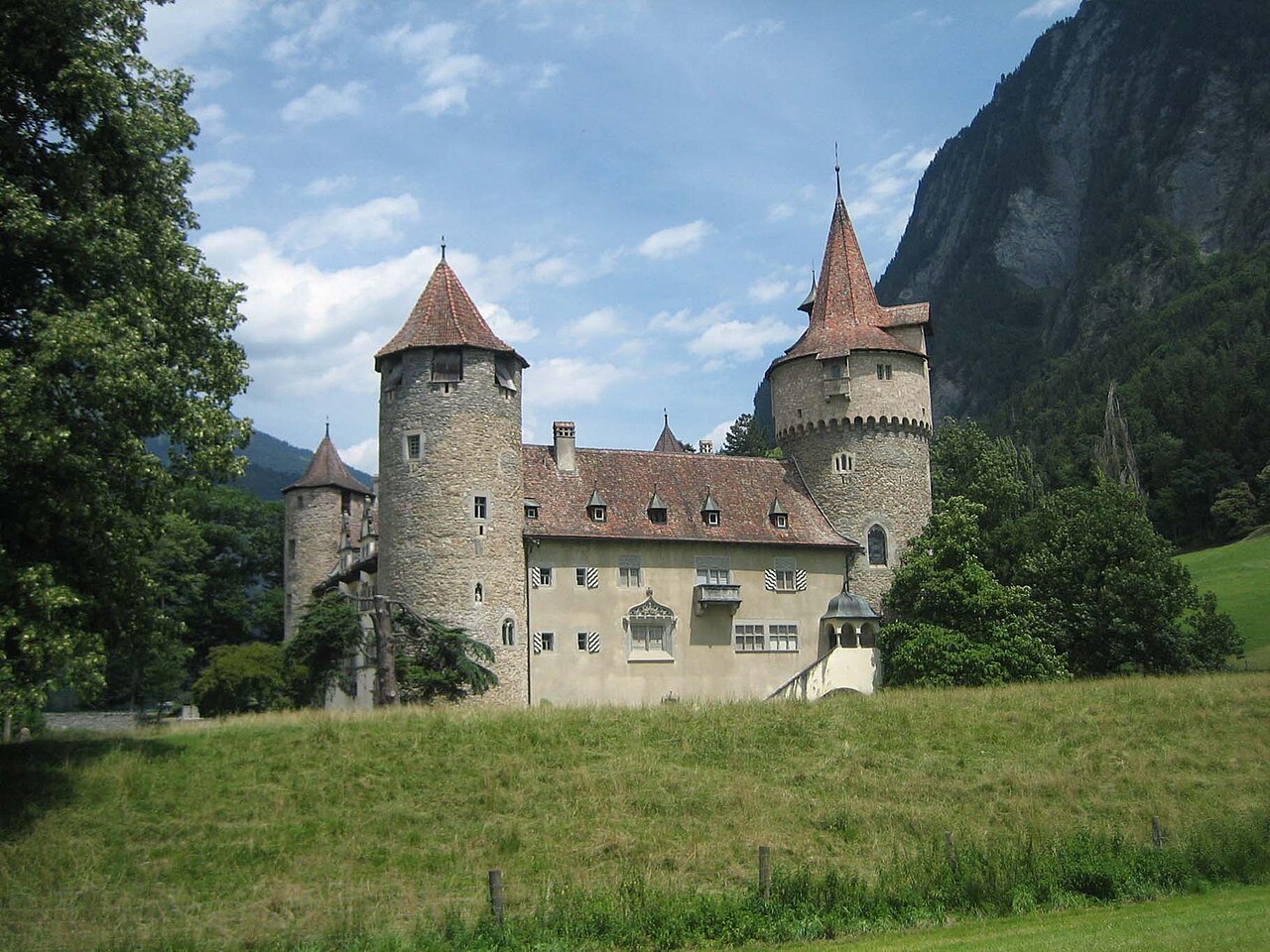
Castels Castle
Castels Castle stands as a remarkable example of a High Medieval hill castle located near the village of Putz in the municipality of Luzein, Switzerland. Its origins trace back to the 12th century, with the earliest construction phases reflecting its initial role as a refuge castle or fortified church. The castle's strategic position atop a rocky outcrop at approximately 1,065 meters above sea level, with natural defenses such as a sheer cliff to the south, highlights its importance in medieval territorial control and defense.
Early history and medieval significance
Little is definitively known about the very earliest history of Castels Castle, but archaeological and architectural evidence suggests that the oldest parts of the castle, including the ring wall, were constructed during the 12th century. Initially, the site may have served as a refuge or sanctuary during turbulent times in the Middle Ages. By the High Middle Ages, the castle became the residence of a noble family, serving as a fortified seat of power.
By the early 14th century, Castels Castle had risen in prominence as the administrative center for the Aspermont estates in Upper Prättigau, while the Lower Prättigau was managed from Solavers Castle. This division of administrative control underscores the castle's regional importance in managing feudal estates and local governance.
Ownership changes and political turmoil
In 1338, the castle and its associated estates were sold to Count Friedrich V von Toggenburg and the knight Ulrich von Matsch. A subsequent division in 1344 allocated Castels Castle to the Matsch family. However, the castle's ownership fluctuated between the Toggenburg and Matsch families over the next century, reflecting the shifting allegiances and political dynamics of the region.
By the late 15th century, financial difficulties forced Gaudenz von Matsch to sell Castels Castle to Emperor Maximilian I of Habsburg, marking the castle's integration into the extensive Habsburg territories. This transition alarmed the local League of the Ten Jurisdictions, who feared a Habsburg stronghold within their lands.
During the Swabian War in February 1499, forces from the League captured Castels Castle, compelling its inhabitants to swear loyalty to the League. However, the Peace of Basel later that year restored the castle to Habsburg control. To mitigate tensions, many of the appointed Austrian vogts were local Graubünden nobles, ensuring a degree of local governance within the imperial framework.
16th and 17th century military role and decline
Throughout the 16th century, Castels Castle remained a central administrative and military hub for Habsburg interests in the Prättigau region. Defensive upgrades during this period included the addition of a five-meter-wide zwinger and an outer wall with a distinctive half-round tower, reflecting adaptations to evolving military technologies such as firearms.
In 1622, the castle faced a significant challenge when local inhabitants revolted against Austrian rule. The Prättigau residents besieged Castels Castle in April, capturing it after cutting off its water supply and causing considerable damage. Austrian forces recaptured the fortress in September, and the subsequent Lindau peace treaty mandated repairs to the castle, though the extent of restoration remains uncertain.
By 1649, the Prättigau region secured its independence from Austria and deliberately demolished Castels Castle, ending its role as a military stronghold and administrative center.
Architectural features and castle layout
The ruins of Castels Castle occupy a naturally defensible rocky hilltop, with a steep cliff protecting the southern side and a visible defensive ditch on the northern approach. The castle's ring wall was constructed in phases from the 12th to the 15th centuries, with later fortifications added in the 16th or 17th century.
The main entrance was originally located on the western side but was later moved to the north, where a barbican fortified the gateway. Remnants of this barbican include firing slits designed for firearms or small cannons, illustrating the castle's adaptation to gunpowder weaponry.
A dominant architectural feature is the square bergfried (main tower), measuring approximately 8.5 by 8.5 meters with walls about two meters thick. This tower stands free within the ring wall, rising at least four stories tall, and originally featured a high entrance on the second floor facing west, accessible by wooden stairs. The tower's corners are constructed from finely worked bossed ashlar masonry, and traces of 16th-century plaster remain on its walls.
The residential wing, located on the southwest side, evolved into a richly appointed two-story palas by the early 17th century. This section included a large hall, multiple chambers, a chapel, kitchen, granary, and wine cellar. The courtyard contained essential service buildings such as a well, stables, a laundry oven, and a heated bathing house, demonstrating the castle's self-sufficiency and comfort for its inhabitants.
The bergfried also served as a prison and powder magazine, equipped with shackles and a hoisting mechanism for prisoners. Defensive enhancements include battlemented wall walks with crenellations and firing slits on the northern curtain wall, reflecting the castle's ongoing military significance through the early modern period.
Cultural heritage and preservation
Today, Castels Castle stands as a protected ruin of national heritage importance in Switzerland. Its remains provide valuable insights into medieval and early modern castle architecture, military evolution, and regional history in the Graubünden canton. Visitors can explore the site to appreciate the complex layering of construction phases, defensive innovations, and the castle's role in the turbulent political landscape of the Alps.
The castle's location offers panoramic views of the surrounding Prättigau valley, emphasizing its strategic significance. Preservation efforts focus on maintaining the structural integrity of the remaining walls and towers while facilitating educational and cultural tourism.
Frequently asked questions (FAQ)
- How do I get to Castels Castle in Luzein?
- Castels Castle is located near the village of Putz in Luzein, Switzerland. Visitors can reach the site by local roads and hiking trails that lead up to the rocky hilltop where the ruins stand. It is advisable to wear sturdy footwear due to uneven terrain.
- What is the historical significance of Castels Castle?
- Castels Castle was an important administrative center in the High Middle Ages, serving noble families and later the Habsburgs. It played a key role in regional conflicts such as the Swabian War and the 1622 Prättigau uprising, reflecting its strategic and political importance.
- Can I explore the ruins of Castels Castle?
- Yes, the ruins of Castels Castle are accessible to the public. Visitors can explore the remains of the ring walls, the bergfried tower, and other structures. However, as the site is a protected ruin, caution is advised when walking on uneven surfaces.
- When was Castels Castle built?
- The castle's oldest sections, including the ring wall, date back to the 12th century. It was expanded and modified through the 13th to 17th centuries to adapt to changing defensive needs.
- Why was Castels Castle demolished?
- After the Prättigau region gained independence from Austria in 1649, Castels Castle was deliberately demolished to prevent its future use as a Habsburg stronghold, marking the end of its military and administrative role.
Information
Website
Visit websiteSources & official resources
Verify the information above using these authoritative references.
Loading map...
Visitor reviews
No reviews yet. Been here? Write the first review and help other travelers!
Write the first reviewVisited this castle? Share your experience
Your review helps other travelers and adds first-hand knowledge to our encyclopedia.