Castelmur Castle
Castelmur Castle, also known as Palazzo Castelmur, is a remarkable historic site located in Stampa, Switzerland. Originally built in 1723 for Johannes Redolfi, the castle was later transformed into a museum during the second half of the 20th century. The museum today houses the Archivio Storico on its second floor, an important archive dedicated to preserving and researching documents related to the Val Bregaglia region. Additionally, visitors can explore a permanent exhibition focused on the rich history of Graubünden's pastry bakers, highlighting a unique cultural aspect of the area.
Ancient origins and strategic location
The site of Castelmur Castle holds immense historical significance, with evidence of occupation and fortification dating back to the Roman era. Situated along the vital trade route over the Septimer Pass through the Val Bregaglia, the location was crucial for controlling alpine commerce. The Romans established a guard station and village named Murus, as recorded in the 3rd-century Itinerarium Antonini. Archaeological excavations have uncovered the foundations of several Roman buildings, including a hypocaust system and two small votive altars, underscoring the site's importance in antiquity.
Medieval fortifications and ownership
Following the fall of the Western Roman Empire, the castle next appears in historical records in 842 as castellum ad Bergalliam. At that time, it was owned by the Emperor and held by Constantius of Sargans. In 960, Emperor Otto I granted the castle and the right to collect tolls to the Bishop of Chur to secure this vital alpine trade route. This grant was confirmed by Emperor Otto II in 988, who specifically mentioned both the castle and the nearby Nossa Donna Church.
The castle's prominent tower was likely constructed around 1200. Throughout the Middle Ages, ownership and control of Castelmur Castle were contested between the Bishop of Chur and the town of Chiavenna. In 1121 or 1122, Chiavenna captured the castle, but Pope Callixtus II intervened, compelling the town to return it to the Bishop. In 1190, the Bishop granted the castle to Albertus de Castello Muro, whose descendants governed the castle until 1264.
Conflict arose when Albertus Popus Castelmur stole cattle from the nobles of Chiavenna and Piuro, leading to an invasion and the castle's conquest in 1268. After four years, the castle was returned to the Castelmur family in 1272. Around 1340, the Bishop reclaimed the castle and mortgaged it to the Planta family. To prevent the Planta family from annexing the castle permanently, the Bishop mortgaged it in 1410 to Jacob Perutt von Castelmur. Two decades later, the Bishop used a loan from the Salis family to buy out the mortgage and transfer the castle to them. The last known grant was to Michel Pfannholz in 1490, who abandoned the castle in 1538, leading to its decline into ruin.
Architectural features and fortifications
Original defensive structures
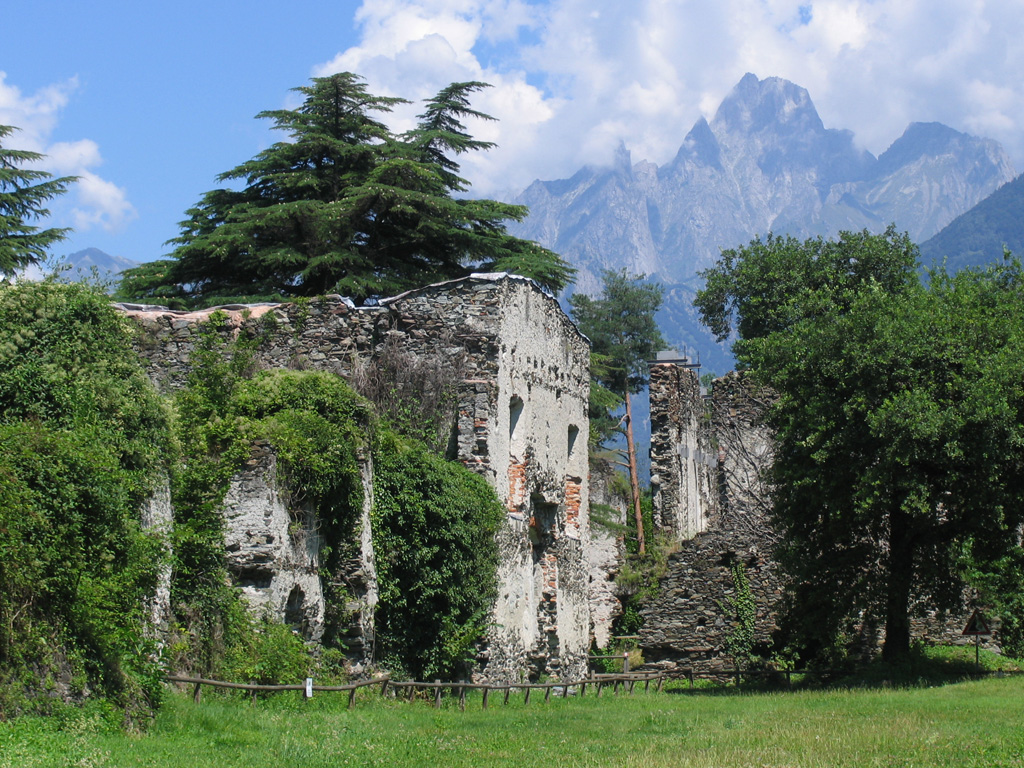
The earliest fortifications at Castelmur included a substantial wall or letzi that spanned the valley between the Maira river and the castle hill. This defensive wall was up to 3.7 meters thick and featured a gate that could be blocked with logs for protection. The remains of this wall still exist northwest of the main tower, illustrating the strategic design to control valley access.
The medieval castle complex
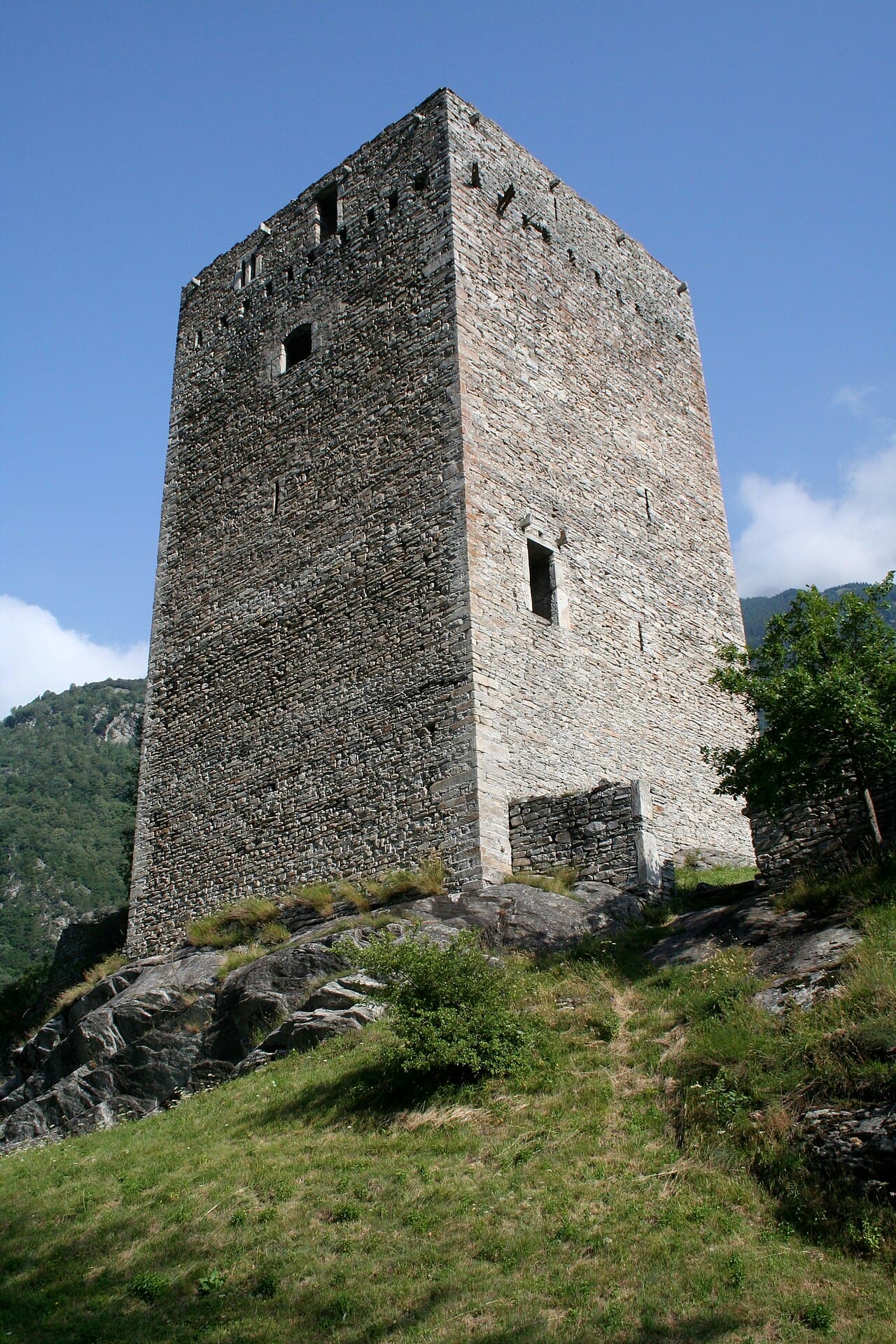
In the 12th century, a square tower accompanied by a ring wall was constructed atop the steep outcrop, transforming Castelmur from a mere toll station into a regional administrative center. This five-story tower measures approximately 12 meters on each side, with walls up to 2.4 meters thick on the lowest floor. Much of this imposing tower remains visible today, offering insight into medieval military architecture.
Below the castle hill to the south lies the castle church, dedicated to Santa Maria (Nossa Donna). The church's Romanesque bell tower survives from earlier construction phases, while much of the nave and other parts were rebuilt during the 19th-century renovations by Baron Giovanni de Castelmur. Additionally, a second tower once stood on a tall hill south of the main tower, measuring about 10 by 10 meters, though only fragments of this structure remain today.
19th-century restoration and cultural significance
After centuries of neglect, the castle ruins were restored and cleaned in the 19th century by Baron Giovanni de Castelmur, who also undertook the restoration and rededication of the nearby Church of Santa Maria. This restoration helped preserve the site's historical legacy and architectural heritage. The castle and church together represent an important cultural landmark in the Graubünden region.
Today, Castelmur Castle stands as a testament to the region's layered history, from its Roman roots through its medieval prominence as a fortified administrative center, to its modern role as a museum preserving local history and culture. The castle's strategic location along ancient trade routes and its architectural evolution reflect the broader historical dynamics of alpine Switzerland.
Visiting Castelmur Castle
Visitors to Castelmur Castle can explore the museum's exhibits, including the Archivio Storico and the pastry bakers' history display. The castle's well-preserved tower and surrounding fortifications offer a tangible connection to medieval defensive architecture. The nearby church, with its Romanesque bell tower and 19th-century renovations, adds to the site's historical ambiance.
Castelmur Castle provides a unique opportunity to experience a site that encapsulates centuries of alpine history, architecture, and culture in one location.
Frequently asked questions (FAQ)
- When was Castelmur Castle originally built?
- Castelmur Castle was originally built in 1723 for Johannes Redolfi, although the site has fortifications dating back to the Roman era.
- What historical periods does Castelmur Castle represent?
- The castle site reflects a long history from Roman times through the medieval period and into the post-Renaissance era with 18th-century construction.
- What can visitors see at the Castelmur Castle museum?
- Visitors can explore the Archivio Storico, an archive of documents related to Val Bregaglia, and a permanent exhibit on Graubünden's pastry bakers.
- What are the key architectural features of Castelmur Castle?
- Key features include a five-story square tower from around 1200, thick defensive walls, a Romanesque bell tower of the nearby church, and remnants of valley-spanning fortifications.
- Who owned Castelmur Castle during the medieval period?
- Ownership was contested between the Bishop of Chur, the town of Chiavenna, the Castelmur family, and noble families such as the Planta and Salis families.
Photo gallery

Information
Sources & official resources
Verify the information above using these authoritative references.
Loading map...
Visitor reviews
No reviews yet. Been here? Write the first review and help other travelers!
Write the first reviewVisited this castle? Share your experience
Your review helps other travelers and adds first-hand knowledge to our encyclopedia.