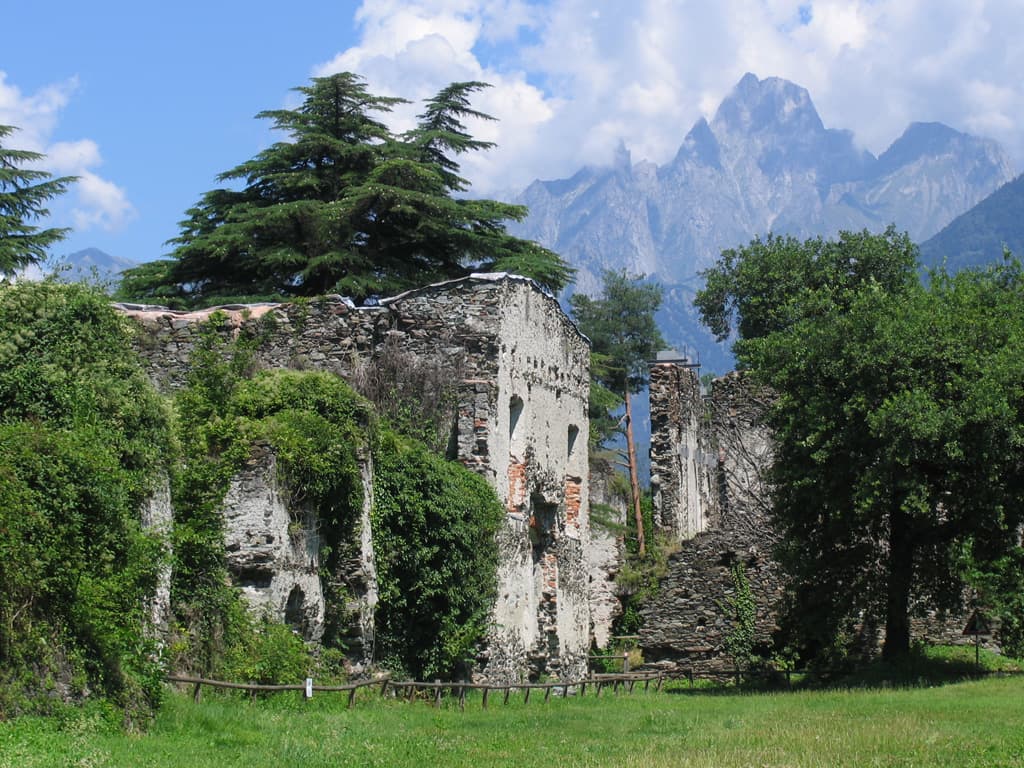
Fort Fuentes
Fort Fuentes (Italian: Forte di Fuentes) is a significant Renaissance military fortification located on the hill of Montecchio or Monteggiolo near Colico in the province of Lecco, Lombardy, northern Italy. Constructed in the early 17th century, it was designed to command the strategic crossroads known as the Trivio di Fuentes, which connected the Valtellina, Valchiavenna, and the Alto Lario regions. This fort played a crucial role in controlling the northern border of the Spanish domain in Milan against the neighboring Grisons to the north.
Construction and strategic purpose
The fort was commissioned by Don Pedro Enríquez de Acevedo, Count of Fuentes, the Spanish governor of Milan. Construction began between 1603 and October 1609 under the supervision of the military architect Gabrio Brusca. The fortification was substantially completed within three years, reflecting the urgency of securing the border. Fort Fuentes was part of a network of ancillary fortified structures including the tower of Sorico, Torretta del Passo, Fortino d'Adda, Torrino di Borgofrancone, Torretta di Curcio, and the tower of Fontanedo, all designed to reinforce control over the region.
Architectural features and layout
The fort was built in the Renaissance style typical of early 17th-century military architecture, emphasizing robust stone walls, bastions, and defensive towers. Its elevated position on the hill allowed commanding views of the surrounding valleys and the strategic Pian di Spagna plain. The design incorporated multiple gun emplacements and fortified towers to provide overlapping fields of fire and strong defensive capabilities against any advancing forces.
Historical significance and military engagements
Fort Fuentes was a pivotal military asset during the Spanish rule in northern Italy. In 1706, during the War of the Spanish Succession, the fort surrendered to Prince Eugène of Savoy, marking the end of Spanish control over the area. The fort's garrisons are believed to have contributed to the local equine breeds, notably influencing the Samolaco horse through the introduction of Spanish stock.
Decommissioning and decline
By 1769, the fort was inspected by Emperor Joseph II, who declared it militarily obsolete. It was officially decommissioned in 1782, and the property was sold to a private owner. The fortress suffered significant demolition in 1796 under orders from Napoleon Bonaparte, executed by General François Rambeaud, partly at the request of the Grisons. The ruins later became a hideout for bandits during the 19th century, challenging Austrian authorities.
20th-century developments and preservation efforts
Between 1911 and 1913, the site saw new military construction with the building of Fort Montecchio-Lusardi, featuring eight gun emplacements. This modernization led to the demolition of the original circular Spanish tower on the western side. Despite these updates, the fortifications did not see action during the First World War.
Modern conservation
In 1987, the entire hill encompassing the ruins was acquired by the province of Como and later transferred to the province of Lecco. The Associazione Forte di Fuentes was established in 1998 to protect and promote the historical site. Today, Fort Fuentes stands as an important archaeological ruin offering insights into Renaissance military architecture and the geopolitical history of northern Italy during Spanish rule.
Frequently asked questions (FAQ)
- What is the historical significance of Fort Fuentes?
- Fort Fuentes was a key Spanish military fortification built in the early 17th century to defend northern Italy's borders and control strategic crossroads.
- When was Fort Fuentes constructed and by whom?
- Construction began between 1603 and 1609 under Spanish governor Don Pedro Enríquez de Acevedo and military architect Gabrio Brusca.
- Can visitors access the ruins of Fort Fuentes today?
- Yes, the ruins are accessible to the public and are managed by the Province of Lecco, with preservation efforts led by the Associazione Forte di Fuentes.
- Why was Fort Fuentes decommissioned?
- Emperor Joseph II declared the fort militarily obsolete in 1769, leading to its decommissioning in 1782 and eventual partial demolition in 1796.
- What architectural style characterizes Fort Fuentes?
- The fort is an example of Renaissance military architecture, featuring robust stone walls, bastions, and defensive towers.
Photo gallery

Information
Current owner
Province of Lecco
Loading map...
Visitor reviews
No reviews yet. Been here? Write the first review and help other travelers!
Write the first reviewVisited this castle? Share your experience
Your review helps other travelers and adds first-hand knowledge to our encyclopedia.



