Castello di Calenzano
The Castello di Calenzano is a remarkable example of a medieval hill castle situated in the municipality of Calenzano, Tuscany, Italy. Perched atop an isolated hill overlooking the Marina stream valley and the plains surrounding Florence, it occupies a strategic vantage point that historically controlled key communication routes toward the Mugello region and the Apennine passes leading to Emilia-Romagna. This location was crucial for military and political control during the Middle Ages.
Originally established by the powerful Guidi family, a noble lineage influential in the region, the castle's earliest fortifications were likely constructed to secure their territorial interests. By the 12th century, the fortress had gained significant importance, both militarily and politically, as it stood on the border between the dioceses of Florence and Pistoia. The surrounding lands were divided among feudal lords such as the Guidi, the Alberti counts, and the Ghibelline Ubaldini family from Mugello, making the castle a contested stronghold.
Historical significance and early conflicts
The first written mentions of Castello di Calenzano appear in 13th-century documents, including the Libro di Montaperti (1260) and the Libro degli Estimi (1269). These records highlight the castle's involvement in the turbulent conflicts between the Guelf and Ghibelline factions. Notably, after the Guelf defeat at the Battle of Montaperti in 1260, the castle suffered damage, reflecting its frontline role in regional power struggles.
Throughout the 14th century, the castle's ownership transitioned from the Guidi family to the bishop of Florence and eventually to the Republic of Florence. This period was marked by repeated attacks and sieges that tested the fortress's defenses. In 1325, it was burned by Ghibelline forces led by Castruccio Castracani, a prominent military leader. Later, in 1351, Milanese troops under Giovanni di Oleggio of the Visconti family besieged and damaged the castle. The conflict continued in 1363 when Pisani forces, supported by English mercenaries commanded by the famed condottiero John Hawkwood, assaulted the fortress.
Architectural evolution and fortifications
Following these assaults, the Republic of Florence undertook extensive repairs and fortification enhancements. The defensive walls were significantly reinforced to withstand future attacks, resulting in the massive stone walls that largely define the castle's current appearance. The city also enacted a regulation in 1363 prohibiting construction within 200 braccia (an old Tuscan unit of length) of the walls to maintain clear defensive perimeters.
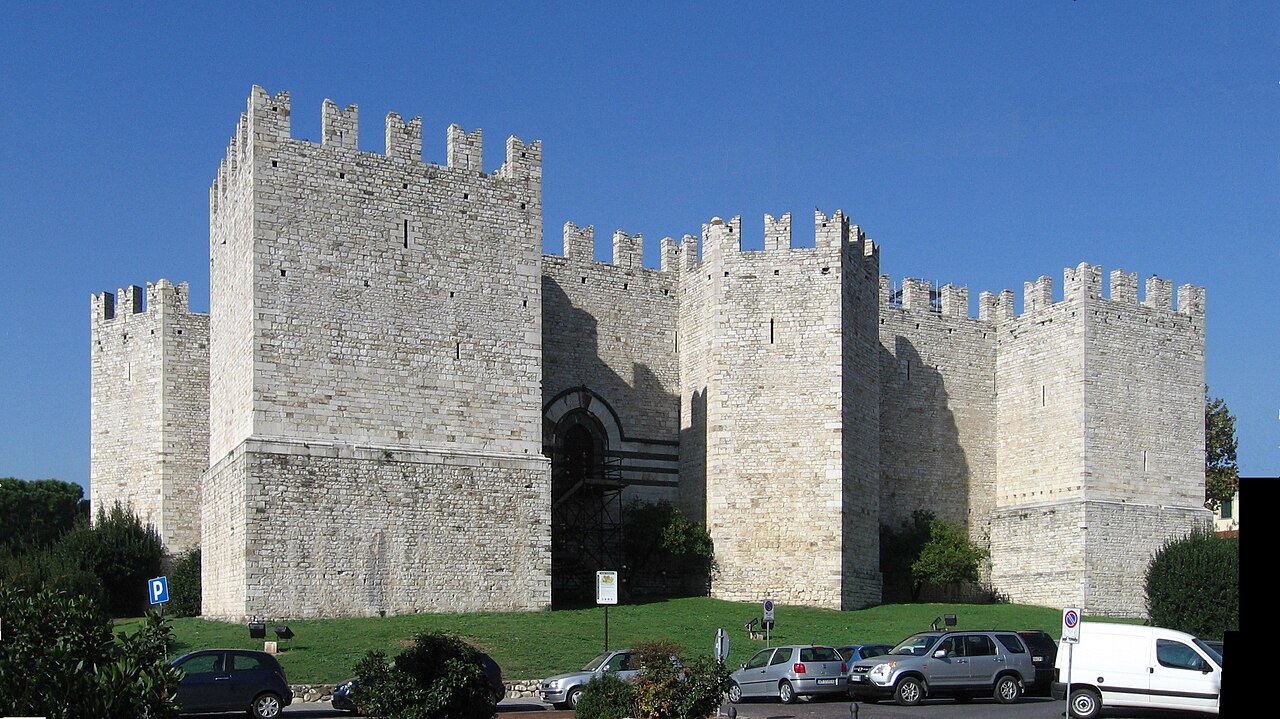
The castle's layout follows the typical oval-shaped plan of medieval hilltop fortifications in Italy, designed to maximize defensive capabilities while accommodating the settlement within. Key architectural features include the Porta al Serraglio, the northern entrance gate, which has been restored and serves as a prominent access point. Above this gate stands a tower housing the altana, a restored hall now used for conferences and ceremonies, offering panoramic views of the surrounding landscape.
Within the castle walls lies a garden enclosed by a 14th-century bastion, illustrating the medieval adaptation of defensive structures for more domestic and recreational purposes as the fortress's military role diminished over time. The original defensive towers, once critical for protection, were later converted into private residences, reflecting the castle's transition from a military stronghold to a residential and agricultural center.
Later history and cultural significance
From the late 13th to early 15th centuries, Castello di Calenzano thrived economically and militarily. However, as the Republic of Florence consolidated power in Tuscany, the fortress's strategic importance declined. By the early 16th century, it had shifted primarily to agricultural and residential functions. Notably, the castle escaped damage during the sack of Prato in 1512 but was reactivated for defense during the 1529–1530 siege of Florence, with Agnolo Anselmi serving as commissioner overseeing the fortress.
Under the Grand Duchy of Tuscany established by Cosimo I de' Medici, the castle lost its military purpose entirely. Defensive towers were rented out as private homes, and the surrounding lands were fully devoted to agriculture.
In modern times, the municipality of Calenzano has preserved and restored parts of the castle's fortifications, including the Porta al Serraglio and the internal garden within the bastion. Today, the castle serves as a cultural venue hosting festivals, historical reenactments, and exhibitions, thereby maintaining its medieval heritage and community significance.
Architectural features and museum
The castle's fortifications are characterized by the massive stone walls dating primarily from the 14th-century Florentine renovations. The oval-shaped village layout within the walls reflects typical medieval hilltop settlement patterns designed for defense and habitation.
The restored northern gate, Porta al Serraglio, is a key architectural highlight, featuring a tower with the altana hall that provides visitors with expansive views of the Tuscan landscape. This tower is accessible to the public and serves as a venue for various cultural activities.
Inside the castle, the Municipal Museum of Historical Figurines showcases an extensive collection of miniature soldiers, dioramas, and models. This museum offers visitors a unique insight into European and local history through detailed reenactments housed within the medieval fortress itself.
Location and strategic importance
Strategically located on a hill overlooking the valley where the Marina stream opens onto the plains near Florence, the castle commanded views essential for monitoring and controlling the communication and trade routes toward the Mugello region and beyond. Its position made it a critical defensive and administrative center during the Middle Ages, especially given the fragmented political landscape of Tuscany at the time.
Frequently asked questions (FAQ)
- How do I get to Castello di Calenzano?
- Castello di Calenzano is located in the municipality of Calenzano, Tuscany, Italy. It is accessible by car and public transportation from Florence, with local buses and taxis serving the area.
- What are the opening hours of Castello di Calenzano?
- The castle is open daily from 10:00 to 18:00, allowing visitors ample time to explore the fortifications, museum, and gardens.
- Is there an entrance fee to visit the castle?
- Yes, the entrance fee is €5 for adults and €3 for children, supporting the maintenance and cultural activities of the site.
- What can I see inside the castle?
- Visitors can explore the restored defensive walls, the Porta al Serraglio gate and tower with panoramic views, the internal garden within the 14th-century bastion, and the Municipal Museum of Historical Figurines featuring detailed historical dioramas.
- Why is Castello di Calenzano historically significant?
- The castle played a crucial role in medieval Tuscany as a strategic military fortress controlling key routes and witnessing numerous battles between Guelf and Ghibelline factions, as well as sieges by major regional powers.
- Can I attend events or festivals at the castle?
- Yes, the castle hosts various cultural events, including historical reenactments and festivals that celebrate its medieval heritage and engage the local community.
Information
Opening hours
10:00-18:00, daily
Ticket prices
€5 adult, €3 child
Current owner
Municipality of Calenzano
Website
Visit websiteSources & official resources
Verify the information above using these authoritative references.
Loading map...
Visitor reviews
No reviews yet. Been here? Write the first review and help other travelers!
Write the first reviewVisited this castle? Share your experience
Your review helps other travelers and adds first-hand knowledge to our encyclopedia.